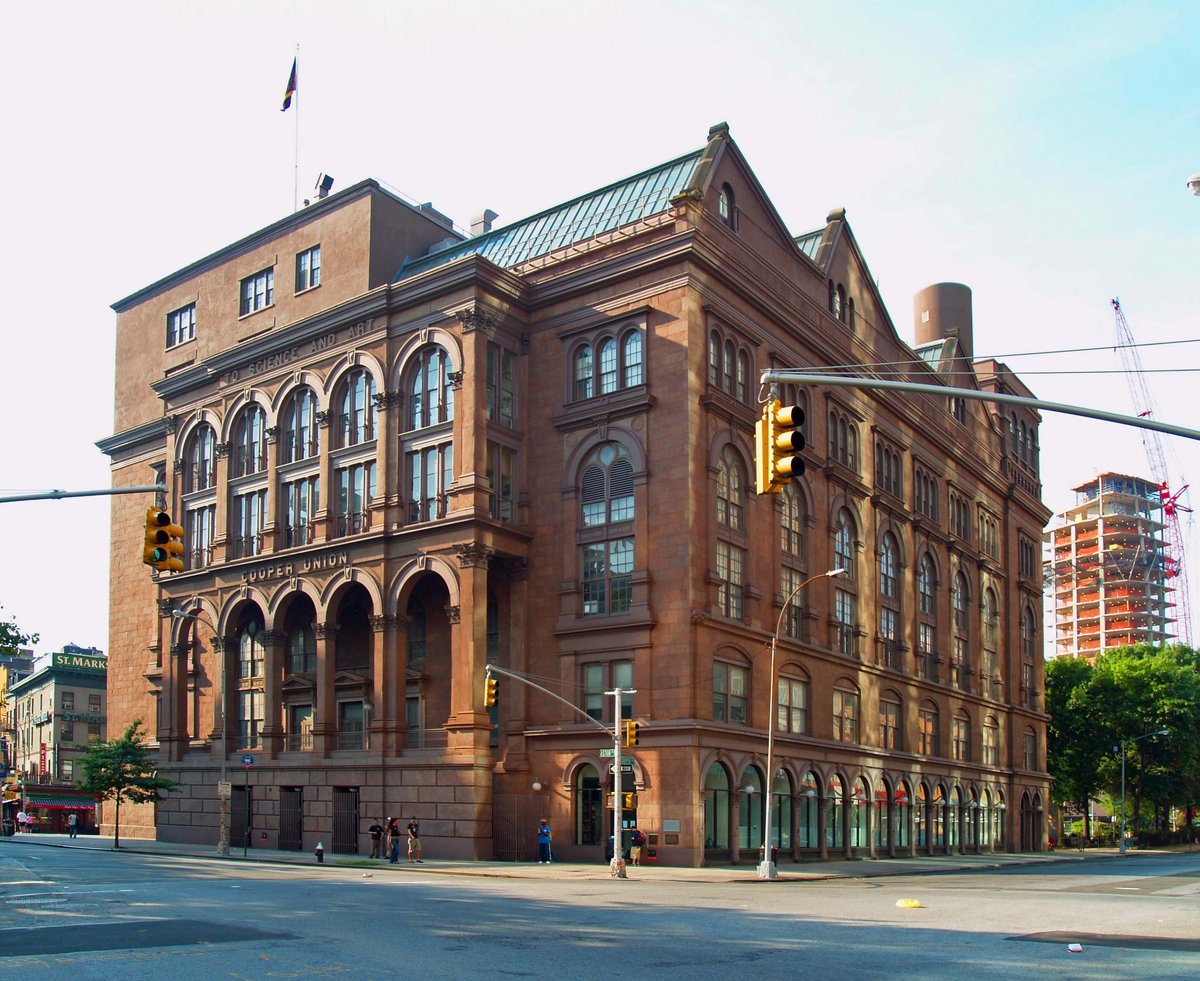
The Cooper Union was founded in 1859 by American industrialist Peter Cooper, who designed and built America's first steam railroad engine and made a fortune with a glue factory and iron foundry. Cooper was a workingman's son who had less than a year of formal schooling. He was a principal investor and first president of the New York, Newfoundland and London Telegraph Company, which laid the first transatlantic telegraph cable. He also ran for President under the Greenback Party, becoming the oldest person ever nominated for the office by a political party.
Cooper's dream was to give talented young people an education from an institution which was "open and free to all." To achieve these goals, he designated the bulk of his wealth to The Cooper Union. The school was built on a radical new model based on the belief that education should be accessible to those who qualify, independent of their race, religion, sex, wealth or social status. The institution was one of very few American institutions of higher learning to offer a full-tuition scholarship to every admitted student, a practice it discontinued in 2014, instead offering a half-tuition scholarship to each admitted student.
As of 2024, nearly half of its undergraduate students were attending on a tuition-free basis. In September 2024, the school announced that for the next four years, all students, including current students, would not pay tuition for their senior year. This initiative is supported by an endowment of over $600 million, which includes revenues from real estate, such as the land under the Chrysler Building.
Sources: Wikipedia, Wikidata, Wikimedia Commons





Written by No Other
Discuss this with the author and others
No comments yet. Be the first to start the conversation.