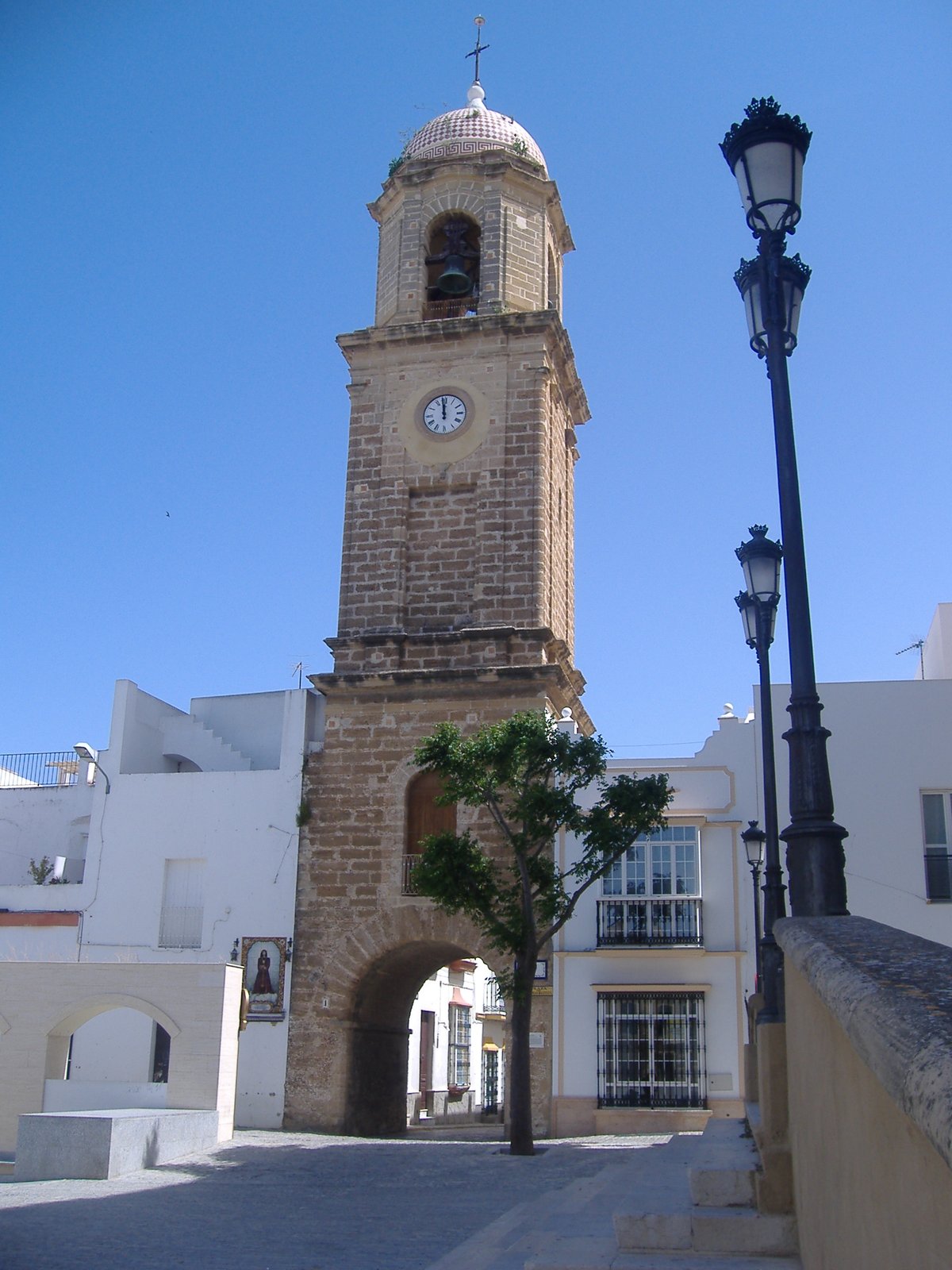

The Torre del Reloj de Chiclana de la Frontera, or popularly named Arquillo del Reloj, is an emblematic structure of Chiclana de la Frontera. Originally constructed as part of the ancient gates and Casa del Cabildo – the old Town Hall – in the 18th century, it now forms a striking monumental frame with the Church of San Juan Bautista in the Plaza Mayor. The tower, older than the Church, had originally served as a campanario. Its construction dates back to before the town’s expansion after 1303 when it was part of the Casa del Cabildo.
Two arches from the town’s original walls have been preserved, one near the Castle (El Castillo) and another in the Plaza Mayor, where it supports the Torre del Reloj. The tower was repaired in the 18th century by the Sevillian master clockmaker, José Varales. A new tower was built in 1757, replacing the initially planned reconstruction over the arch. This new tower was completed in 1764, with work inside still continuing for 12 years afterward. The Church of San Juan Bautista's clock was placed in the tower in 1787.
Standing 30 meters tall, the Torre features Ostionera stone. Its structure has four distinct sections: the base, main body, bell tower, and a semispherical dome. Regarded as a result of several reforms and modifications, the Torre del Reloj is classified as a Bien de Interés Cultural (BIC) and is considered a Monumento Nacional.
Sources: Wikipedia, OpenStreetMap, Wikidata, Wikimedia Commons
Written by Nicolo Ciampini
Discuss this with the author and others
No comments yet. Be the first to start the conversation.