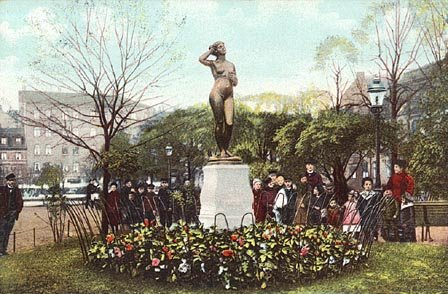

The Snowdrop sculpture, also known as Snöklockan or La Perce-Neige, is a standing female nude sculpted by Per Hasselberg in 1881. Named after the snowdrop flower at the woman's feet, it symbolizes her transition from childhood to womanhood, as Hasselberg used a sixteen-year-old Italian girl as his model for the work. The sculpture was exhibited at the 1881 Paris Salon, where it was the only Swedish work of art to receive an honorable mention, leading to Hasselberg’s definitive breakthrough as an artist.
The Nationalmuseum in Sweden commissioned a copy in marble in 1883 at the cost of 6,000 kroner – this was awarded a gold medal at the 1883 Salon. Snowdrop became very popular in both public and private contexts, leading to high demand for replicas and various reproductions. It was cast in bronze for Stockholm’s Mariatorget, the city's first non-honorific public statue – it was funded by director CR Lamm at Ludvigsberg and inaugurated in November 1900.
The Nordic Company workshops in Nyköping and Falun also produced bronze casts of Snowdrop in 1910. Rottneros Park also has a bronze cast of Snowdrop, created by C & A Nicci in 1953. Miniature versions of Snowdrop, made of Parian marble, were produced at the Gustavberg porcelain factory between 1887 and 1926.
Sources: Wikipedia, OpenStreetMap, Wikidata, Wikimedia Commons
Written by Nik Frost
Discuss this with the author and others
No comments yet. Be the first to start the conversation.