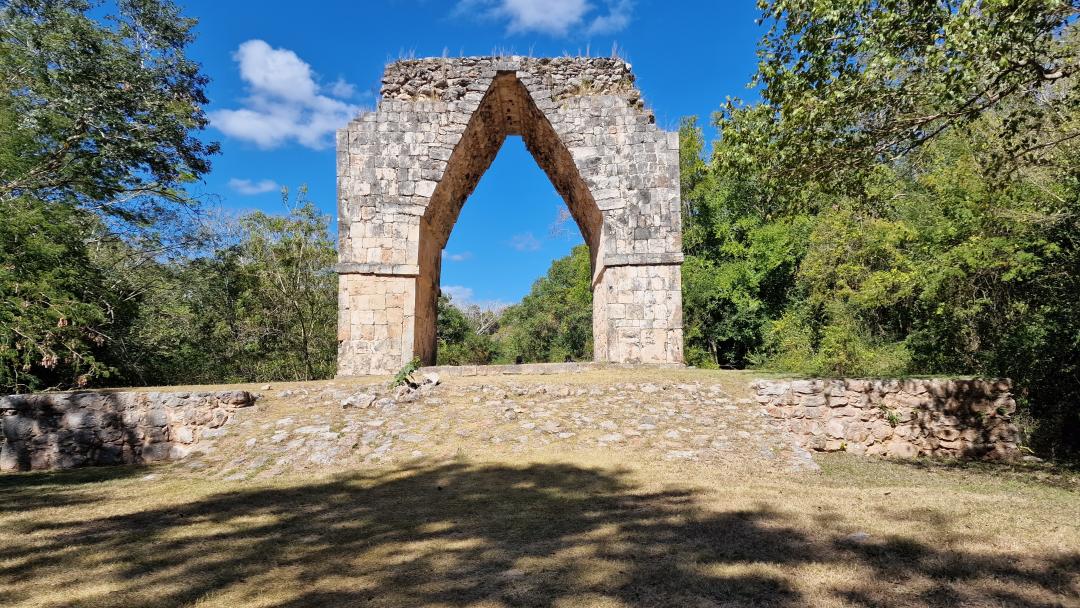

Kabah is located on a fairly extensive plain, bounded by low hills to the south and west of the site. The main ceremonial complex is situated next to the pyramidal temple. From this point, a road begins heading south, which connects to another small group, also of a ceremonial nature, and another road (sacbe – white road) leading northwest, exits the city and apparently leads south to Uxmal, located 18 kilometers away. On this roadway stands one of the most monumental arches recorded to this day. Thirteen steps lead up through the arch, which serves as the entrance to the city of Kabah, although the thirteenth step is inside the arch and not visible in these photographs. The arch was built as a city gate and was clearly a dominant feature and landmark of the city.

This freestanding structure, located on a platform 4 meters high in the center of the roadway, can be ascended by stairs on the north side or by a ramp on the south. It has an impressive internal height of 6.50 meters, a large width of 4.18 meters, and a length of 3.85 meters, making it one of the most outstanding architectural objects of Puuc. Pollock, in his graphic reconstruction of the arch, drew an openwork crest nearly 4 meters high above it, resulting in a total height of 13.70 meters, precisely so that it could be seen from a height and made visible, standing out from the low jungle characteristic of this area. Pollock drew and described the arch in the state preceding its restoration, in ruins and preserving only half of its height, that is, as it was depicted by Catherwood in the 19th century.

The shape of the arch section, which begins 1.10 meters above the middle cornice, has small projections and straight walls. The smooth stepped arrangement corresponds to the structural solution of its interior, made of four rows of well-carved pilasters and rougher details between them, bounded by corner pilasters worked on both sides. During restoration, the arch was crowned with a bracket above the top slab, a feature often found in Maya vaults. Regarding decoration, the Kabah arch is austere and contains no iconographic motifs, only traces of red pigment under the middle cornice, indicating that it was plastered and painted red.
Sources:
Laura Gilabert Sansalvador, Andrea Peiró, Vitoria Rosana, Martínez Vanaclocha: El arco urbano en la arquitectura Maya
https://www.themayanruinswebsite.com/kabah.html
Sylvanus G. Morley: The Ancient Maya, pp. 341-2