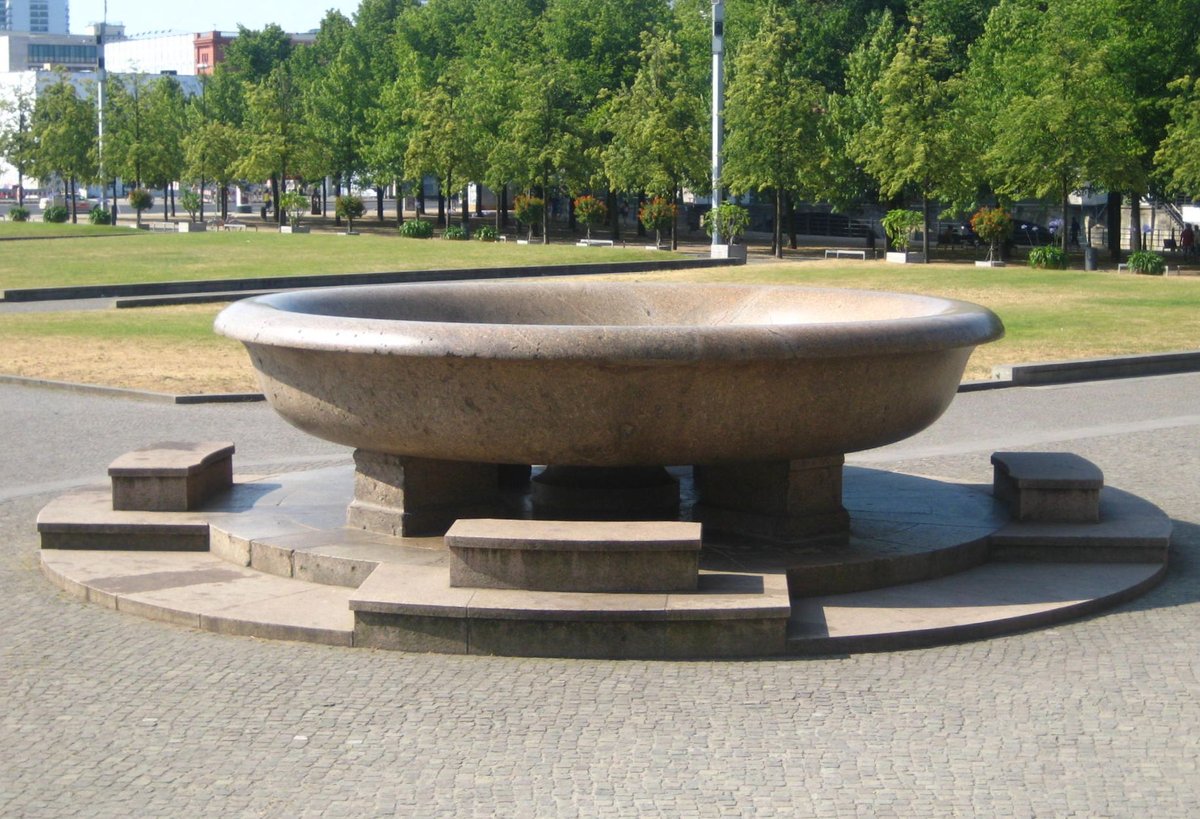
The Great Granite Bowl sits in the Lustgarten as a heavy, red mass of Karlshamn granite. It weighs 75 tons. At 6.91 meters across, it is the largest bowl ever carved from a single stone. It is a remnant of the Saale or Weichselian Ice Age that traveled from southern Sweden to the Rauenschen mountains over 1.42 billion years ago.
Prussian King Frederick William III commissioned the stonemason Christian Gottlieb Cantian to create a bowl that would surpass an English version in size. Cantian claimed his work would be more impressive than the porphyry bowl from Nero's Golden House in the Vatican. This undertaking produced what the era called a patriotic symbol, a cult stone, and a myth.
Cantian first scouted a 600-ton block near the Neuendorf school district in Oderberg, but the stone was too brittle to hold a carve. Instead, he turned to the Großer Markgrafenstein, an erratic boulder weighing between 700 and 750 tons. In September 1827, the blank for the bowl was split from the larger of these two stones.
The bowl was initially intended for the rotunda of the Altes Museum, but architect Karl Friedrich Schinkel argued that a 22-foot bowl would be aesthetically detrimental to the interior. He designed a semicircle in front of the museum's staircase instead, allowing the bowl to sit in the public eye. The King approved the outdoor display of the bowl on February 21, 1829.
During this period, granite was more than just a building material; it was a narrative of human quality. Because it was so difficult to polish, it came to symbolize power and unshakeable firmness. While the bowl sat in the Lustgarten, other granite projects were unfolding across the land, from the Luther Monument in Wittenberg to the proposed mausoleum for Blücher.
Today, the bowl remains in front of the Altes Museum in Berlin-Mitte. It is a piece of public art that you can walk around. It holds the weight of a lost era of monumentalism, where leaders desired more than historical structures could provide and sought to manufacture greatness out of boulders that had been moving since the ice ages began. You can see the texture of the red granite and the smoothness of the curve, a 21.7-meter circumference of royal pride and geological patience.
Sources: Wikipedia, OpenStreetMap, Wikidata, Wikimedia Commons


Written by Aurora
Discuss this with the author and others
No comments yet. Be the first to start the conversation.