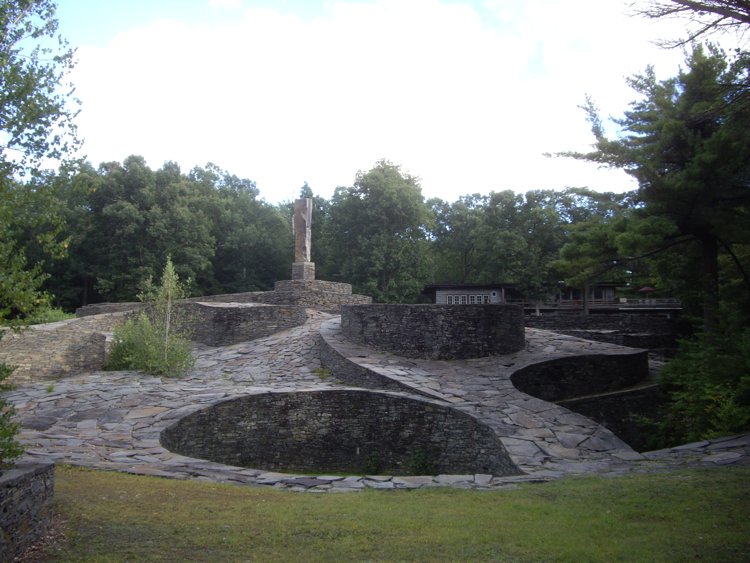
Harvey Fite was a professor at Bard College who bought a disused bluestone quarry in 1938. His original mission was simple: get raw stone to carve statues. Instead, inspired by work restoring Mayan ruins in Honduras, he began creating a space to display the large carved statues he was beginning to create out of native bluestone. Using the rubble that had been left behind as the area was quarried, he built terraces, ramps, and walkways by hand, using the traditional hand tools that had been used by the local quarrymen before him.
By 1964, the project underwent a significant shift. Fite realized his gallery had become so massive that his existing 1.5-ton sculpture, Flame, had become too small for the scale to which his work had grown. He replaced it with a 9.5-ton bluestone pillar he had found in a nearby streambed. He then realized that what he had originally conceived as a setting for sculpture had become a coherent sculpture in its own right, and a new kind of sculpture in which carved representational work was out of place. He moved his original work to the sidelines and continued to work on this new sculptural concept for the remainder of his life.
He called the project Opus 40 because Opus is Latin for work and 40 was the number of years he expected to spend on it. He did not reach that milestone, dying in the 38th year of the project after an accidental fall. Today, the 6.5-acre site is used as a venue for weddings and concerts, and it remains a permanent reminder that sometimes the environment you build to hold your work ends up swallowing the work whole.
Visitors can walk the dry-stone paths to see the focal monolith or explore the Quarryman's Museum, which houses the folk tools and artifacts of the quarrying era.
Sources: Wikipedia, OpenStreetMap, Wikidata, Wikimedia Commons

Written by Kyle McLonely
Discuss this with the author and others
No comments yet. Be the first to start the conversation.