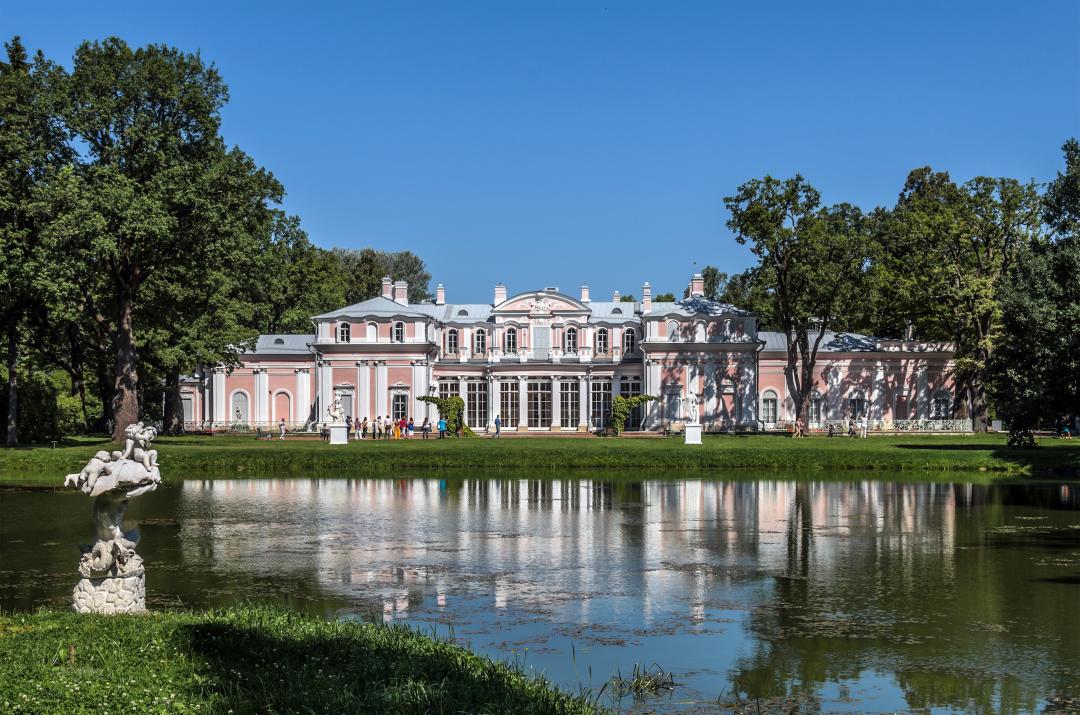
Striving not to participate in her husband's rough soldierly games, Catherine, still a grand duchess, erected on the opposite bank of Karosta, according to the same Rinaldi’s design, a picturesque ensemble of the Private Dacha with the architectural masterpiece of the Chinese Palace at its center. Built between 1762 and 1768 based on Antonio Rinaldi’s project, the originally one-story palace was only given a second floor in the mid-19th century for the daughter of Grand Duke Mikhail Pavlovich, Catherine Mikhailovna. A glazed gallery appeared, and small rooms were added to the eastern and western ends of the building. The Chinese Palace became the favorite place of solitary retreat for the future Empress Catherine II during her "straw widowhood," at a time when her husband was hosting noisy orgies among her young and undemanding ladies-in-waiting. Here she tried to overcome forced boredom in the close circle of faithful and devoted friends. Perhaps that is why a legend lived in St. Petersburg that Catherine herself embroidered the panels for the Glass Bead Cabinet of the Chinese Palace during long hours of enforced solitude. It is said that the empress’s shadow still occasionally visits the Chinese Palace and wanders through its enfilades.
The name "Chinese Palace" first appeared in 1774 in the chamber-porter’s journal. Before that, the palace was called the "Dutch house" (just like the Monplaisir Palace in Peterhof), the "house in the Upper Garden," or simply the "small house." The name "Chinese" arose because, in accordance with mid-18th-century taste for "chinoiserie," several interiors of the palace (the Large and Small Chinese Cabinets, the Chinese Bedroom) were decorated in the spirit of Chinese art or with the use of authentic works of art from China and Japan.
The center of the palace’s layout composition is the Large Hall, decorated with paintings, gilded stucco, mosaics, and artificial marble. On the walls are two medallions with marble bas-reliefs depicting Peter I and Elizabeth Petrovna. From the Large Hall, along the main axis in both directions, extend the ceremonial rooms, ending with the Hall of the Muses to the east and the Large Chinese Cabinet to the west. In the "Anteroom" of the Chinese Palace, Serafino Barozzi painted the ceiling "Apollo and the Arts" and created ornamental frescoes. For the Large Chinese Cabinet, brothers Serafino and Gioacchino Barozzi created the ceiling "Union of Europe and Asia." According to J. A. Kuchariants, Serafino Barozzi "plays a leading role in the decorative design of the interiors of both the Chinese Palace and the Pavilion of the Sliding Hill."
The most famous room of the Chinese Palace is the Glass Bead Cabinet, which has preserved its original decoration from the 1760s. The walls of the room are decorated with glass bead panels. These are canvases embroidered with glass beads. The glass beads were produced at the mosaic factory founded near Oranienbaum (in Ust-Ruditsa) by the Russian scientist M. V. Lomonosov. Against the background of the glass beads, complex compositions are embroidered with chenille (velvety silk) depicting fantastic birds among an equally fantastic landscape. For a long time, it was believed that the panels were made in France; however, it is now established that they were embroidered by nine Russian gold embroiderers under the guidance of Maria de Shel. The panels are framed with gilded carvings imitating tree trunks entwined with leaves, flowers, and grape clusters.
Originally, the floor in the Glass Bead Cabinet was made of multicolored smalts, also produced at the Ust-Ruditsa factory, but by the mid-19th century, it had deteriorated and the smalts were replaced with parquet flooring preserving the original pattern.
The Chinese Palace is unique in Russia as a monument of the Rococo style. Most of the palace interiors have preserved their original mid-18th-century decoration. It is also especially valuable for its unique items of decorative and applied art from China and Japan from the late 17th to mid-18th centuries, as well as the surviving parquet floors from the second third of the 18th century (made according to Antonio Rinaldi’s sketches).
During the war years, the Chinese Palace was conserved, and the museum valuables were evacuated. In 1946, the palace was reopened as a museum. Striving to oppose her hateful husband’s rough soldierly games with refined sophistication and carefree leisure in a close circle of chosen ones amid the luxury and splendor of painting, architecture, and sculpture, Catherine, still a grand duchess, erected on the opposite bank of Karosta, according to the same Rinaldi’s design, a picturesque ensemble of the Private Dacha with the architectural masterpiece of the Chinese Palace at its center. Around the palace, Rinaldi laid out a landscape park, including almost the entire Upper Park with the Concert Hall and the colossal toy—the Sliding Hill, more than half of which has been lost to our time.
From the Concert Hall, or as it was called in the 18th century, the Stone Hall, to the Chinese Palace, Rinaldi laid a wide Triple Linden Alley, slightly shifting its axis from the palace’s axis, as required by the canons of landscape park design. Thanks to this impeccable technique, the palace suddenly opens to the traveler’s view, striking with the subtle elegance of a balanced facade that retains in its plasticity the features of the fading Baroque, already classical in its simplicity and clarity. The northern facade is especially attractive. Its central part is marked by three-sided, column-decorated projections topped with a complex sculptural finish. The southern facade, whose fate was affected by the reconstruction undertaken by architects Bonstedt and Stakenschneider in the mid-19th century, is less impressive, although it still looks festive and elegant against the backdrop of tall centuries-old oaks. This festivity is delicately emphasized by a very Rinaldi-style low Baroque fence surrounding the palace on all sides.
Rinaldi paid special attention to the interior decoration of the Chinese Palace, where all types of fine and applied arts merged into one. The most significant are the Small and Large Chinese Cabinets, illustrating the rather vague contemporary ideas of the architect about distant China, and the famous Glass Bead Cabinet. Its walls are completely covered with twelve unique panels depicting exotic birds against fantastic oriental landscapes. All are hand-embroidered with wool on canvas, previously covered with glass beads—tiny milky-colored glass tubes. The panels were made by domestic craftsmen under the guidance of the Frenchwoman de Chen in a St. Petersburg workshop.
Sources:
Naum Sindalovsky: Legends of St. Petersburg Gardens and Parks
https://peterhofmuseum.ru/objects/oranienbaum
https://ru.wikipedia.org/wiki/Oranienbaum_(palace_and_park_ensemble)