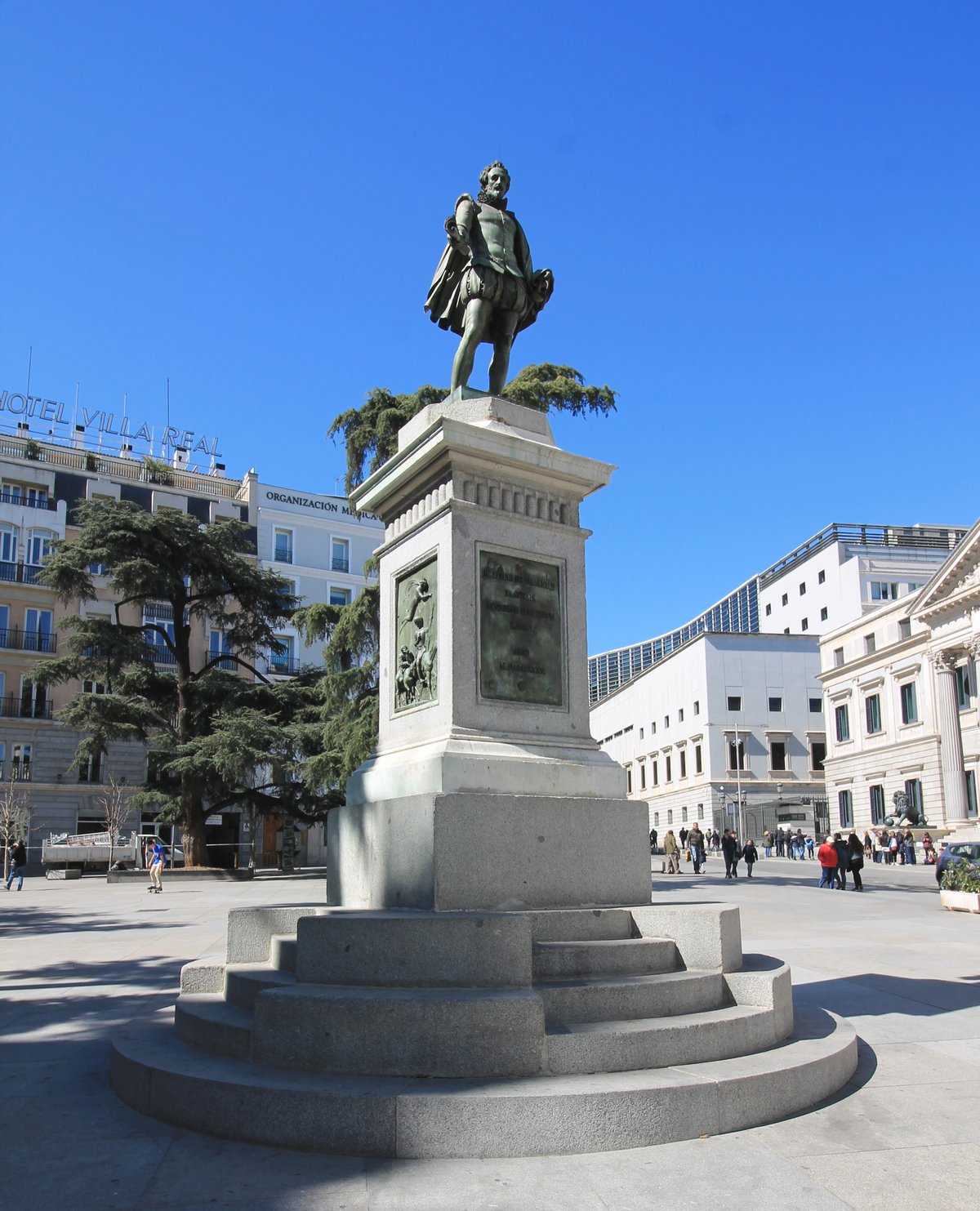

On Madrid’s Plaza de las Cortes, a bronze statue stands tall, honoring Miguel de Cervantes Saavedra, author of one of Spanish literature’s greatest works - Don Quixote. Sculpted by Antonio Solá, the statue was first erected in 1835, a testament to Cervantes' influence on Spanish culture. The statue depicts Cervantes in his late 40s, leaning on a sword with a roll of papers tucked beneath his arm, ready to continue writing. The pedestal, adorned with plaques in Spanish and Latin, pays homage to Cervantes.
Originally placed in Madrid’s plaza del Duque de Nájera, it was relocated to Plaza de las Cortes by July 1835. In 2009, during a relocation, a time capsule was discovered beneath the statue, filled with historical artifacts, including four copies of Don Quixote and government gazettes from the time period. Today, the Statue of Cervantes stands as a proud symbol of Spanish literary heritage, a lasting tribute to the great mind of Miguel de Cervantes Saavedra, and a must-see for any visitor to Madrid.
Sources: Wikipedia, OpenStreetMap, Wikidata, Wikimedia Commons
Written by Nicolo Ciampini
Discuss this with the author and others
No comments yet. Be the first to start the conversation.