P15, opp. Qutab Minar, Seth Sarai, Mehrauli, New Delhi, Delhi 110030, India


Qutb Minar, also known as Qutub Minar and Qutab Minar, is a minaret and "victory tower" that is part of the Qutb complex, located on the site of the oldest fortified fortress of Delhi — Lal Kot, founded by the Tomar Rajputs. The tower has 399 steps. It is included in the UNESCO World Heritage list and is situated in the Mehrauli area in South Delhi, India. It is one of the most visited tourist attractions in the city, with construction mainly carried out between 1199 and 1220.
It can be compared to the 62-meter brick minaret of Jam in Afghanistan, built around 1190, a decade before the construction of the tower in Delhi began. The surfaces of both minarets are richly decorated with inscriptions and geometric patterns. The shaft of Qutb Minar is fluted and adorned with magnificent stalactite brackets under the balconies at the top of each level. Overall, minarets were rarely used in India and are often detached from the main mosque where they exist.
The tower incorporates elements of traditional Islamic architecture and Southwest Asian design. Elizabeth Lamborn's book "Islam Beyond Empires: Mosques and Islamic Landscapes in India and the Indian Ocean" explores the introduction of Islam to South Asia and the region's influence on Islamic religious architecture. These newly arrived Muslims from the Islamic West were fleeing the Mongol Empire and emigrated to India, where they built religious centers. Qutb Minar serves as a central marker for these new Muslim communities and also reminds of the presence of Islam in this area. The minaret's architecture differs significantly from the typical style and design of mosques built in the Middle East. The style of these structures was influenced by local architecture, such as Hindu temples, which affected the choice of materials, techniques, and decorations used in the construction of Qutb Minar.
Historically, tower minarets were rare in South Asian Islamic design until the 17th century due to the slow adoption of typical Middle Eastern styles in India. It is also detached from the main mosque, demonstrating how local culture influenced the design of the Middle Eastern structure. Qutb Minar is considered "the earliest and finest example of the synthesis of Hindu-Muslim traditions," according to Veda Parkash in his essay "Qutb Minar from Contemporary and Near-Contemporary Sources." Like many mosques built in South Asia during this period, the minaret was constructed by Hindu workers and craftsmen under the guidance of Muslim architects. This led to a construction that synthesizes Hindu and Islamic religious architecture. Since some of the craftsmen were Hindus and unfamiliar with the Quran, the inscriptions are a mix of disordered Quranic texts and other Arabic expressions.
Qutb Minar was built on the ruins of Lal Kot, the citadel of Dhillika. Qutb Minar was started after the Quwwat-ul-Islam mosque. Drawing inspiration from their Ghurid homeland, Qutb-ud-Din Aibak and Shams-ud-Din Iltutmish built the minaret in the southeast corner of Quwwat-ul-Islam between 1199 and 1503.
It is generally believed that the tower is named after Qutb-ud-Din Aibak, who began its construction. It is also possible that it is named after the 13th-century Sufi saint Khwaja Qutb-ud-Din Bakhtiar Kaki, because Shams-ud-Din Iltutmish was his devoted follower.
The minaret is surrounded by several historically significant monuments of the Qutb complex. The Quwwat-ul-Islam mosque, located northeast of the minaret, was built by Qutb-ud-Din Aibak in 1199. It is the oldest surviving mosque built by the Delhi sultans. It consists of a rectangular courtyard surrounded by colonnades made from carved columns and architectural elements of 27 Jain and Hindu temples destroyed by Qutb-ud-Din Aibak, as recorded in his inscription on the main eastern entrance. Later, a high arched wall was erected, and the mosque was expanded by Shams-ud-Din Iltutmish (1210–1235) and Ala-ud-Din Khalji. The iron pillar in the courtyard bears an inscription in Brahmi script in Sanskrit from the 4th century AD, stating that the pillar was erected as Vishnudhvaja (standard of the god Vishnu) on a hill known as Vishnupada, in memory of a powerful king named Chandra. The mosque complex is one of the earliest surviving on the Indian subcontinent.
In 1505, an earthquake damaged Qutb Minar; it was repaired by Sikandar Lodi.
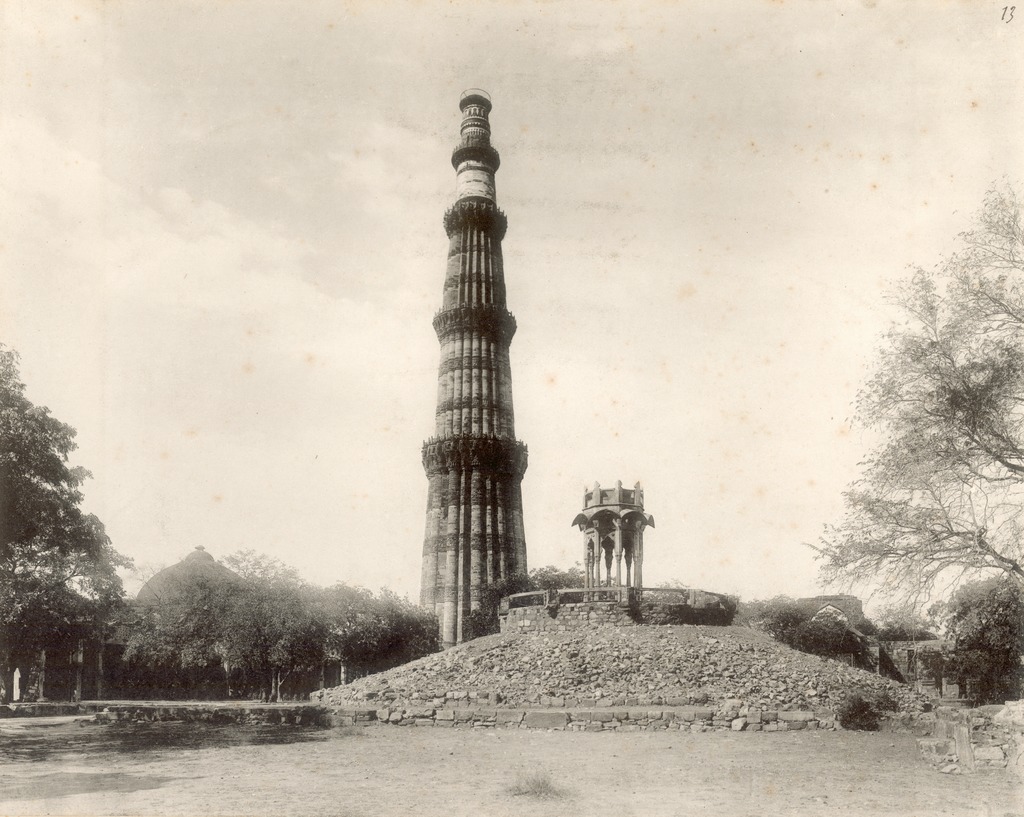
On September 1, 1803, a strong earthquake caused serious damage. Major Robert Smith of the British Indian Army restored the tower in 1828 and installed a columned pavilion on the fifth floor, creating a sixth floor. The pavilion was removed in 1848 by order of Viscount Hardinge, then Governor-General of India. It was placed at ground level to the east of Qutb Minar, where it remains today. It is known as "Smith's Folly."
The construction of Qutb Minar was planned and financed by the Ghurids, who emigrated to India and brought Islam with them. The Ghurids, historically known as Shansabani, were a clan of Tajik origin from Ghor, a mountainous region of modern western Afghanistan. In the late 11th to early 12th century, various sects of this nomadic clan united, losing their nomadic culture. During this period, they also converted to Islam.
They then expanded into the territory of modern India and quickly took control of a significant part of the country. The Ghurids annexed Multan and Uch in western Punjab in 1175–76, the northwestern areas around Peshawar in 1177, and the Sindh region in 1185–86. In 1193, Qutb al-Din Aibak conquered Delhi and established Ghurid rule in the province, and the Qutb Minar mosque complex was founded in 1193. Previously, scholars believed the complex was built to promote Islam among the new Ghurid subjects and as a symbol of their commitment to Islam. New evidence now suggests that conversion to Islam was not the main priority of the new annexations; instead, Ghurid rulers sought a peaceful synthesis of local culture and Islam.
Qutb-ud-Din Aibak, deputy of Muhammad of Ghor, who founded the Delhi Sultanate after Muhammad of Ghor's death, began construction of the first floor of Qutb Minar in 1199. Aibak's successor and son-in-law Shams-ud-Din Iltutmish completed three more floors. After a lightning strike in 1369 damaged the then top floor, the ruler of the time, Firoz Shah Tughlaq, replaced the damaged floor and added another. Sher Shah Suri also added an entrance during his reign when the Mughal emperor Humayun was in exile.
Persian-Arabic and Nagari inscriptions in various sections of Qutb Minar recount its construction and subsequent restorations and repairs carried out by Firoz Shah Tughlaq (1351–1388) and Sikandar Lodi (1489–1517).
The height of Qutb Minar is 72.5 meters, making it the tallest brick minaret in the world. The tower tapers, with a diameter of 14.3 meters at the base, decreasing to 2.7 meters at the top. Inside the tower is a spiral staircase of 379 steps.
At the foot of the tower is the Quwwat-ul-Islam mosque. The minaret leans slightly more than 65 cm from vertical, which is considered safe.
Qutb Minar inspired and served as a prototype for many minarets and towers built later. Chand Minar and Mini Qutb Minar are similar to Qutb Minar and were inspired by it. The floors of Qutb Minar vary in size, style, and materials due to different architects and builders constructing each section.
Qutb Minar consists of five floors made of red and gray sandstone. The lowest floor, also known as the plinth, was completed during the lifetime of Sultan Ghiyas ad-Din Muhammad of the Ghurid dynasty.
It is decorated with twelve semicircular and twelve fluted pilasters arranged alternately. This floor is divided by flutes and multi-level balconies supported by muqarnas corbels. The floor is set on a low circular pedestal decorated with a twelve-pointed star with a semicircle placed in each corner between the star points.
This floor also has six horizontal bands with inscriptions in Islamic Naskh calligraphy style. The inscriptions are as follows: Quran, Surah II, verses 255–260; Quran, Surah LIX, verses 22–23, and attributes of God; the name and titles of Ghiyas ad-Din; Quran, Surah XLVIII, verses 1–6; the name and titles of Mu'izz ad-Din; and Quranic quotes and the following titles in this repeatedly restored inscription: "Amir, the most glorious and great commander of the army." At this level, there are also inscriptions praising Muhammad of Ghor, Sultan of the Ghurids.

The second, third, and fourth floors were built by Shams-ud-Din Iltutmish, the first Muslim ruler of Delhi. He is considered the first of the Delhi Sultanate dynasty. The second and third floors are also decorated with twelve semicircular and twelve fluted pilasters arranged alternately. These red sandstone columns are divided by flutes and multi-level balconies supported by muqarnas corbels. Before reconstruction and size reduction, the fourth floor was also decorated with semicircular pilasters. It was reconstructed in white marble and is relatively simple.
In 1369, the fourth floor was repaired after a lightning strike. During reconstruction, Sultan Firoz Shah Tughlaq decided to reduce the size of the fourth floor and then divided it into two floors.
On November 14, 2000, Delhi newspapers reported that Hindu nationalist groups Vishva Hindu Parishad and Bajrang Dal planned to conduct a yajna, a ritual Hindu purification ceremony, in the Qutb Minar complex where the minaret is located. Delhi police detained 80 activists led by Ram Krishan Gaur, who were near Qutb Minar and were stopped from conducting the yajna inside the tower. Due to the police cordon, the activists instead performed the ritual on the streets outside the mosque complex. Since materials from Jain and Hindu temples were used in the construction of the minaret, right-wing Hindu groups believed it was necessary to purify the complex to free Hindu icons "locked" inside the minaret and mosque complex.
On May 18, 2022, former regional director of the Archaeological Survey of India Dharavmeer Sharma stated that Qutb Minar was built by Raja Vikramaditya in the 5th century to observe the changing position of the sun.
On May 21, 2022, the Secretary of the Ministry of Culture Govind Mohan decided to conduct excavations and iconography of Hindu sculptures found in Qutb Minar. The Ministry requested the ASI to provide a report on the excavations. Excavations may begin to the south of the minaret, 15 meters from the mosque.
On December 8, 1946, Czech actress Tara Devi, the sixth wife of Maharaja Jagatjit Singh, fell from the tower and died along with her two Pomeranian Spitz dogs. Until 1976, public access to the first floor of the minaret via the internal staircase was allowed. Access to the top was closed after 2000 due to suicides. On December 4, 1981, the stairway lighting failed. Between 300 and 400 visitors panicked and rushed to the exit. Forty-five people died, some were injured. Most of them were schoolchildren. Since then, the tower has been closed to the public. After this incident, access rules were tightened.
Bollywood actor and director Dev Anand wanted to shoot the song "Dil Ka Bhanwar Kare Pukar" from his film "Tere Ghar Ke Samne" inside the minaret. However, cameras at that time were too large to fit in the narrow passage of the tower, so the song was filmed inside a replica of Qutb Minar.
This site served as a checkpoint for the second stage of the second season of the show "The Amazing Race Australia."
In recent years, Qutb Minar has been illuminated on special occasions related to international relations. In September 2023, the monument was lit up in the colors of the Mexican flag in honor of the 213th anniversary of Mexico's independence, which was noted and appreciated by the Embassy of Mexico in India. Similarly, on October 30, Qutb Minar was illuminated in the colors of the Turkish flag to mark the 100th anniversary of the Turkish Republic, attracting special attention from the Turkish Embassy in New Delhi.
Sources:
https://en.wikipedia.org/wiki/Qutb_Minar

