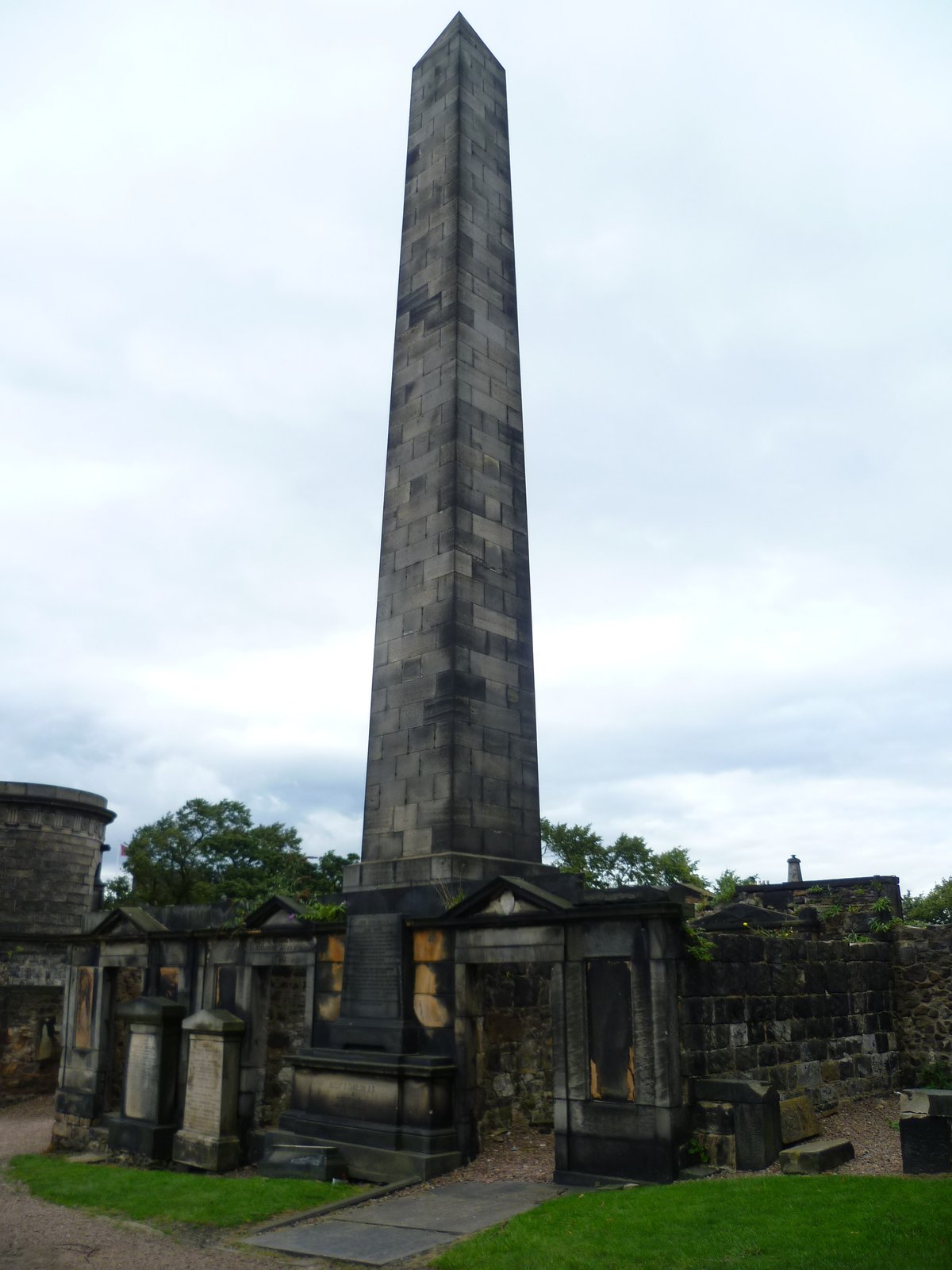
The Political Martyrs Monument, located in the Old Calton Burial Ground on Calton Hill, Edinburgh, Scotland, commemorates five political reformists from the late 18th and early 19th centuries. Designed by Thomas Hamilton and erected in 1844, it is a 27 meter tall obelisk on a square-plan base plinth, all constructed in ashlar sandstone blocks. As part of the Burial Ground it is Category A listed. The monument is inscribed with quotations from two of the men commemorated.
The five men commemorated - all from the British Isles - were imprisoned for campaigning for parliamentary reform. Specifically, their support of Palmer’s 1793 address that advocated for universal suffrage and annual parliaments was considered incendiary. The five were accused of sedition in a series of trials in 1793 and 1794, and sentenced to terms of penal transportation in the British colony of New South Wales.
Only Palmer and Margarot served their full 14-year sentences and were released. Palmer remained in New South Wales and established a thriving beer-brewing operation near Sydney Cove; he died of a fever on a trading voyage back to England. Margarot departed the colony when his sentence expired, and was the only one of the five to return to the British Isles.
Sources: Wikipedia, OpenStreetMap, Wikidata, Wikimedia Commons
Written by Nicolo Ciampini
Discuss this with the author and others
No comments yet. Be the first to start the conversation.