3JGQ+X8 Isakovo, Arkhangelsk Oblast, Russia

Prisons at Orthodox monasteries are a very unusual (and probably even unique) phenomenon in the history of the Russian Empire. At different times, the Nikolo-Karelsky, Trinity (in Siberia), Kirillo-Belozersky (on the Northern Dvina River), Novodevichy (in Moscow), and many other large monasteries were used as places of detention. The most vivid example of such a prison should be recognized as the Solovetsky.
The monastic political and ecclesiastical prison existed in the Solovetsky Monastery from the sixteenth to the early twentieth century. Both spiritual and secular authorities considered this place a reliable detention site due to the remoteness of the Solovetsky Islands archipelago from the mainland and extremely harsh climatic conditions, which made prisoner escapes extremely difficult.
The monastery itself on the Solovki was a unique military-engineering structure. The severe northern climate (the archipelago consists of six large and several dozen rocky small islands near the Arctic Circle) opposed the plans of the builders.
Work was carried out only in summer — in winter, the ground froze so hard that it was impossible to dig a grave. Graves, by the way, were prepared in summer, roughly estimating how many prisoners would not survive the next winter. The monastery was built from huge stones, with gaps filled with brickwork.
Escaping from the Solovetsky Monastery was practically impossible. Even if successful, the prisoner would hardly be able to cross the cold strait alone. In winter, the White Sea froze, but walking several kilometers on cracking ice due to underwater currents was also difficult. The coastline for 1000 km from the monastery was sparsely populated.
The first prisoner at Solovki was the abbot of the Trinity Monastery Artemy — a supporter of extensive Orthodox reform, who denied the essence of Jesus Christ, advocated abandoning the veneration of icons, and sought Protestant books. He was not held very strictly; for example, Artemy could move freely around the monastery grounds. The abbot, taking advantage of the lack of rules for prisoner detention, escaped. It is likely that he was helped in this. The fugitive crossed the White Sea by ship, successfully reached Lithuania, and later wrote several theological books.
The first real criminal (a murderer) appeared at Solovki during the Time of Troubles. This was the notorious church plunderer Peter Otyaev, known throughout the Moscow Tsardom. He died in the monastery; the location of his burial is unknown.
By the 1620s, lawbreakers began to be systematically sent to the Solovetsky Monastery. People were exiled to Solovki for rather atypical crimes. In 1623, the son of a boyar was sent here for forcibly tonsuring his wife into monasticism; in 1628, the clerk Vasily Markov for corrupting a daughter; in 1648, priest Nektary for urinating in the church while intoxicated. The latter stayed in the Solovetsky Monastery for almost a year.
From the times of Ivan the Terrible until 1883, between 500 and 550 prisoners were held in the Solovetsky prison. The prison officially existed until 1883, when the last prisoners were released. Guard soldiers remained there until 1886. Subsequently, the Solovetsky Monastery continued to serve as a place of exile for church servants who had committed some offense.
The first camp on Solovki was established on February 3, 1919, by the White government of Miller-Chaikovsky: its decree stated that citizens "whose presence is harmful... may be subjected to arrest and expulsion without trial to places indicated in paragraph 4 of this decree." The specified paragraph stated: "The place of exile is designated as the Solovetsky Monastery or one of the islands of the Solovetsky group, where the exiled can be settled."
Earlier, the Provisional Government of the Northern Region began sending political opponents to the islands of Mud'yug and Iokanga. "People called prisoners of war were driven to the brink of starvation: like hungry dogs, they threw themselves, grabbing bones gnawed by the prison administration, knowing in advance that this would cost them beatings with rifle butts, solitary confinement, etc. The bodies of the imprisoned were brought from hunger to a state where a slight gust of wind would knock them down, which was considered simulation, and therefore the unfortunate were beaten again... More than 50 percent of those imprisoned on Mud'yug died, many went insane..." — described the situation after the liberation of Mud'yug by the Arkhangelsk Trade Union Council in August 1919.
In the exile-penal prison in Iokanga, prisoners were beaten, starved, tortured, and exterminated by slow, painful death from hunger and cold. Of the 1200 detainees who passed through Iokanga, only 20 were Bolsheviks; the rest were non-party members. By the time the prison was liberated from the White Guards, just over a third of the prisoners remained alive, of whom 205 could no longer move.
In 1919, the Cheka established several forced labor camps in the Arkhangelsk province: in Pertominsk, Kholmogory, and near Arkhangelsk. The camps were to operate on a self-supporting basis without central support. A labor camp subordinated to the forced labor sub-department of the Arkhangelsk Provincial Executive Committee was organized on May 20, 1920, for the detention of civil war prisoners sentenced to forced labor. The camp commandant of the Solovetsky Islands was appointed Abakumov, who held this position from 1920 to May 1921.
In 1921, these camps began to be called Northern Special Purpose Camps (SLON). In a 1921 report of the Island Administration of the Arkhangelsk Provincial Executive Committee, the idea of using prisoners' labor for food was first proposed. At the beginning of 1923, the GPU of the RSFSR, which replaced the Cheka, proposed increasing the number of northern camps by building a new camp on the Solovetsky archipelago.
In May 1923, the deputy chairman of the GPU, Unshlikht, appealed to the All-Russian Central Executive Committee with a project to organize the Solovetsky forced labor camp. On June 6, 1923 (even before the decision to create the Solovetsky camp was made), the paddle steamer "Pechora" delivered the first batch of prisoners from Arkhangelsk and Pertominsk to the Solovetsky Islands.
On Revolution Island (formerly Popov Island) in the Kem Bay, where the sawmill was located, it was decided to create a transit point between the Kemi railway station and the new camp on the Solovetsky Islands. The government of the Autonomous Karelian SSR opposed the actions of the OGPU, but the transit point was opened anyway.
According to the OGPU decree presented to the Council of People's Commissars of the RSFSR on August 18, 1923, the new camp was to hold "political and criminal prisoners sentenced by additional judicial bodies of the GPU, former Cheka, 'Special Meeting under the GPU Collegium,' and ordinary courts, if the GPU quickly gave permission."
Soon, based on the USSR Council of People's Commissars Resolution of October 13, 1923, the Northern Camps of the GPU were liquidated, and on their basis, the Administration of the Solovetsky Special Purpose Forced Labor Camp (USLON or SLON) of the OGPU was organized. The camp was given all the property of the Solovetsky Monastery, closed since 1920. The camp was planned to accommodate 8,000 people.
Prisoners working at individual enterprises were divided into artels, and those into tens, led by decemasters responsible for work productivity.
The regulation on the Solovetsky special purpose camps of the OGPU (October 2, 1924) stipulated that "the work of prisoners has an educational and labor significance, aiming to encourage and accustom those serving sentences to work, giving them the opportunity to live an honest working life and be useful citizens of the USSR after leaving the camps." This document outlined various disciplinary measures for refusal to work, failure to fulfill orders, damage to tools, disobedience; however, economic incentives for labor were practically not mentioned. At this time, not everyone could find work, so in the second half of 1924, the OGPU was forced to allocate an additional 600,000 rubles for camp maintenance.
"Political" prisoners (members of socialist parties: SRs, Mensheviks, Bundists, and anarchists), who made up a small part of the total number of prisoners (about 400 people), nevertheless occupied a privileged position in the camp and were usually exempt from physical labor (except emergency work), freely communicated with each other, had their own governing body (starostate), could see relatives, and received aid from the Political Red Cross and parcels.
In early December 1923, USLON chief Eichmans announced to the starosts that new instructions had been received regarding the regime for political prisoners at Solovki, which included, in particular, a ban on walks from 6 p.m. to 6 a.m. Without consulting other prisoners, the starosts decided not to comply with the innovation. The SRs, Left SRs, and anarchists decided not to stop walks and organized group outings, taking turns. Social Democrats refrained from demonstrations. On December 19, 1923, at 5 p.m., the SR starost Ivanitsky went to negotiate with the head of the Savvatyev Skete Nogtev, but he did not receive him. At 6 p.m., soldiers came out into the yard and demanded that those walking return to the building. In response to disobedience, the guards used weapons, killing five and seriously wounding three (one fatally) members of the SR and anarchist parties. A commission of the All-Russian Central Executive Committee led by Smirnov investigated the incident and recognized the guards' actions as unlawful.
The Prosecutor of the Supreme Court of the USSR Krasikov reported in the "SLON" magazine in autumn 1924 on the results of the inspection of the Solovetsky camp and the Kem transit point, noting that political prisoners ate much better than criminals and even better than Red Army soldiers; some had a dietary table with white bread and butter. They could also receive parcels from outside without restrictions, which included chocolate, cocoa, butter, totaling 500–600 poods per year. The premises of the monastic sketes allocated to them were the best on the islands: well heated, spacious, bright rooms with views of the sea and forest. There were no bars or guards inside the houses. Political prisoners were not engaged in any work, seeing this as a violation of their freedom. They only had to prepare food from the allocated products and maintain order in the premises, which they did not do very well. Even organizing firewood procurement for political prisoners by their own efforts was not successful. At the end of 1924, there were 320–330 political prisoners, including women and children, both born on Solovki and brought by their parents, the prosecutor noted. Criminal prisoners related negatively to them, considering them to lead a parasitic lifestyle and make excessive demands on the administration: for example, electric lighting not until midnight but around the clock, placing arriving guests not in a hotel but in isolation with them, walks not until 6 p.m. but at any time of day. Political prisoners portrayed their stay in the camp as a struggle against Soviet power, appealing to the foreign press. When discussing the possibility of the budget meeting the growing demands of political prisoners, their starosts said: "What do we care about your budgets! Our only desire is for your budget to burst, and we are glad to contribute to this as much as we can. Your duty is to provide us with everything we need and require."
A protest against the privileges of political prisoners was expressed in the "SLON" magazine No. 9-10 of 1924 by prisoner Sukhov. "They will soon demand orderlies and horses for outings," as they had previously demanded prepared firewood by others' hands and stokers for the laundry. Political prisoners behaved insultingly towards Red Army soldiers, calling them "sheep" and urging them to rise against Soviet power, the author complained.
As of October 1, 1924, the number of political prisoners in the camp was 429 out of about 3,000 total, including 176 Mensheviks, 130 right SRs, 67 anarchists, 26 left SRs, and 30 socialists from other organizations. On June 10, 1925, a resolution was adopted to cease holding political prisoners in SLON. In the summer of 1925, political prisoners were taken to the mainland.
Most prisoners were sent to SLON without trial. Their sentences ranged from 3 to a maximum of 10 years in the 1920s.
The first group of prisoners consisted of those officially recognized by the authorities as political prisoners — SRs, Mensheviks, anarchists. They were not subjected to forced labor, received a special ("enhanced") ration, and had elected starosts. Until 1925, they were held in complete isolation from other prisoners in the Savvatyev, and later in the Anzersky and Muksalomski sketes of the monastery. In 1925, they were all transferred to OGPU political isolators on the mainland.
The second group consisted of other political prisoners called "kaery" ("counter-revolutionaries"). These were people of various intellectual professions, former students, former officers, priests of various confessions (in 1925, the number of detained clergy varied from 120 to 500 according to different sources, and by 1926, there were 29 Orthodox bishops among the prisoners), workers, and peasants who participated in mass anti-Bolshevik movements. They were widely used for hard labor.
The third category consisted of criminals and "everyday" offenders sent to the camp by court decision (initially no more than 20% of all prisoners), as well as professional beggars, prostitutes, homeless children, and juvenile criminals sent to the camp from large cities without trial. As of April 1, 1930, the camp held 3,357 minors.
Due to a shortage of hired staff, prisoners (including those convicted under "political" articles) occupied most leadership positions in workshops and enterprises of USLON since 1923: out of 659 managers and specialists, 559 were prisoners. The internal camp guard was composed of armed "supervision," mainly staffed by prisoners — former communists, Red commanders, Red Army soldiers, Chekists, those convicted of official crimes, as well as criminals. In April 1931, "everyday" offenders and former Soviet and party workers began to be recruited for lower administrative positions and as shooters in the militarized guard.
Initially, the scope of USLON's activities was limited to the Solovetsky Islands; in Kemi, on the territory of the Autonomous Karelia, there was only a transit-distribution point. During an inspection of SLON in autumn 1924, the Prosecutor of the Supreme Court of the USSR Krasikov noted that the Kemi transit point was built by the British for their landing and was thoroughly renovated in 1924, equipped with stoves, kitchens, a hospital with a pharmacy, and medical staff. Communication with Solovki was maintained during navigation by two steamers; the trip to Moscow took 36-38 hours, and the crossing from Kemi to Solovki took 2 hours.
In 1924, former Odessa merchant Naftaliy Aronovich Frenkel arrived at Solovki. At this time, the administrative structure of the SLON Management was formed, where the production-technical department was responsible for the development of production activities (managing enterprises, factories, and workshops; technical, construction-repair, and forestry operations; workforce and its rational use; organization of processing and extractive industries) and the economic department (control of fishing and seal hunting; operation of auxiliary repair workshops; procurement and supply of materials, raw materials, and household inventory for all production-technical enterprises, factories, and fisheries; sales). In 1926, all these functions were combined into the operational-production department of the economic part (EPO EKCh), headed by prisoner Frenkel. His innovation was replacing the standard ration with a clear differentiated method of food distribution depending on output and category of prisoners' working capacity, which sharply increased labor productivity.
One of Frenkel's main tasks was "developing methods and ways to increase work productivity by organizing it on rational principles." If in 1925 USLON chief Eichmans admitted in a report on the economic state of the camps that "...there is nowhere to use the workforce at Solovki given our enterprises," by 1928 he noted the opposite: the number of prisoners grew from 5,872 to 21,900, of whom about 10,000 were engaged in contract construction and logging works on the mainland. The camp turned into a multi-sector industrial zone. According to reports for 1927, logging alone brought the camp economy a net profit of 5 million gold rubles.
In 1926, the OGPU board reduced Frenkel's sentence to 5 years, and on June 23, 1927, he was released early. Naftaliy Aronovich was far from the only prisoner who made a career in the camp at that time: of the 659 employees in his department at Solovki and on the mainland, 559 were convicted for counter-revolutionary activities. This displeased the party cell, which wanted to manage the camp's production and economic life itself rather than obey Frenkel. However, they acknowledged that Frenkel "...put the Solovetsky economy on its feet. Of course, his approach is that of a proprietor-merchant, and by no means a Soviet public figure. But as a worker — valuable...". "Firing Frenkel now is impossible — a replacement must be prepared," the party members thought, creating an Organizational Bureau to control and audit all camp productions, duplicating the EPO EKCh.
The Solovetsky party cell's claims against Frenkel, with the desire to gradually remove counter-revolutionary prisoners from leadership positions and replace them with "unemployed comrades" from party members, led to a special meeting of VKP(b) members of SLON OGPU on April 5, 1929, with the participation of the head of the OGPU special department Bokiy, representatives of the Kemi city prosecutor's office, the Solovetsky party organization, and the camp party organization. Bokiy supported Frenkel's camp development strategy, declaring that Frenkel was not a counter-revolutionary but a secret OGPU agent. As a result, he forbade party organizations from interfering in the operational production work, "...because the economic affairs of the camps are often secret."
The camp's extensive economy included the construction and operation of railways, logging, peat extraction, iodine and agar-agar extraction from seaweed, marine animal and fish harvesting, agricultural production, saltworks, fur farming (including breeding valuable rabbit breeds whose pelts were exported to the UK), craft workshops, brick, leather, lime, mechanical, pottery, tar distillation, and tallow rendering factories. Some of these (brick factory, iodine production, fish and fur industry, fur farming, logging) operated not for self-sufficiency but for export and even export abroad.

In 1930, the Solovetsky camps held 63,000 prisoners, of whom 24,534 were engaged in contract works and 11,029 in their own enterprises. The average income of USLON per person-day rose to 4 rubles. At the same time, the leadership structures of Arkhangelsk and the Karelian ASSR increasingly desired to take control of USLON. The decisive word was said by the OGPU, which in 1929 petitioned the Secretariat of the All-Russian Central Executive Committee to keep the Solovetsky Islands as part of the Northern Krai.
The USLON leadership tried to defend its own development concept, presenting in April 1930 the "Materials on the Reorganization of SLON," which pointed out shortcomings such as interdepartmental rivalry, weak "...technical and operational management of all operational-commercial activities of USLON, which is an impossible task for one person or one department." It was proposed to reorganize the management of all USLON enterprises by creating specialized departments: forestry, road construction, trade, fishing industry, agriculture, and others, each with an independent balance sheet, to open "new ways of rational use of the incoming workforce."
However, the proposed project was not implemented: the OGPU began creating a network of corrective labor camps based on the mainland subdivisions of SLON. The official name of SLON OGPU (until 1930) included six departments located on the Solovetsky archipelago. During the camp's existence, about 7,500 people died there, including 3,583 in the last quarter of 1929 and the first quarter of 1930 due to a typhus epidemic. The investigation into the epidemic case lasted until late autumn 1930, after which several guilty parties were convicted, including three sentenced to death for failure to assist the sick and abuse of sick prisoners. The USLON leadership was replaced.
According to former prisoners' memoirs, Sekirnaya Hill, where the camp's punishment isolation ward was located, was a place of individual and mass executions. The well-known 1929 execution (the so-called "execution of three hundred") actually included the shooting of participants in an alleged conspiracy aimed at a mass escape. The burial of the executed was carried out at the former monastery cemetery near the Kremlin and on Sekirnaya Hill.
In 1937, before the formation of the Solovetsky special purpose prison, 2,000 prisoners were executed. On February 14, 1938, 198 prisoners were shot in the forest on the road to Sekirnaya Hill.
In December 1933, the camp was disbanded, and its property transferred to the Belomoro-Baltic camp. Subsequently, one of the camp divisions of BelBaltLag was located on Solovki, and in 1937–1939 — the Solovetsky special purpose prison (STON) of the Main Directorate of State Security (GUGB) of the NKVD USSR.
During 1939, the remaining prisoners of the Solovetsky special purpose prison were transferred to Norillag, Vladimir, and Oryol prisons.
Maxim Gorky, who visited the camp in 1929, cited in his essay "Solovki" prisoners' testimonies about the conditions of the Soviet system of labor re-education. Oleg Volkov, in his work "Immersion into Darkness," recalls Gorky's arrival at Solovki:
"I was at Solovki when Gorky was brought there. Swollen with pride (no wonder! A whole ship was provided for him alone, he was escorted, surrounded by an honorary retinue), he walked along the path near the Administration. He looked only in the direction he was pointed to, talked with Chekists dressed in brand-new prisoner clothes, entered the barracks of the guards, from which the racks with rifles had just been removed and the Red Army soldiers expelled... And he praised it!"
One verst from the place where Gorky played the role of a noble tourist with enthusiasm and shed a tear, moved by people devoted to the humane mission of re-education through labor of the lost victims of the remnants of capitalism — one verst from there, enraged supervisors beat with sticks eight or ten prisoners harnessed to sleds loaded with firewood — Polish military prisoners. They were treated especially inhumanly.
According to historian Yuri Brodsky, various tortures and humiliations were applied to prisoners at Solovki. For example, prisoners were:
· forced to move stones or logs from place to place,
· forced to count seagulls,
· forced to loudly shout the Internationale for many hours in a row. If a prisoner stopped, two or three were killed, after which people stood and shouted until they began to fall from exhaustion. This could be done at night, in the cold,
· stripped naked and tied to a tree to be eaten by mosquitoes. This torture was called "mosquitoes" in the camps.
Interrogations of several guards and prisoners revealed an established system of arbitrariness and complete degradation in USLON. Bribery and extortion from prisoners were widespread, as well as embezzlement of clothing and food rations intended for prisoners. The tendency for personal enrichment at the expense of prisoners developed on the basis of legalized abuse and terrorizing of prisoners in USLON. The formation of the guard was from the most socially degraded, and sometimes counter-revolutionary elements, who were given complete freedom of action. The methods of terrorizing prisoners included:
1. Beatings with sticks, rifle butts, ramrods, whips.
2. In winter, prisoners were made to stand on so-called "stones" in their underwear at attention for up to 3–4 hours.
3. In summer, prisoners were made to stand "on mosquitoes," i.e., naked at attention.
4. Confinement in "kibitkas," in solitary cells, which were cold small wooden annexes where prisoners in winter in their underwear were kept for several hours. There were cases of death from freezing.
5. Sitting on so-called "perches," narrow benches on which prisoners were seated squatting and absolutely forbidden to move or talk, kept in this position from early morning to late evening.
6. Killings disguised as escapes.
7. Rape of women and coercion of female prisoners to cohabit with guards.
8. So-called "seagulls": a prisoner in winter in underwear was taken to a pole near the pier, on which a wooden seagull was made, and forced to count: "seagull one, seagull two" — up to 2,000 times, practically to the point of complete exhaustion.
9. Forced prisoners to pour water by hand from one ice hole to another.
10. Placing prisoners in underwear in solitary confinement, which was a pit no more than a meter high, with the ceiling and floor lined with prickly branches. The prisoner lasted no more than 3 days and died.
11. So-called "dolphins": when prisoners passed over a bridge, guards would shout "dolphin" pointing at a prisoner. The prisoner had to jump into the water; failure to do so resulted in beatings and being thrown into the water, and so on.
Many organizers involved in the creation of the Solovetsky camp were executed:
The man who proposed gathering camps on Solovki, Arkhangelsk figure Ivan Vasilyevich Bogovoy — executed.
The first camp chief Nogtev received 15 years, was released under amnesty, but died before registering in Moscow.
The second camp chief Eichmans — executed as an English spy.
The chief of the Solovetsky special purpose prison Apeter — executed.
At the same time, for example, SLON prisoner Naftaliy Aronovich Frenkel, who proposed innovative ideas for camp development and was one of the "godfathers" of the GULAG, advanced in his career and retired in 1947 as head of the Main Directorate of Railway Construction Camps with the rank of NKVD Lieutenant General.
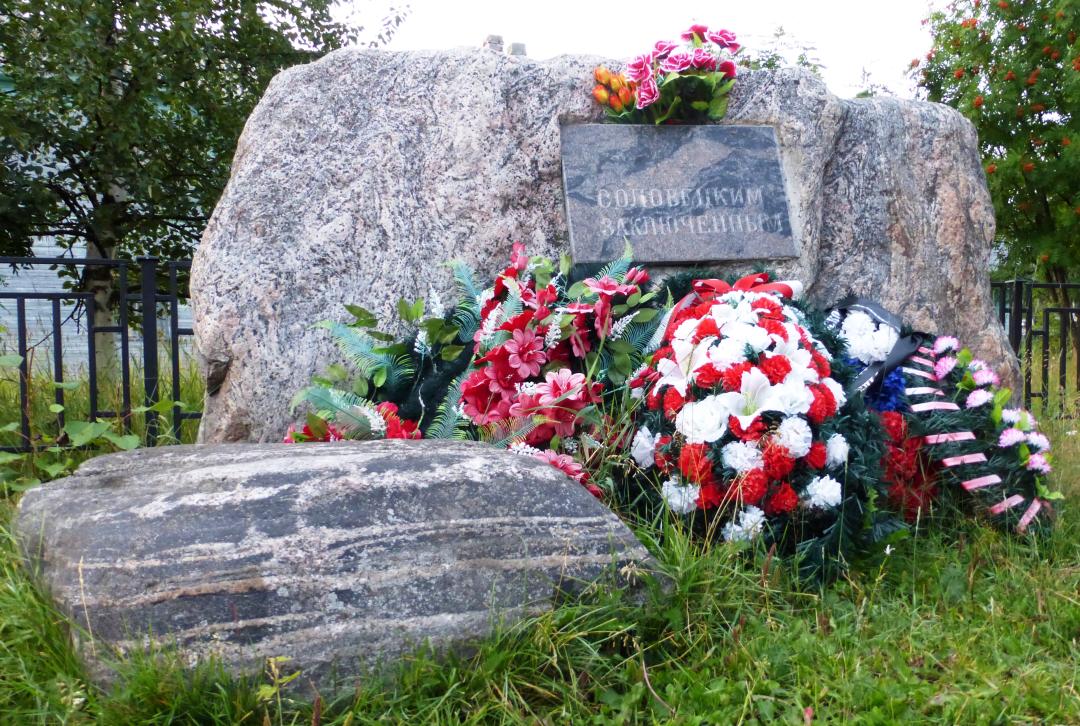
The Day of the Political Prisoner in the USSR was declared on October 30, 1990. On this day, a Solovetsky memorial stone was installed on Lubyanskaya Square in Moscow in memory of those who died during the years of political repression. The stone itself was brought from the Solovetsky Islands.
Sources:
https://ru.wikipedia.org/wiki/Соловецкий_лагерь_особого_назначения

