On September 15, 2009, the Soho Synagogue signed a 7-year lease for the first floor of the building at 43 Crosby Street, located between Spring Street and Broome Street. As a result, the former clothing store at this address in New York’s SoHo neighborhood became the world’s most fashionable SoHo Synagogue. The goal of its founders, Rabbi Dovi Scheiner and his wife Etzi, was to create an Orthodox Jewish community for modern Jews living in the area who work in design, art, and architecture.
The synagogue building was designed by New York resident and Israeli-born architect and designer Dror Benshetrit, who previously worked with the Gucci retail chain. He transformed the space into a luxurious synagogue to serve the growing Jewish "hipster" community. The synagogue’s storefront is draped with white strips of varying lengths, concealing worshippers from passersby. This barcode-like curtain references modern culture while also resembling the shawls worn by Jewish men, reminding visitors of faith, as does everything in the synagogue. Upon entering, visitors pass through a long foyer with a wall installation made of blue bricks displaying the names of donors. Lines on the ceiling lead into the prayer room.
Striving to transform the synagogue into a comfortable and pleasant environment, the designer employed double meanings throughout the space. Located in a former fashion boutique, the prayer house preserved many original elements, including the brick walls and the store’s exterior facade.
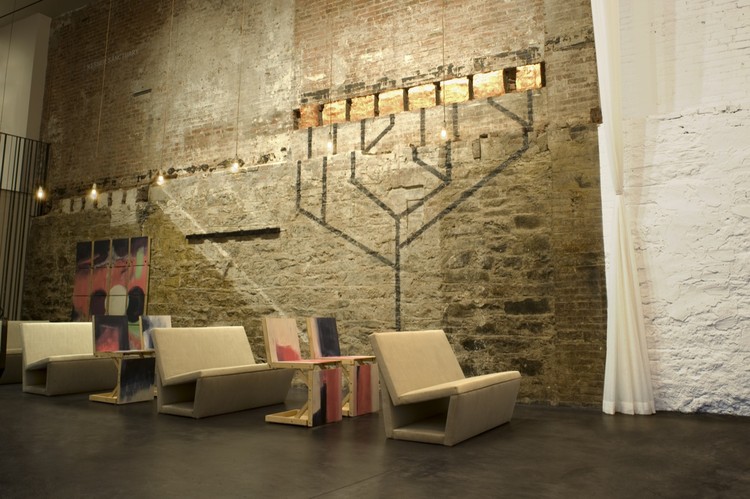
Guests ascend a steel and glass staircase leading to the lower sanctuary. Pipes are left exposed to emphasize the characteristic brick walls, while artworks consist of a series of panels that can be removed and stacked on chairs or coffee tables as needed. The prayer benches are comfortable beige sofas with low seats, contrasting with the industrial atmosphere of the space.
A mural depicting a menorah decorates one wall; it was made from seven aligned brick squares that Benshetrit discovered at the base of the wall during renovations.
“The intention was to embrace and integrate the history and nature of the architectural shell in which the religious space was to be housed,” says Benshetrit.
To reach the prayer room, located in the basement, one must descend a rough metal staircase. The brick walls of the room are left in their original state, and the bricks that stand out in color and texture are connected by a wall pattern resembling a menorah.
At the very end of the hall, in a cylindrical niche, rests a Torah scroll wrapped in fabric chosen and draped by fashion designer Yigal Azrouel. The niche is opened and closed by two shutters—circles with inscribed triangles—that, when closed, form the Star of David.
Sources:
https://www.buro247.ru/news/culture/1205.html
https://frameweb.com/article/facade/soho-synagogue
https://www.studiodror.com/for/soho-synagogue/