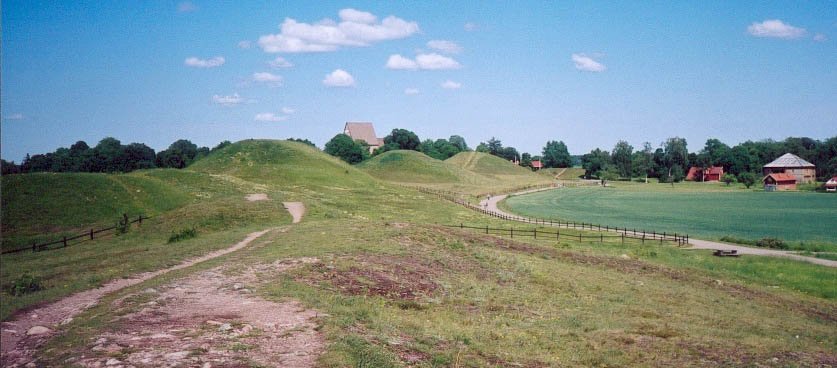

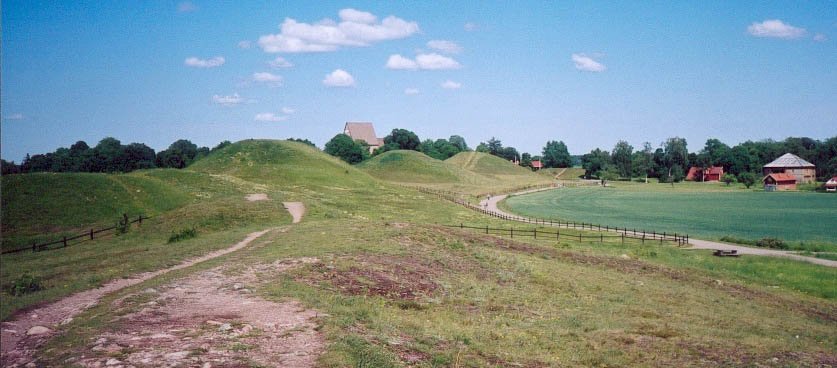
The Gamla Uppsala archaeological area is the collective term for the monumental mounds, gravefields, and other relics found at Gamla Uppsala. This site has been excavated in stages since the 17th century, with significant work occurring during the 19th century and the 2010s. The three largest mounds are known as the Kungshögarna. Historically, these have been associated with the legendary kings Adils, Aun, and Egil mentioned in the Ynglingatal, though they are now primarily referred to by their geographic positions: Västhögen, Mitthögen, and Östhögen.
Two of these mounds have been excavated in the past. The excavation of Västhögen in 1874 revealed remarkably exclusive finds from the Vendel period, between the years 550 and 625 AD. Notable items from this excavation include a small gold filigree mask that likely once adorned a gold necklace.
Further exploration of the area has revealed a large number of pit houses east and southeast of Tingshögen, a low, flat mound nearby. The discovery of over 30 pit houses is a significant find, as such a large collection has not been previously encountered. These structures show signs of crafts such as weaving and metalworking, supporting the theory of Gamla Uppsala as an ancient power center. Additionally, a large row of post holes, which may mark a monumental road or a boundary, was identified near the mounds, with some areas showing evidence of hearths and lights.
Sources: Wikipedia, OpenStreetMap, Wikidata, Wikimedia Commons



Written by Nik Frost
Discuss this with the author and others
No comments yet. Be the first to start the conversation.