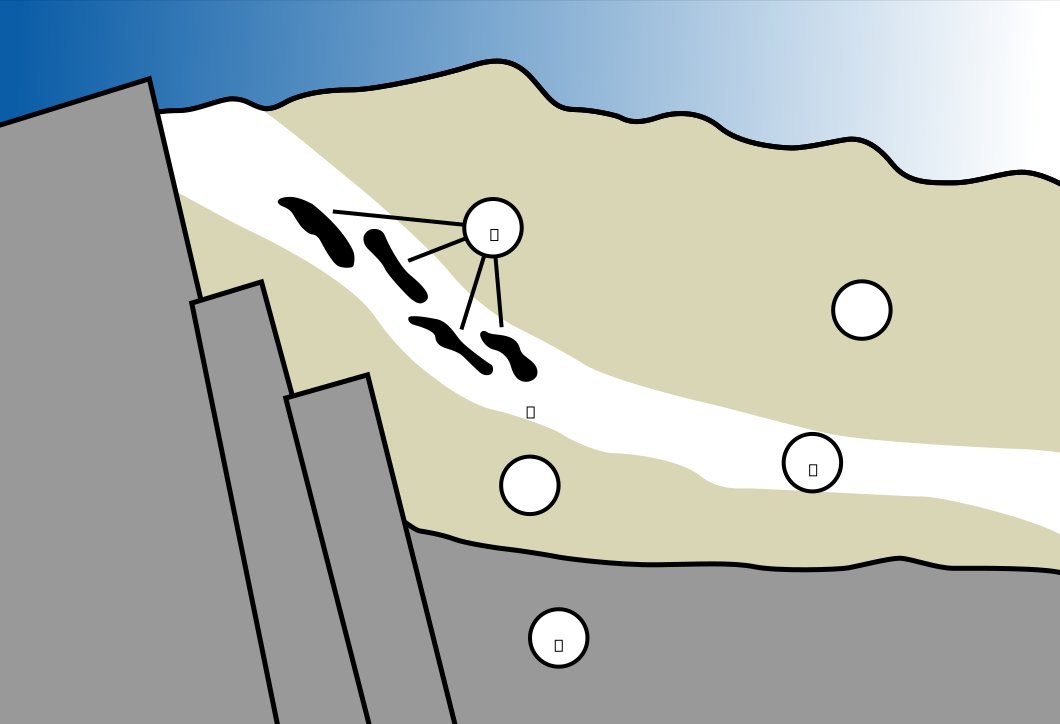

In the Oklo region of Gabon, researchers discovered a natural nuclear fission reactor where self-sustaining nuclear chain reactions occurred through natural geological processes. These reactions are thought to have taken place approximately 1.7 billion years ago, during the Statherian period of the Paleoproterozoic. This was a time when life on Earth consisted largely of sea-bound algae and the first eukaryotes, living under a 2% oxygen atmosphere.
The presence of oxygen was pivotal for the assembly of the reactor. Because uranium dissolves in water only in the presence of oxygen, the increasing oxygen content in the Earth's atmosphere during the aging of the planet may have allowed uranium to be dissolved and transported with groundwater. This allowed a high enough concentration to accumulate to form rich uranium ore bodies, as these concentrations probably could not have taken place in a non-aerobic environment.
The existence of the reactors was confirmed in 1972 by researchers from the French Atomic Energy Commission. They detected sharp depletions of fissile 235U in gaseous uranium hexafluoride made from Gabonese ore. Analysis of isotope ratios of uranium and fission products confirmed that the ore had operated as a natural fission reactor in the distant geological past. Fission in the ore at Oklo continued off and on for a few hundred thousand years and probably never exceeded 100 kW of thermal power.
Sources: Wikipedia, OpenStreetMap, Wikidata, Wikimedia Commons

Written by Mutabor
Discuss this with the author and others
No comments yet. Be the first to start the conversation.