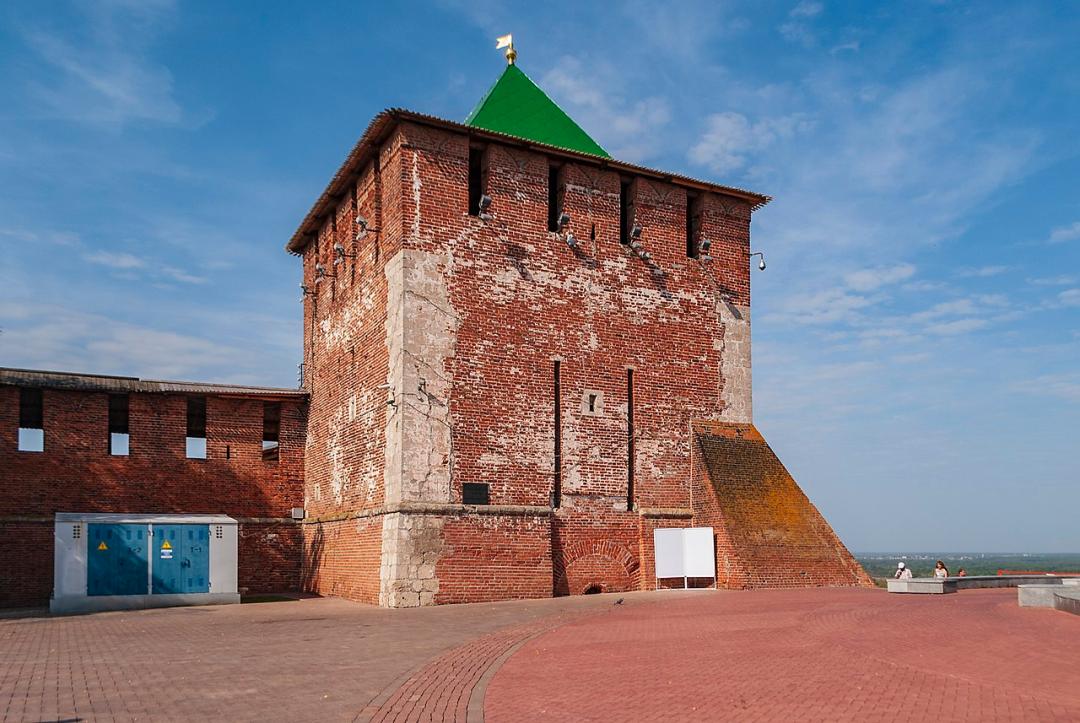
Koromyslova Tower — a round tower in the upper part between the Nikolskaya and Taynitskaya towers

Kremlin, 12A, Nizhny Novgorod, Nizhny Novgorod Region, Russia, 603082

Koromyslova Tower is a round tower of the Nizhny Novgorod Kremlin, located in the upper part between the Nikolskaya and Taynitskaya towers. If you view the structure from the opposite side of the Zelensky Descent, you can notice that the tower, together with the adjoining curtain walls, resembles the shape of a woman carrying a yoke.

Koromyslova Tower is a round tower of the Nizhny Novgorod Kremlin, located in the upper part between the Nikolskaya and Taynitskaya towers. If you look at the structure from the opposite side of the Zelensky Descent, you can notice that the tower together with the adjoining curtain walls resembles the shape of a woman with a yoke.

The distinctive feature of the tower is that it is entirely made of white stone, including the interior rooms. In terms of preservation of its original appearance, Koromyslova is the best among all the round towers of the Nizhny Novgorod Kremlin.

Like all towers of the Nizhny Novgorod Kremlin, Koromyslova has four combat tiers. The ground-level fire (the lowest tier), now buried under soil, is equipped with loopholes located 30-40 centimeters above ground level, allowing for direct fire to "clear the moat" of enemies. The two middle combat tiers have firing chambers where small-caliber hand cannons were placed. For example, in 1622 and 1663, one copper hand cannon on wheels was installed on Koromyslova Tower. The upper tier housed a fighting platform with embrasures and battlements. Additional combat chambers were arranged within the thickness of the fortress walls adjoining the tower. The loopholes are arranged not one above another but in a fan-shaped order, which reduces the "dead" (unreachable) space — the area adjacent to the tower inaccessible to the fortress defenders' fire. Two loopholes were used for firing along the curtain walls, and one combat chamber facing the "field" was intended for flanking the enemy approaching the Kremlin. Koromyslova Tower has two entrances: the lower one is arranged within the wall thickness to the left of the tower, and the upper one leads from the fighting platform.


The curtain wall stretching between Koromyslova and Taynitskaya towers is the longest in the Kremlin (205 meters). This is explained by the fact that the steep ravine was extremely inconvenient for the attacking enemy, and the builders only reinforced the slopes with fortress walls. In the past, the steep ravine began directly at the foundations of the Kremlin wall; it was landscaped in the 1830s and turned into a fairly wide park. The lower part of the curtain wall and the tower up to the height of the belt semi-oval is made of white limestone to increase the citadel's strength. The rest of the walls, as in the entire Kremlin, are built of dark brown brick.

In the 1700s, the tower tilted due to soil erosion in front of it. The danger of collapse was eliminated in the mid-19th century when city authorities arranged the Zelensky Descent and reinforced the ravine slope with soil. Until 1886, an archive was housed within the walls of the ancient structure. During the 1965 restoration, the upper tier floors and the tent roof of Koromyslova Tower were restored.

There is a notable legend associated with the tower's name. In 1520, the Astrakhan Tatars led by Said Giray besieged the city. The legend tells: "An innumerable hostile force besieged Nizhny Novgorod. Day after day, the defenders repelled the enemy's heavy assaults, and their forces began to dwindle. The city was running out of food supplies, and most importantly — water was scarce. The defenders began to think that they would have to surrender to the mercy of the victor. Among the besieged was a brave girl. She volunteered to bring water from the Pochayna River. Early in the morning, under the cover of fog, she was lowered from the wall. Carefully, she passed the Tatar patrols, descended to the Pochayna, drank herself, filled the buckets with water, and began to climb the steep hill with them. Friendly hands were already close, ready to catch her, when a Tatar patrol appeared. The enemy raised the alarm. A fierce fight broke out between the Tatars and the girl, who defended herself with her yoke. The girl killed several Tatars with it but was herself killed. The girl's bravery confused the enemies. They reasoned: 'If such brave women are in this fortress, and one of them without weapons killed several of our warriors, then what must the men be like?' The siege was lifted. The dead girl was buried with honors under the tower, with the buckets and the yoke laid with her. Since then, that tower has been called Koromyslova."

The most well-known version of the legend is summarized as follows: "In Nizhny Novgorod, masons began building the Kremlin. The next morning, they came and saw that everything they had built had collapsed. The masons were surprised, shook their heads, but continued working. The next day, they again saw everything collapsed. The masons decided to ask the elders for advice. The elders said: for the Kremlin to be strong, durable, and not taken by enemy forces, it must be built on the blood of the first living being to approach the construction site. Near the place where the Kremlin was being built lived a townsman. He had a young wife — the beautiful Alyona, who was expecting a child. That morning, Alyona went early to fetch water from the Pochayna River. She took buckets and a yoke, descended to the river, filled the buckets, and began climbing the steep hill. Alyona saw that people were standing near the Kremlin construction site waiting for something. She approached the builders. The gray-bearded boyar waved his hand. They seized Alyona and walled her alive under the tower's foundation. Along with her, they placed buckets and a yoke. Since then, the tower has been called Koromyslova. Alyona's husband, learning of his wife's terrible death, committed suicide — he threw himself into the Volga." Another Nizhny Novgorod legend says that the builders supposedly pitied the girl and instead buried a dragonfly ("the insect yoke") to observe the ancient custom.

Similar legends are common not only in the Nizhny Novgorod region but throughout Europe. In honor of the legend of the brave Alyona, who killed Tatars with a yoke, a stone monument was erected near the tower.

Sources:

https://ru.wikipedia.org/wiki/Koromyslova_Tower

http://www.unn.runnet.ru/rus/volgovyt/nizhobl/nizhnov/kreml/korom.htm

Follow us on social media

More stories from Nizhny Novgorod: Kremlin

The White Tower is a round tower located in the lower mountain area between the Ivanovskaya and Zachatyevskaya towers.

Kremlin, 2V, Nizhny Novgorod, Nizhny Novgorod Region, Russia, 603001

The White Tower is a round tower of the Nizhny Novgorod Kremlin, located in the lower part between the Ivanovskaya and Zachatyevskaya towers, opposite the turn of the Kremlin descent. It is the only surviving round tower in the lower part of the Nizhny Novgorod Kremlin and dates back to the 16th century. It was rebuilt in 1620. The tower received its modern name in the 19th century due to the preserved white stone cladding of the lower part of the outer facade. However, there is another reason for its name. It was built in the 16th century on monastery lands. At that time, these lands were called "white" in contrast to the peasant "black" lands. While the latter were taxed, the "white" lands were completely exempt from taxes.

Borisoglebskaya Tower — a round tower located between the Zachatyevskaya and Georgievskaya towers.

Kremlin, 4B, Nizhny Novgorod, Nizhny Novgorod Region, Russia, 603001

Borisoglebskaya Tower is a tower of the Nizhny Novgorod Kremlin, built in the 1970s on the site of the tower of the same name, which was dismantled 200 years earlier. It is located between the Zachatyevskaya and Georgievskaya towers.

The Georgievskaya Tower (Yegoryevskaya Tower) is the easternmost tower of the Nizhny Novgorod Kremlin.

Kremlin, 4B, Nizhny Novgorod, Nizhny Novgorod Region, Russia, 603001

The Georgievskaya Tower (Yegoryevskaya Tower) is the easternmost tower of the Nizhny Novgorod Kremlin. It is located between the Borisoglebskaya and Porokhovaya towers, on the edge of the Volga riverbank, near the Valery Chkalov monument at the beginning of the Chkalov Staircase. In the 1220s, there was a traveler's house of Georgiy ("Georgievsky Terem") here, on the edge of the slope.

Dmitrievskaya (Dmitrovskaya) Tower — a gate tower facing Minin and Pozharsky Square

Kremlin, 6A, Nizhny Novgorod, Nizhny Novgorod Region, Russia, 603005

Dmitrievskaya (Dmitrovskaya) Tower is a gate tower of the Nizhny Novgorod Kremlin, opening onto Minin and Pozharsky Square. It is considered the main gate of the fortress and is an unofficial symbol of Nizhny Novgorod. Its current appearance in the Russian style was acquired in 1895.

Zachatevskaya (Zachatsskaya) Tower — a rectangular gate tower of the Nizhny Novgorod Kremlin

Kremlin, 2g, Nizhny Novgorod, Nizhny Novgorod Region, Russia, 603001

Zachatyevskaya (Zachatskaya) Tower is a rectangular gate tower of the Nizhny Novgorod Kremlin, located in the foothill section between the Belaya and Borisoglebskaya towers. It is named after the nearby Zachatyevsky Monastery, which was situated outside the Kremlin walls. In 17th-century documents, it is also referred to as the "White" tower, apparently due to the white stone cladding of its lower part. In some 18th-century documents, it is mentioned as the Zhivonosovskaya Tower (named after the church and monastery dedicated to the Life-Giving Spring). It was destroyed by a landslide and subsequently dismantled for building materials used in the repair of the Kremlin in 1785–1787 by order of the Nizhny Novgorod governor Rebinder.

The Ivanovskaya Tower is the oldest and largest four-tiered gate tower of the Nizhny Novgorod Kremlin.

Kremlin, 2B, Nizhny Novgorod, Nizhny Novgorod Region, Russia, 603001

The Ivanovskaya Tower is the largest four-tiered gate tower of the Nizhny Novgorod Kremlin. It is located in the lower part of the hill between the Chasovaya and Belaya towers. The lower section of the Ivanovsky Descent, formerly called Bolshaya Mostovaya Street, passes through it. It is named after the Church of John the Baptist, located at its approaches, which has stood on the Nizhneposadsky Market since the 15th century. Another version states that the tower's name commemorates its founder — Tsar Ivan III, who began rebuilding the Nizhny Novgorod Kremlin in stone in 1500. The tower acquired its modern appearance only in the 1950s, when restorers doubled its height.

The Storeroom Tower is a round tower located in the upper part between the Dmitrievskaya and Nikolskaya towers.

territory Kremlin, building 4, office 5, Nizhny Novgorod, Nizhny Novgorod region, Russia, 603005

The Storage Tower is a round tower of the Nizhny Novgorod Kremlin. It is located in the upper part between the Dmitrievskaya and Nikolskaya towers, near the beginning of the Zelensky Descent. The tower's current name is due to its continuous use as a warehouse for military and civilian goods.

The Nikolskaya Tower is a passage tower located in the upper part between the Kladovaya and Koromyslovaya towers.

Kremlin, 11A, Nizhny Novgorod, Nizhny Novgorod Region, Russia, 603005

The Nikolskaya Tower is a passage tower of the Nizhny Novgorod Kremlin. It is located in the upper part between the Kladovaya and Koromyslovaya towers. A pedestrian bridge, built over the Zelensky descent in 1982 on the site of an old wooden bridge constructed "in cages," adjoins the tower closely.

The Powder Tower is a round tower located in the upper part between the Dmitrievskaya and Georgievskaya towers.

Kremlin, 6B, Nizhny Novgorod, Nizhny Novgorod Region, Russia, 603005

The Powder Tower is a round tower of the Nizhny Novgorod Kremlin. It is located in the upper part between the Dmitrievskaya and Georgievskaya towers, opposite the former building of the Nizhny Novgorod Seminary on Minin and Pozharsky Square.

The Northern Tower is a round tower located in the upper part between the Taynitskaya and Chasovaya towers.

Kremlin, 1b, Nizhny Novgorod, Nizhny Novgorod Region, Russia, 603082

The Northern Tower is a round tower of the Nizhny Novgorod Kremlin. It is located in the upper part between the Taynitskaya and Chasovaya towers. Contrary to its name, the tower is not the northernmost structure in the Kremlin, but the fortress wall extending from the Taynitskaya Tower towards the Northern Tower aligns with the direction of north.

Taynitskaya Tower — a round tower in the upper part between the Koromyslova and Northern towers

Kremlin, 1B, Nizhny Novgorod, Nizhny Novgorod Region, Russia, 603082

Taynitskaya Tower is a round tower of the Nizhny Novgorod Kremlin. It is located in the upper part between the Koromyslovaya and Severnaya towers. Unlike the other round towers (except for the Chasovaya), it features a watchtower on the spire, similar to the Chasovaya and Nikolskaya towers.

The Clock Tower - a tower on the top of the Kremlin hill

Kremlin, 1g, Nizhny Novgorod, Nizhny Novgorod Region, Russia, 603082

The Clock Tower is a tower of the Nizhny Novgorod Kremlin, located at the top of the Kremlin hill on the bank slope of the Volga River between the Northern and Ivanov towers, at the very edge of the Kremlin hill. The section between the Clock Tower and the Northern Tower is the shortest in the Kremlin: its length is only 39 meters.

Nizhny Novgorod Kremlin

territory Kremlin, building 4, office 5, Nizhny Novgorod, Nizhny Novgorod region, Russia, 603005

The Nizhny Novgorod Kremlin is a majestic medieval fortress, one of the best preserved in Russia. It is the second largest after the Moscow Kremlin, a fortress in the historic center of Nizhny Novgorod and its oldest part. It is located on the high right bank, at the confluence of the Volga and Oka rivers.