

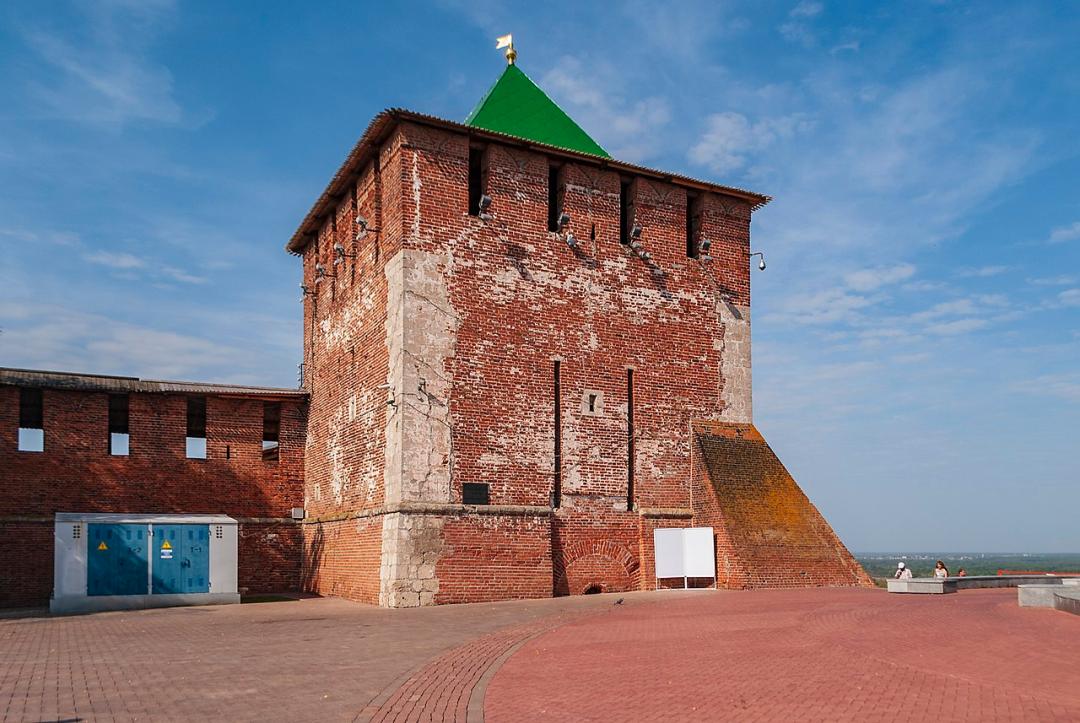
Dmitrievskaya (Dmitrovskaya) Tower — a gate tower of the Nizhny Novgorod Kremlin, facing Minin and Pozharsky Square. It is considered the main gate of the fortress and is an unofficial symbol of Nizhny Novgorod. Its current appearance in the Russian style was acquired in 1895.
From the first half of the 16th century, old fortresses in Russia were being rebuilt. The new Nizhny Novgorod Kremlin was founded in 1500, and its accelerated construction took place from 1508–1509. Presumably, construction was fully completed only after 1516.
The Kremlin had 13 towers, the central one being Dmitrievskaya. It got its name either after Prince Dmitry Konstantinovich or, according to another version, from the church dedicated to the Holy Great Martyr Demetrius of Thessaloniki, built by Prince Dmitry in front of the tower in 1378. The first known mention of the Dmitrovskaya Tower appears in the 1617 Chronograph:
“…in the year 7018 [1509], on September 1, they laid the stone Dmitrievskaya shooting tower of Nizhny Novgorod.”
Later, in the Nizhny Novgorod chronicles, this report was combined with another about the arrival of master Peter Fryazin to the city to dig a moat for the stone wall. As a result, it was concluded that Peter Fryazin attached a stone wall seven versts long to the already standing 14th-century tower. This length corresponds to the outer fortification of Nizhny Novgorod — the Bolshoy Ostrog.
The next mention of the tower was in July 1540: “There was a great thunderstorm in Nizhny Novgorod… because of this, the roof of the Dmitrievskaya gates burned down.” Resembling other square gate towers of the Kremlin, Dmitrovskaya Tower, it is assumed, had an additional superstructure like the Ivanovskaya Tower. This is indicated by the 1732 inventory: “…at the Dmitrievskaya gates… three walls of the upper tower were broken off.”

Therefore, the tower had at least 4 and at most 5–6 combat tiers. It is possible that above its wooden tent roof there was also a watchtower. Dmitrievskaya Tower was the only one in the Kremlin with an additional stone fortification: an arched bridge with a forebridge fortification — a detached tower (see below). A dry moat 2.5 to 4 meters deep and about 25–30 meters wide existed both in front of the tower and surrounding the detached tower. It is assumed that the moat near Dmitrievskaya Tower may have had separate deepened sections filled with groundwater or simply accumulated water, as it was the lowest part of the entire moat (see main article).
The lowest tier of the tower was completely submerged in the dry moat, and two loopholes on this level, located closer to the walls (curtains), together with loopholes in additional side casemates of the curtains, formed the lower or base fire. The ceiling of this tier in Dmitrievskaya Tower is a cylindrical vault.
The second tier is the gate or passage. The floor level of the passage corresponded to the ground surface inside the Kremlin and in front of the moat. At this level was also the passage of the bridge and the detached tower. The tower’s passage could be closed by three leaf gates, two portcullises, and, presumably, a drawbridge. However, several facts suggest that there might not have been a drawbridge. For example, the stone bridge adjoins the tower directly, no evidence of a drawbridge was found on the facade, and the facade itself is designed for leaf gates, which may not be a result of reconstruction but preserved from antiquity. In this case, the tower would have four leaf gates. But the description mentions only two gates, partially sheathed with boiler (sheet) iron. This means either some gates were broken by that time or were never hung at all. The side walls of the passage had two combat fireplaces with loopholes each: one in the passage chamber and one in isolated side casemates. The passage itself was under fire from internal corner loopholes directed from the same isolated casemates. All sections of the passage on this tier were probably also covered with brick cylindrical vaults and circular arches.
The third tier of the tower housed mechanisms for raising the portcullises and the drawbridge (if it existed). From this level, there was access to the walls. The ceiling between the third and fourth tiers was wooden. The fourth tier, known for certain, was a battlement with merlons. In ancient times, the combat windows between the merlons were closed with wooden shutters with viewing slits. Small combat windows were located in some of the merlons themselves. Wooden shutters were also present on all loopholes of the fireplaces in the Kremlin. The fireplaces were also equipped with wooden beams to absorb the recoil of the arquebus and with ventilation to remove gunpowder gases.

The internal rooms of the tower were connected by spiral and straight stairs built into the walls, located in the most protected places from enemy fire. Access to the side casemates and further to the third tier was possible from the inner facade side through two entrances located on both sides of the passage. From the right entrance, one could also descend to the first tier located under the passage. Another entrance was in the wall of the passage, in its inner vestibule; it led only to one of the two isolated casemates that covered the passage and the area along the curtain wall. The combat walkway of the curtain also had a passage to the third tier of the tower. One could also climb the wall via a stone staircase on arches located to the left of the tower in a special annex[b].
Same, current condition. Between the tower and the wall, a fragment of a porch demolished in the 1950s is visible.
The detached tower is the second forebridge fortification in Russia after the Kutafya Tower (1516) of the Moscow Kremlin. It had no personal name. Later, in 1697, it was called the “exit wall” and “stone exit.” The tower had a pentagonal plan (to eliminate dead zones in front of it) and only two tiers without ceilings or a roof. The lower tier had a passage and four fireplaces with loopholes, and above, along the battlement, was a fighting gallery or combat walkway. From the bridge passage side, the tower had no gates. Outside, two passages led into the tower, located in both side walls and directed in opposite directions. This was designed to avoid the danger of direct fire on the bridge and Dmitrievskaya Tower gates. The western passage was closed by two gates: “lifted on rings,” i.e., a drawbridge, and “shutter” gates. The opposite gates, according to reports, were not closed but “cut off and filled with rubble (gravel).”
There are different opinions about the arrangement of the lower part of the detached tower. It either stood on an island surrounded by a moat (and then was exactly two tiers high) or on the bottom of the moat like the other towers (then it should have a massive 4-meter-high plinth under the passage). The stone bridge, 13 sazhen (about 23 meters) long, had three arches resting on stone pillars. On the sides were battlemented parapets, each with seven combat windows.
Dmitrievskaya Tower also had an additional wood-earth fortification — an obrub or, alternatively, a rakat. These began to be built in the 16th–17th centuries as log structures up to 4 meters high, filled with earth and rubble, to accommodate powerful artillery. It is unknown but more likely that only in the 17th century the obrub blocked one of the gates of the detached tower. There is also mention of a “new rakat” constructed or renovated between 1662 and 1697, which Agafonov places near the northeastern side of Dmitrievskaya Tower, although there are no additional exits there.
As the defense center in the upper part of the Kremlin, Dmitrievskaya Tower and the adjacent curtains had 70% of the Kremlin’s entire artillery. In 1621–1622, there were 5 bronze arquebuses (including one “Kazan”) firing cannonballs weighing from 0.6 to 1.2 kilograms. They were served by 8 gunners. From 1621 to 1629, each cannon and arquebus had its own gunner.
In 1663, the tower was armed with 63 fortress rifles and 7 arquebuses, the largest being a “bronze smoothbore… mounted on a wheeled carriage” capable of firing 1.4-kilogram cannonballs.
By 1697, Nizhny Novgorod had lost its military significance. That year, 9 arquebuses and two tyufyaks — guns firing shot — stood on the “new rakat by Dmitrievskaya gates.” Due to the tower’s dilapidation, some artillery was moved to the curtains. Only two gunners served the tower.
In 1704, the entire Kremlin had three gunners, and in 1705 all usable armaments were sent to Kazan.
This period marked significant losses for the tower. From 1782, its destruction and reconstruction began. First, in 1782–1783, the bridge and detached shooting tower were dismantled. Between 1785 and 1790, a complete Kremlin reconstruction took place. During this time, the upper part of the tower was thoroughly altered. The original design of the front vestibule was distorted. Apparently, the cylindrical vault over the main passage chamber was replaced with a more complex cross vault. The wall thickness above the passage was reduced by more than half. Rectangular windows replaced the loopholes. The merlons on all curtains were cut down by two-thirds of their height. Additionally, alterations in the lower tiers disrupted the communication system between casemates, and the staircase leading to the wall inside the Kremlin near the tower was dismantled. In 1815, additional breach gates appeared to the right of the tower, closer to the Arsenal (now nonexistent).
Between 1834 and 1837, the dry moat was filled in, lowering the height of Dmitrievskaya Tower by almost 6 meters. The lowest tier of the tower and remains of the forebridge fortification ended up underground. At that time, the tower looked like an ordinary house. The windows on the facade had wooden frames with casings. There was a low sloping iron roof with a dormer window and a chimney on the inner slope. Two downspouts at the outer corners of the building reached only to a decorative half-pillar for safety. Above the passage, in a kiot with a protruding canopy, hung an icon. There was also a kiot on the inner facade. Two lanterns were fixed near the gate in the wall, and the corners of the gate were protected by guards. The tower was whitewashed, and the roof was painted red (as was the entire Kremlin).
In the late 18th and early 19th centuries, the tower housed regimental records, and at the very top was a garrison school for soldiers’ children. At that time, the entire fortress was in a deplorable state, as all its brickwork had deteriorated. In 1857, the building was converted into the provincial government archive. The archive remained there until 1867. Later, the tower stood empty for a long time, increasingly falling into ruin.
In 1894, a new reconstruction of the tower began. The project author and reconstruction leader was architect Nikolai Sultanov, who was tasked with converting it into an art-historical museum. For this, the tower’s leading position in the Kremlin had to be restored. Sultanov based his design on the Pokrovskaya Tower of the Novgorod Detinets or the Kolymazhnye Gates of the Moscow Kremlin. Dmitrievskaya Tower was greatly transformed again. It became taller, and the floor of the passage, which was empty and deteriorating, was reinforced. Above the passage, a single room was created at the height of the former two tiers, illuminated by two rows of large windows that replaced the original loopholes in fireplaces and battlements, as well as a glass lantern on the roof. The windows that replaced the battlement combat openings were designed as overhanging machicolations. The battlement of the fifth tier was imitated by the surrounding roof parapet, styled with Western European merlons, which are purely decorative since their lower openings are at the sloping roof level and serve as drains. The glass lantern on the open upper platform was intended to be hidden behind the parapet. The pyramidal part of the roof above the lantern was covered with metal scales and ribs made of pipes decorated with discs. On the front and rear sides of the roof were pairs of dormer windows. The top was crowned with a double-headed eagle in the style of the state emblem of Ivan III, under whose reign the stone Kremlin construction began. An icon of the Holy Great Martyr Demetrius of Thessaloniki was installed in the kiot above the entrance. On the inner side, two chimneys rose behind the parapet at the corners.
Entrance to the museum was through an arched porch protruding from the Kremlin wall to the left of the tower. From it, a staircase ascended through a pierced opening in the wall, connecting to glazed “seni” — a gallery arranged behind the tower. The ascent and seni had an iron roof. There was no exit from the seni to the curtains — only windows at both ends. The section of the staircase running along the wall was topped with small decorative battlements. A similar row of battlements appeared above the breach gates near the Arsenal. The museum room occupied two floors without a ceiling between them. However, there was a gallery with railings running along the walls, accessible by a similar ladder. This design allowed exhibition lighting by daylight from two rows of windows and the ceiling lantern.
Access to the tower’s upper platform is only possible via a system of stairs on the inner facade. First, one must climb a ladder (either portable or fixed) to the wall to the left of the tower, then another ladder to the roof of the seni, and then through a “fire” ladder into one of the parapet’s loopholes. In the same wall, the niche closest to the tower was closed off by a wall. The resulting room, still existing, has its own entrance and two vaulted windows. A metal chimney pipe passes through its vault. Instead of the old right entrance to the tower, a new one was made through a bricked-up arch in the wall on the right side, partially occupied by the museum access structure. This entrance connected to passages and casemates (now nonexistent, as the arch was restored). The former entrance was then bricked up into a rectangular window. The ancient entrance, as well as the vertical window to the left and the larger vaulted window to the right, were occasionally bricked up and reopened but are still in use today.
The museum opened in 1896. Emperor Nicholas II and his wife attended the grand opening. Opposite Dmitrievskaya Tower, on Annunciation Square, a large celebration was held in 1913 for the 300th anniversary of the Romanov family. A military parade took place near the Kremlin walls, and a prayer service was held in the Transfiguration Cathedral. The following year, 1914, World War I began, and military units were sent to the front. The tower functioned as a museum at that time.
During Soviet times, the symbol of autocracy — the double-headed eagle — was removed from the tower’s spire and replaced with the USSR flag, which was raised on ceremonial occasions during holidays and parades. The Kremlin was repainted red.
The museum remained in Dmitrievskaya Tower until 1919. Then exhibits and paintings were removed and distributed elsewhere. Some were destroyed as relics of the past era. After that, the tower housed a decoration workshop for the Opera and Ballet Theater for a long time.
Later, the tower’s existence was threatened — in 1935–1937, plans were made to demolish it during the expansion of Soviet Square. According to the project by the Leningrad institute “Giprogor,” the expanded square was to pass through the Kremlin territory to the House of Soviets. The Nizhny Novgorod Kremlin was perceived by the authorities as a “monument to greedy feudalism and tsarist autocracy,” so demolishing “obstructive” walls and the “altered” tower was unquestioned. However, this project was never realized due to the outbreak of war. Unlike the Taynitskaya, Northern, and Chasovaya towers, Dmitrievskaya was not involved in air defense.
In 1953, the tower was restored, and the porch with stairs was removed. Access to the upper room was arranged inside the Kremlin, on the site of the former city staircase. Wooden roof structures were replaced with metal ones, but in 1963 they had to be replaced again due to a large fire. Two years later, a gilded city emblem — a walking deer — was installed on the tower’s spire.
In the 1990s, the Dmitrievskaya Tower housed the “NKB-Progress” bank. It also financed the installation in 1993 of an icon of the founder of Nizhny Novgorod — Prince Yuri (George) Vsevolodovich — in the kiot above the gates. Souvenir shops were located in the tower’s passage, and its fireplaces were adapted as storage rooms equipped with doors. In the bricked-up left niche, the “Podkova” bar was located for a long time, and in the next glazed niche — a souvenir shop. In 2020, as part of the improvement of the Nizhny Novgorod Kremlin for the city’s 800th anniversary, the passage was cleared of trade points and storage. The bricked-up niche became the “Tourist Service Center of the Nizhny Novgorod Kremlin,” and the glazed one became a café.
Currently, a ceiling has been installed between the third and fourth tiers of the tower, housing the exhibition hall “Dmitrievskaya Tower,” where historical exhibitions from the Museum-Reserve’s collections are held. Visitors ascend to the museum via a staircase located on the site of the former city staircase, entering a glazed section of the combat walkway and then the seni. This entrance is also one of the starting points for the Kremlin wall tour.
In spring 2021, along with large-scale repair work throughout the Kremlin, work began on Dmitrievskaya Tower. The changes affected only the external appearance of the masonry and the repair of various structures; no reconstruction of the tower was planned.
There are two versions of the origin of the tower’s name:
The Lavrentievsky Chronicle reports that the fortress was erected by Grand Prince Dmitry Konstantinovich in 1372.
According to another version, the tower was named after the nearby Church of Saint Demetrius of Thessaloniki.
In front of the Dmitrievskaya gates was a detached shooting tower connected to the tower by a drawbridge. The shooting tower served as a forebridge fortification and had two tiers. The lower tier contained loopholes and a passage arch, while the upper tier was used as a combat platform.
In the 1660s, Dmitrievskaya Tower surpassed all others in firepower. Sixty-three fortress rifles and seven arquebuses allowed effective enemy bombardment.
Sources:
https://ru.wikipedia.org/wiki/Дмитриевская_башня




Written by Jermaine
Discuss this with the author and others
No comments yet. Be the first to start the conversation.