Napoleon Bonaparte had a truly imperial worldview and considered it wise to reconcile French society with the local Jewish community. Therefore, in 1808, he granted official status to the community, allowing them to build a temple. Thus, in 1822, a synagogue appeared on Notre-Dame-de-Nazareth Street. Thirty years later, it was rebuilt on the same site, despite all the efforts of James Rothschild to move the temple to the Marais district. Only during the time of Baron Haussmann did the Rothschild brothers manage to obtain permission to build a synagogue on Victory Street, as the mayor was on good terms with the Jewish community of Paris. Parisians often call it the Great Victory Synagogue after the street on which the temple is located. Moreover, part of the expenses for building the Victory Synagogue was covered by the municipality.

The project for the Great Synagogue was designed by Alfred Aldrophe, who also built the synagogue in Versailles. In 1867, the Rothschilds purchased two mansions in the Jewish district of Paris, on the site of which construction began. In 1874, the new temple was consecrated by Chief Rabbi Zadoc Kahn, a well-known defender of Admiral Alfred Dreyfus, a Knight of the Legion of Honor, who was unjustly accused of treason. And in 1875, the synagogue was opened to the public. The Great Synagogue of Paris is, as the name suggests, the largest synagogue in the capital. This synagogue has seen virtually all French leaders over more than a 150-year period; under its vaults, the marriage ceremonies of Captain Alfred Dreyfus and Léon Blum—the first Jew and socialist to head the French government—took place. During the Holocaust, collaborationists—the stormtroopers of the Vichy government—attempted several times to blow it up, but dozens of Parisian Jews were saved from raids in its vast underground casemates. The building itself was saved from destruction by the Paris municipality, which declared to the German occupation authorities that it was city property, not that of the Jewish community. During those years, it was turned into a warehouse. After the war, the synagogue underwent lengthy restoration. It was only in 1967 that it was reconsecrated.

Today, besides regular prayer services, it serves as the residence of the Chief Rabbi of France and a number of organizations of the country's Jewish community. Every year, memorial ceremonies are held here in remembrance of the deportation of French Jews to concentration camps, attended by the highest state officials, with television channels broadcasting the events across Europe. Besides its primary function, the Victory Synagogue is an architectural landmark of Paris, where tours are regularly conducted. Today, the Great Victory Synagogue is an active temple and the residence of the Chief Rabbi of Paris.
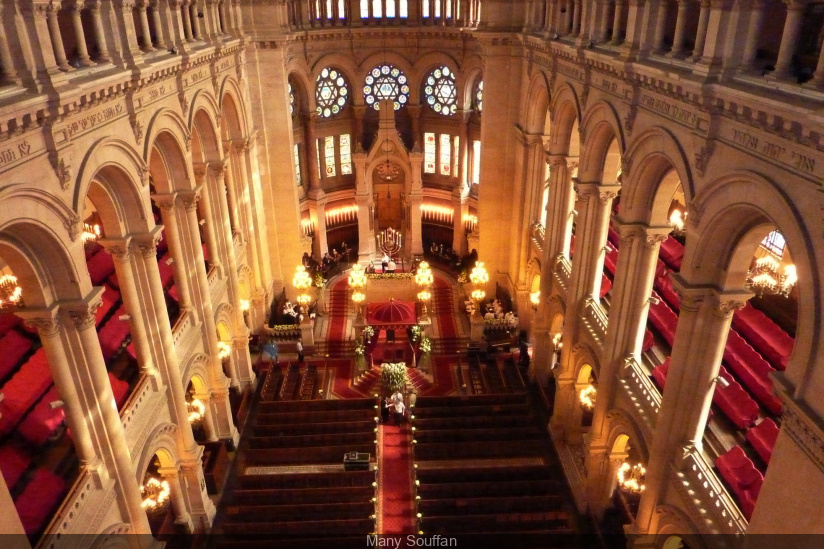
The impressive building of the Great Synagogue is constructed in the Romanesque style. However, the strict features of this style are very organically complemented by Byzantine ornamentation. Above the central entrance to the temple is an inscription in ancient Hebrew: "My house shall be called a house of prayer for all peoples." Along the edge of the semicircular rosette of the pediment is a verse from Genesis about the Gates of Heaven. The stained-glass windows of the temple depict the 12 tribes of Israel.
The synagogue building accommodates 2,500 people. Services in the main hall are conducted as in Germany, since most parishioners are from Alsace. In the small hall, prayers are held in the Spanish manner, and on the upper floor, Egyptian Jews gather. Besides prayer rooms, the synagogue is equipped with a banquet hall, a library, and classrooms for children.
Every year before the Jewish New Year, a ceremony in memory of the victims of deportation is held in the synagogue, which is broadcast on national television.
The synagogue building accommodates 2,500 people. Services in the main hall are conducted as in Germany, since most parishioners are from Alsace. In the small hall, prayers are held in the Spanish manner, and on the upper floor, Egyptian Jews gather. Besides prayer rooms, the synagogue is equipped with a banquet hall, a library, and classrooms for children.
Inside the synagogue, which has been listed as a historical monument since 1987, visitors will find stunning decor: a nave of impressive volume, red velvet, and magnificent stained-glass windows by Antoine Lusson, Eugène Oudiné, and Lefèvre, depicting the twelve tribes of Israel.
Sources:
https://frenchparis.ru/grande-synagogue-de-paris/
https://stmegi.com/posts/98135/sinagoga-pobedy/