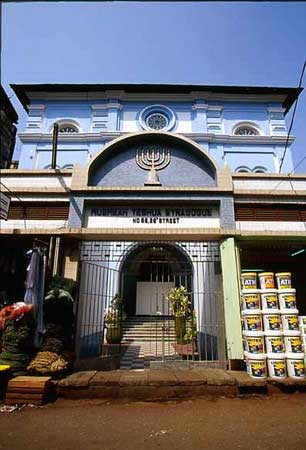

The Musmeah Yeshua Synagogue is the last remaining Jewish house of worship in downtown Yangon and the only synagogue in Burma. The synagogue stands between Indian paint shops and Muslim traders on a small street near the city center. A memorial plaque at the entrance states that the current stone building, constructed between 1893 and 1896, replaced an earlier smaller wooden structure built in 1854. It serves the few remaining Jews in the country, mostly descendants of Baghdadi Jews from Iraq.
The first synagogue was built in the 1850s for the growing number of Baghdadi Jews from the Middle East, as well as Bene Israel and Cochini Jews from India, who arrived during British rule in Burma. It was a wooden building in 1854. The land was granted by the British colonial government. The current building was completed in 1896. Today, the area is predominantly inhabited by Muslims.
At one time, the Musmeah Yeshua community had 126 Torah scrolls. The Jewish cemetery is located about six miles away and was established in the 19th century; it contains around 700 graves.
The second synagogue, Beth-El, opened in 1932, reflecting the growth of the Jewish population. The Jewish community worked as merchants and also cooperated with the British colonial government. In 1940, before the start of World War II, the Jewish community in Rangoon peaked at 2,500 people. About half of the community fled after the Japanese invasion in 1942, often undertaking a difficult overland march to India. This “forgotten march” cost tens of thousands of lives, mostly Indians. Beth-El closed after the war due to population decline.
What distinguishes Musmeah Yeshua from others is its striking architectural blend, harmoniously combining elements of Jewish and Burmese design. Approaching the synagogue, its facade immediately draws attention with a stunning combination of traditional Jewish motifs and intricate Burmese craftsmanship. Upon entering, visitors are greeted by the splendor of richly decorated chandeliers and elaborate woodwork, reflecting the subtle fusion of these diverse cultures.

The name Musmeah Yeshua carries deep meaning. “Musmeah” derives from the Burmese word “mesay,” meaning “peaceful,” while “Yeshua” is the Hebrew name Jesus. This unique nomenclature reflects not only the peaceful coexistence of different faiths in this part of Yangon but also the inclusive spirit embodied by this sacred space.
The synagogue’s historical significance goes beyond its architectural charm. During World War II, when Myanmar was occupied by Japanese forces, Musmeah Yeshua was under the protective wing of U Po Khin, the chief judge famed in George Orwell’s classic novel “Burmese Days.” His actions to safeguard the synagogue played a key role in its preservation even amid the turmoil of wartime.
The architectural design of the synagogue is a visual masterpiece. It brilliantly combines elements of both Jewish and Burmese architectural traditions, resulting in a facade that enchants all who visit. The synagogue’s exterior showcases a skillful blend of Jewish motifs and Burmese architectural craftsmanship. This harmonious interplay features intricate details of Jewish traditions seamlessly integrated with the aesthetic elements of Burmese architecture.
The synagogue is a testament to the craftsmanship and meticulous attention to detail used in its construction. Visitors are welcomed by magnificent arches, richly adorned carvings, and decorative motifs that embellish the facade, creating an atmosphere of reverence and admiration. Upon entering the synagogue, visitors are greeted by the dazzling glow of majestic chandeliers. These chandeliers are not merely light fixtures; they symbolize cultural fusion. Their intricate design reflects the shared heritage and mutual respect between the two cultural worlds they represent. The synagogue’s interior is adorned with stunningly intricate wood carvings. This woodwork testifies to the synergy of craftsmanship from both cultures. It is not only a testament to aesthetic beauty but also a tribute to the skill and dedication of those who contributed to its creation.
After Burma gained independence in 1948, the new government granted permission to expand the synagogue. Even more Burmese Jews left the country after the Burmese army seized power in 1962, as the government nationalized most businesses in the 1960s and 1970s. By the early 21st century, there were fewer than 50 Jews in Myanmar.
Restoration was completed in 2013, and other goals were achieved. On December 8, 2013, an interfaith event attended by Myanmar’s Minister at the President’s Office U Aung Min, U.S. Ambassador Derek Mitchell, Israeli Ambassador Hagai Moshe Behar, the Yangon Religious Council, and other guests celebrated the completion of the restoration and the synagogue’s transition to self-sufficiency. They named anthropologist Ruth Cherni, who wrote the history of the Jewish community in Rangoon, Laura Hudson from the Council, and Stuart Spencer, a member of the synagogue diaspora, as the three leaders of this project.
During Cyclone Nargis in May 2008, the synagogue lost its roof and suffered water damage. In 2015, the current Jewish population of Myanmar, including Yangon, was fewer than 19 people. The synagogue ranks among the city’s top ten attractions.
On June 6, 2016, the Yangon Heritage Trust and the Yangon regional government “awarded a commemorative blue heritage plaque to the only synagogue in Yangon” in memory of the Jewish community that lived in Yangon for many generations and in recognition of the various faiths still alive in the city today.
Sources:
https://en.wikipedia.org/wiki/Musmeah_Yeshua_Synagogue
https://www.yangongui.de/musmeah-yeshua-synagogue/
https://www.gomyanmartours.com/musmeah-yeshua-synagogue-100-years/