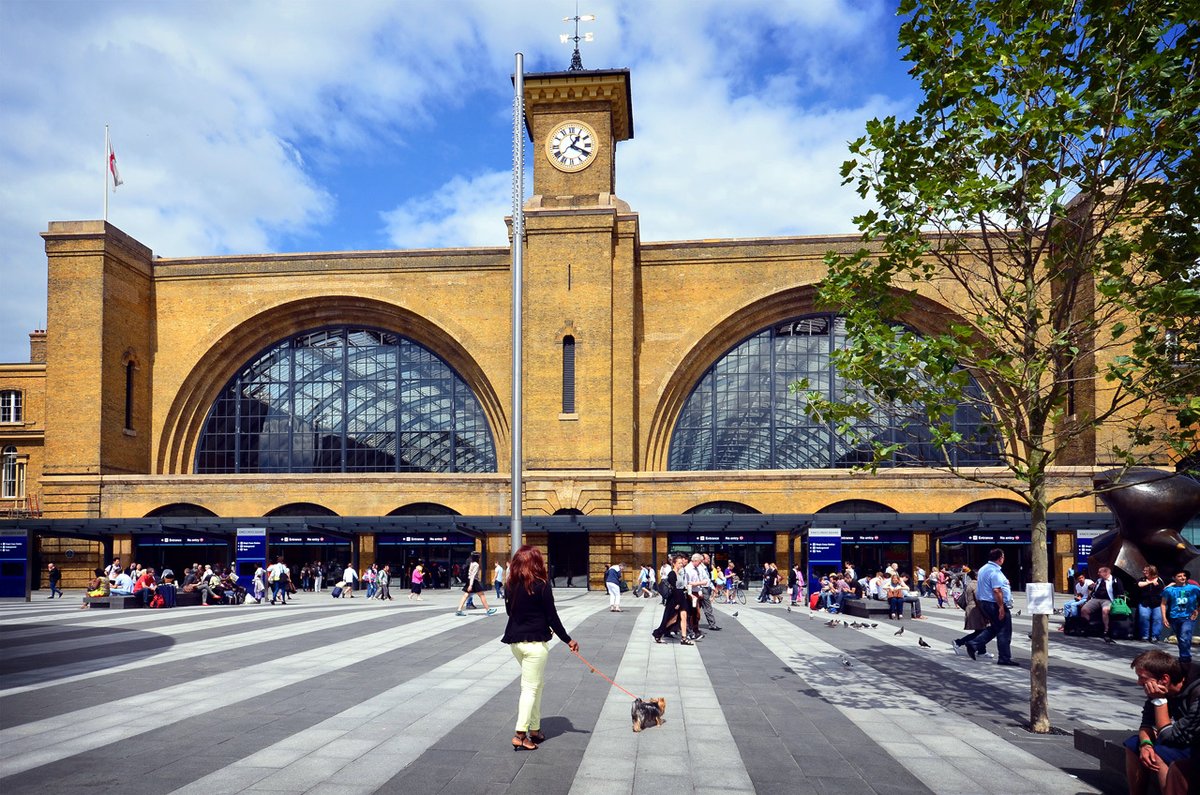
London King's Cross railway station, also known as London King's Cross, is a passenger railway terminus in the London Borough of Camden, on the edge of Central London. It is one of the busiest stations in the United Kingdom and the southern terminus of the East Coast Main Line to Yorkshire and the Humber, North East England and Scotland. Adjacent to King's Cross station is St Pancras International, the London terminus for Eurostar services to continental Europe as well as other national lines.
Beneath both main line stations is King's Cross St Pancras tube station on the London Underground; combined, they form one of the country’s largest and busiest transport hubs. London King’s Cross railway station was opened on 14 October 1852 by the Great Northern Railway on the northern edge of Central London to accommodate the East Coast Main Line. Initially, it had one arrival and one departure platform. The platforms at London King’s Cross were reconfigured several times. As of now, the platforms are numbered 0 – 10.
Cubed in the 14th century, demolished in the 1990s and repurposed as a museum, Falun is now a UNESCO World Heritage site and an astonishing time capsule of Europe’s first industrial revolution. The walkways beneath are eerie, the machinery silent but for the smell. ‘Falun rödfärg,’ the docent said, ‘is another word for our red houses.’
Sources: Wikipedia, OpenStreetMap, Wikidata, Wikimedia Commons
Written by Nicolo Ciampini
Discuss this with the author and others
No comments yet. Be the first to start the conversation.