Kupinik, Kupinovo, Serbia

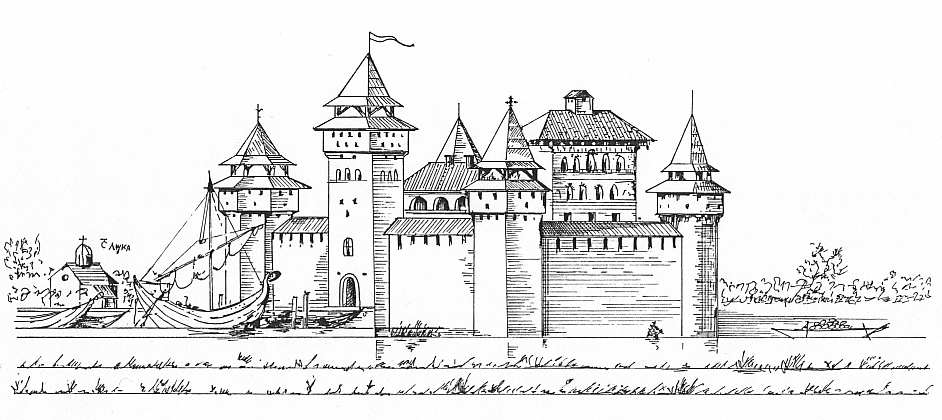
Kupinik or the Water City in Kupinovo is located in Lower Srem near the village of Kupinovo. It was built at the end of the 13th or in the first half of the 14th century as a military-border fortress of the Hungarian king. Srem served as the capital for the last Serbian despots. The fortress was built on a small island on the Sava River, on the outskirts of the modern Obedska Bara reserve. It was constructed from rubble stone, faced on the outside with bricks, and has an irregular quadrangular base (57x57 meters) with protruding round towers at the corners. The entrance to the fortress was through a fifth tower on the northeastern rampart, through gates with a drawbridge. Around the ramparts was a moat up to 3 meters deep and 17 meters wide on the entrance side. The fortress has an irregular quadrangular base with protruding towers of various shapes, reminiscent of the towers of the city of Smederevo and the Nebojša Tower in Belgrade. The towers were about 16 meters high, connected by massive ramparts, and surrounded by a moat. The fortress was built from rubble stone, faced externally with bricks. Inside the fortress were residential buildings, but there is no information about them since archaeological research has not yet been conducted.
The first written mention of Kupinik is found in two charters of King Sigismund from the second half of the 14th century. In the early 15th century, the city passed into the hands of the Serbian despots. Due to the threat from the Turks, it was better and more modernly fortified. Separate parts and entire sections were remodeled so that the fortress, originally designed for cold weapons, became a fortress with artillery towers (the northern hexagonal and eastern octagonal towers). Despot Đurađ Branković built his court church dedicated to Saint Luke next to the fortifications and connected them with a bridge.
After the death of Despot Đurađ in 1456, his grandson Vuk Grgurević, better known as the Fire Dragon Vuk, entered the service of the Hungarian king Matthias Corvinus and elevated the estate of Kupinik to the rank of a capital. We know about him from historical records and two charters from the second half of the 14th century issued by King Sigismund of Luxembourg. The fortress was built as a military-border fortification of the Hungarian king and became the residence of the Serbian despots in the 15th century. Despot Stefan Lazarević received the capital Belgrade and several other cities and estates from the Hungarian king, among which was Kupinik. After the death of Despot Stefan, his successor Đurađ Branković returned all the estates to the Hungarian king but kept part for himself, thus Kupinik became an important residence of Serbian rulers and their successors.
In the early 15th century, when the Serbian despots captured the fortress, it became an artillery fortress with cannon towers. Next to the fortress, Despot Đurađ built a church which, according to many researchers, is the oldest Serbian Orthodox church north of the Danube and Sava rivers. He connected his court church, dedicated to Saint Luke, the patron of his capital Smederevo, with the fortress of Kupinik by a bridge. In 1521, during Sultan Suleiman's campaign on Belgrade, the Ottoman army built a bridge near Šabac and crossed to the Srem side. Then the Turks captured many fortifications, including Kupinik. The last lords of the city of Kupinik were the widow of Jovan Branković, Elena, and her son from her second marriage, Stefan Berislavić. Before the Turkish invasion, Despot Elena and her underage son retreated deep into Hungary.
Kupinik, the fortress on the Sava, awaits restoration and opening to visitors. Beneath layers of weeds and grass, centuries remain silent, preserving the memory of the tragic yet still glorious time of the last Brankovićs. Although it is a cultural monument of great importance, the fortress has still not been researched.
Sources:
https://sr.wikipedia.org/sr-ec/Тврђава_Купиник_у_Купинову
https://tvrdjavesrbije.rs/tvrdjava-kupinik/

