Pietinen House

Leningradsky Ave., 31, Vyborg, Leningrad Region, Russia, 188800

Pietinen House is a residential building with commercial premises in Vyborg. Located at the corner of Leningradsky Prospekt and Vokzalnaya Square, the five-story (partially six-story) building in the center of Vyborg, designed in the Northern Art Nouveau style, is included in the list of architectural monuments.


By order of the wealthy furniture manufacturer Matti Pietinen, in 1907–1908 the architectural bureau "Bertel Jung and Bomanson" built a building opposite the Vyborg railway station that embodied the Finnish national romantic movement. The well-known architect Armas Lindgren, one of the founders of Finnish national romanticism, was invited to design the facades of the building, which had significant urban-forming importance. This house became his only work in Vyborg.


The building acquired its original appearance thanks to the impressive two-story corner tower combined with a picturesque arrangement of balconies and bay windows, a well-chosen shape and rhythm of window openings, as well as a contrasting combination of material textures with the coloring of cladding elements.


The Pietinen House became the main dominant in the railway station area and made a great impression on the city’s guests with its size and monumentality. The facade decorations, inspired by the author by the theme of the Karelian-Finnish epic "Kalevala," amazed with the originality of the idea and the craftsmanship of execution. Large windows of the first-floor rooms, intended for commercial purposes, were divided by pilasters topped with granite mascarons showing a variety of expressions, from a smirk to a snarl. The central arch of the main entrance, clad in granite, was decorated with three bas-reliefs in the form of lion heads.

The Pietinen House gained fame not only because of its facade decor: it became one of the first buildings in Vyborg equipped with elevators and hot water supply. Citizens called it the "palace." For a long time, the two-story tower with large windows displayed the letters KOP — a sign visible from afar of the branch of the National Joint-Stock Bank (Kansallis-Osake-Pankki) located in the building. Among other institutions housed in the building in the 1930s was the Soviet consulate.

The facade of the "Pietinen Palace," harmonizing with the greenery of the Triangular Square, fit well into the development of the Station Square, surrounded by houses with richly decorated facades.
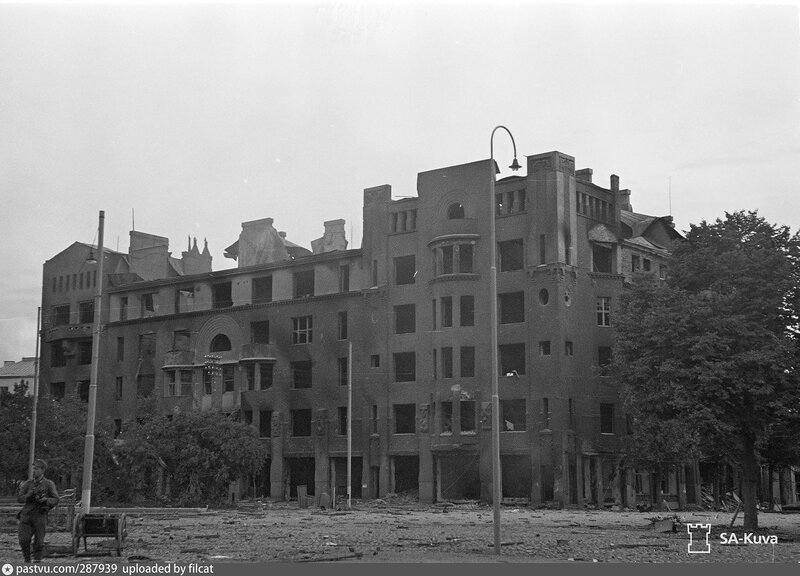

However, during the Soviet-Finnish wars (1939–1944), most of these buildings were destroyed; the Pietinen House also suffered significant damage, losing its interiors, the tall corner tower, the original roof, and part of the bay windows.


During the post-war renovation carried out in the 1950s, at a time strongly influenced by the famous decree "On the elimination of excesses in design and construction," the building’s elegant exterior appearance was lost, as was the expressiveness of its silhouette, distorted by changes to the roof shape and the replacement of the corner tower with a triangular pediment. The 2018 renovation of the building did not include restoration of the lost elements.

The Pietinen House became a source of inspiration for the well-known capital architect A. L. Lishnevsky, who built the A. L. Sagalov tenement house in St. Petersburg in 1913 (Ligovsky Prospect, house No. 91), where researchers note similarities in techniques: in particular, the silhouette and decorative elements (bas-reliefs in the form of lion heads, mascarons, etc.). Notably, the St. Petersburg "house with lion heads" has also lost its corner tower to date, although many facade decorations have been well preserved.

Sources:

https://ru.wikipedia.org/wiki/Дом_Пиетинена

Follow us on social media

More stories from Karelia - Northern Modernism

Winter's Dacha

MM2P+8W Tarulinna, Republic of Karelia, Russia

Eight kilometers from the town of Sortavala, in the skerries of Lake Ladoga, lies Cape Taruniemi (translated from Finnish as Fairy Cape). Once there was a fortress here, and at the beginning of the 20th century, on the picturesque rocky shores, architect Saarinen built a country house for Doctor Gustav Winter.

The Bank of Finland Building (in Finnish Suomen Pankin Talo)

4 Vainemiainen Street, Sortavala, Republic of Karelia, Russia, 186790

A building in the neoclassical style with elements of Finnish national romanticism; located in Sortavala (Republic of Karelia) at 4 Väinämöinen Street. The house, intended for a bank office and employee residence, was built in 1915 by order of the Bank of Finland, designed by Uno Ulberg. The building is notable for its high degree of preservation of decorative elements and interiors; it is protected by the state as an architectural monument with the status of a cultural heritage site of regional significance.

Rauhala Estate - a building in Art Nouveau style

9GHGHQ5W+43

The Rauhala estate was built in 1897 in the Finnish Art Nouveau style by the Winter family. Originally, the building had one floor, but in 1910 a second floor was added. Since the early 1930s, the estate came under state ownership, and by the mid-20th century, it became the largest producer of agricultural products, supplying the entire republic and nearby regions of Russia.

Building of the Bank of the Northern Countries

Karelskaya St., 19, Sortavala, Republic of Karelia, Russia, 186790

In the city of Sortavala, on Karelskaya Street, a brick bank building was established in 1913. It was built according to a design by Uno Werner – an architect from Finland. It was created specifically for the United Bank of the Northern Countries. In addition to bank offices, apartments for the organization's employees and a bookstore were also provided here.

Leander's House

A-121, 13, Sortavala, Republic of Karelia, Russia, 186790

One of the attractions of Sortavala is located in the city center at the corner of Karelskaya and Gagarina streets and the Main Square. It is included in the list of cultural heritage sites (monuments of history and culture) located in the Sortavala district. The building resembles a small castle, built in the style of Finnish national romanticism.

House Lallukka

Mayakovskogo St., 4, Vyborg, Leningrad Region, Russia, 188800

The former building of the company "Hyakli, Lallukka & Co." in Vyborg, built in 1906 according to the design of architect Allan Schulman (1863–1937) in the style of National Romanticism. The building was heavily damaged during the Soviet-Finnish wars (1939–1944) and was restored in the post-war years. The structure is one of the most famous architectural monuments in the city, created in the style of National Romanticism.

House of Merchants Konstantin and Nikolai Siitonen

Kirov Square, Building 11, Sortavala, Republic of Karelia, Russia, 186790

The house was built in 1907 for the brothers Konstantin and Nikolai Siitonen, who were descendants of the merchant Vasily Sidorov, who successfully conducted business in the Helsinki area in the 16th century. At the time, it was one of the most modern rental buildings with Art Nouveau architecture designed by Paavo Uotila.