

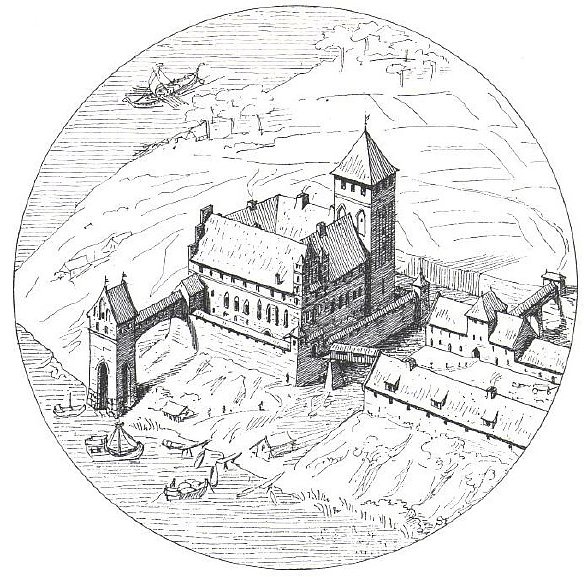
Lochstedt Castle (Burg Lochstedt) — a knightly castle was built in Pillau from wood in 1270. The name Lochstedt comes from the name of the family living there, or perhaps it is much simpler — it is formed from two German words meaning "city by the breach" ("loch" — "breach, hole", "stadt" — "city"), which quite accurately reflects the geography of the place. The castle arose at the northern tip of the Frische Nehrung spit (Baltic Spit), at the place where there once was a strait connecting the sea and the Frisches Haff. Later it became a royal castle and hereditary estate, located 4 kilometers southeast in a straight line from Fishhausen, right next to the lagoon. It began to be built as a permanent point between Königsberg and Brandenburg.
By the end of the 13th century, its walls were erected from stone. It was well fortified and could serve as a fortress. From the east and north, it was surrounded by a profiled moat, and from the west and south, it was protected by 20-meter-high slopes descending into the lagoon. The castle arose at the northern tip of the Frische Nehrung spit (Baltic Spit), at the place where there once was a strait connecting the sea and the Frisches Haff. Initially, this territory belonged to the Sambian bishop, but the key position of the castle prompted the Order to exchange these lands for the territory of the future Fishhausen.
The castle was surrounded from the north and east by a wide profiled moat; from the west and south, it was protected by steep slopes (more than 20 meters) dropping into the lagoon and strait. To the west was a four-winged castle (the Convent House) with an inner courtyard, approximately 53 by 47 meters externally, surrounded by a parkham with a defensive wall. A danzker tower (toilet, in the form of a defensive structure) also faced the lagoon, connected to the castle by a passage. The castle gates were located in the southern wing on the lagoon side. In the northeast corner stood a powerful tower with external walls up to 5 meters thick and internal walls 4.2–4.6 meters thick. The tower had a basement with an entrance from the northern wing. The southern, eastern, and western wings had basements with cylindrical vaults. The first floors were used for utility and auxiliary rooms. On the west side was a huge kitchen measuring 7 by 12 meters. In the southeast part of the southern wing was the castle chapel. All living quarters were decorated with frescoes. In the castle courtyard was a well. In the outer bailey, there were three stone buildings housing living quarters for knights and servants, barracks, warehouses, workshops, and stables.
During the times of the Order, the castle served various functions. It was the residence of the master’s deputy, the regional convent was located here, where decisions of war and peace were made, and military and trade agreements were concluded. From 1291 to 1305, Lochstedt Castle served as the residence of the Komtur; from 1265 to 1581, it housed the amber treasury and the "Kunstkammer" — a kind of capital of the local amber kingdom. With the conquest of Prussia in the 13th century, the Order immediately declared all amber industries its property, establishing a monopoly on the collection, extraction, processing, and sale of amber. Lochstedt Castle served as the seat of the "amber" administration — the management overseeing amber extraction. Punishments were established for unauthorized amber collection.
The strait, which was the main advantage of Lochstedt, began to shallow and fill with sand a few years after the castle was built. The knights did not know how to prevent this. By the early 14th century, navigation through the strait had practically ceased, and by the 1440s, it was completely silted up with sand.
Lochstedt is associated with the last years of the 27th Grand Master of the Teutonic Order, Heinrich von Plauen, who went from "savior" to traitor. In the disastrous Battle of Grunwald, in which the Order not only lost but also lost Grand Master Ulrich von Jungingen, Plauen did not participate but did a very important deed — he took successful command of the defense of the capital, Marienburg, which allowed him to become the new Grand Master. His rule was extremely difficult. Under the Treaty of Toruń, the Order was burdened with heavy reparations. Plauen was forced to raise taxes, which eventually led to a rebellion by the urban nobility and even knights. In the autumn of 1413, it came to the point where Marshal Kuchmeister refused to obey orders and wage war on Poland. At the general chapter convened for this, Plauen accused the marshal of treason, but the verdict ultimately turned against him — the Grand Master was accused of acting against the interests of the Teutonic Order, deprived of office, and thrown into prison. From 1414 to 1429, he was held in the prisons of Danzig and Brandenburg.
The 29th Grand Master of the Order, Paul von Rusdorf, who did not participate in the conspiracy against Plauen, pardoned him and appointed him custodian of Lochstedt Castle. This was Heinrich’s last position — on December 28, 1429, Plauen died within the castle walls. He was buried in Marienburg, the city whose salvation earned him the name "Savior of the Order."
During the Thirty Years' War in 1454, the castle was occupied by supporters of the Prussian Confederation but was retaken the following year. Another year later, a miracle occurred — a new, albeit shallow, strait formed near Lochstedt. There was hope for the revival of former glory, but during wartime, there were neither funds nor human resources to expand and strengthen the strait, so it was abandoned and later disappeared.
In 1510, in the area of the future prosperous Pillau, but then near one of its constituent villages, a storm created a new strait. Essentially, this marked the end of the castle’s defensive functions and its economic attractiveness. Lochstedt Castle began to decline; there was no longer any talk of fortifications, so in 1513, the fortress with its territory was granted for life to two retired knights, Adrian and Faustin von Waiblingen, on the condition that they maintain the building in good order. During the war of 1520–1521, the castle was besieged by Polish troops.
On May 31, 1629, during the war between Poland and Sweden, a landing force of King Gustav Adolf disembarked at Lochstedt. A Swedish stronghold was established here, which made some changes — a rampart with a bastion appeared, and the parkham wall was dismantled. In 1669, in nearby Tenkitten (modern Beregovoye), a chapel erected at the site of the murder of Saint Adalbert collapsed during a storm. It was not rebuilt, and all its furnishings were transferred to the chapel at Lochstedt Castle.
 During the Seven Years' War, the castle was taken by Russian troops under the command of Colonel Freiman, who later became governor of the Pillau fortress.
In 1701, the Kingdom of Prussia was established, and its first ruler, Frederick I, ordered the partial dismantling of the castle to obtain building materials needed for strengthening the Pillau citadel. Between 1703 and 1705, the main tower and danzker, the northern and eastern wings of the castle, the upper floor of the southern wing, and the defensive wall were demolished.
In 1884, what remained of the castle was converted into a school. At the same time, the chapel was restored, but in a heavily altered form. Another renovation was carried out in 1907.
During the Seven Years' War, the castle was captured by Russian troops. In the 19th century, the castle’s outer bailey burned several times, resulting in its destruction. From the 1880s, a school operated in the castle. In 1937, archaeological excavations were carried out on the castle grounds, restoration began, and a local history museum of Samland was established in the restored premises.

During the combat operations of World War II, the castle buildings were reduced to ruins; on April 22, 1945, the Lochstedt stronghold was taken by troops of the 8th Rifle Division of the 11th Guards Army. After the war, the castle ruins were dismantled for building materials. In 1945, manuscripts and books from the 16th–18th centuries, the archive of Ludwig Rhesa, and works by Kristijonas Donelaitis were taken from the ruins of Lochstedt Castle by a Lithuanian expedition. In 1967, ancient manuscripts were discovered in the castle’s basements. In December 1989, the ruins were examined by an expedition from the magazine "Der Spiegel." In 2000, the ground floors and basements were destroyed by excavators and bulldozers during excavations.
At present, the castle practically does not exist.
About 100 meters west of the castle ruins lies the ruined cemetery of the Lochstedt parish.
Sources:
https://ru.wikipedia.org/wiki/Lochstedt_(castle)
https://dzen.ru/a/ZIswt4zeGhE3FmMc


Written by Jermaine
Discuss this with the author and others
No comments yet. Be the first to start the conversation.