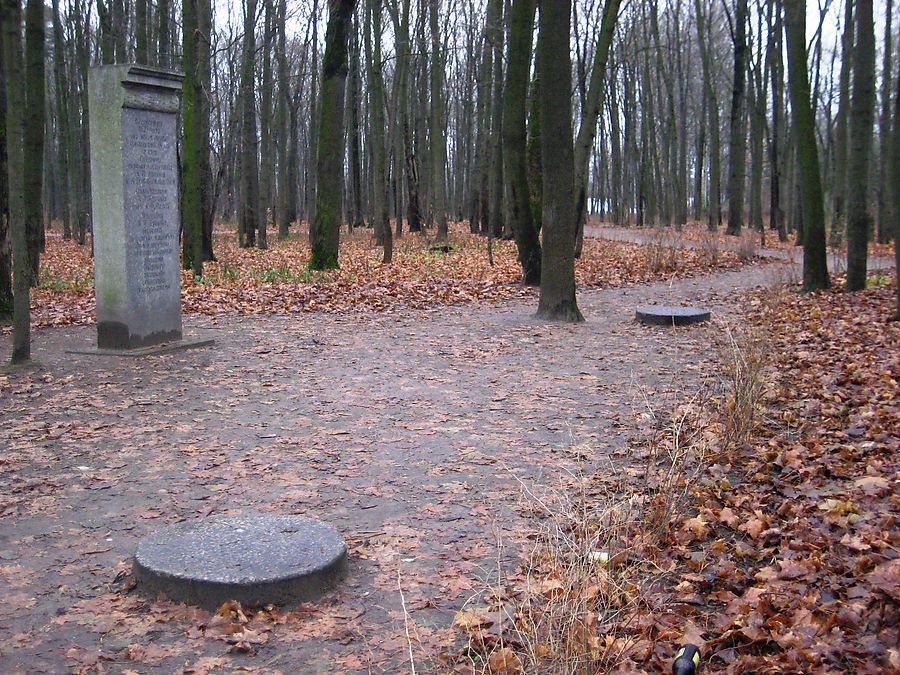

The Park of the Forestry Academy is known as the site of the duel between Chernov and Novosiltsev.
This romantic story began when the brilliant aide-de-camp to Alexander I, Vladimir Novosiltsev, proposed to the daughter of a modest nobleman, Ekaterina Chernov. This happened in the Petersburg Governorate, at the Chernov family estate Bolshoye Zarechye, near the village of Rozhdestveno. After the proposal, Novosiltsev cited the need to visit his sick father in Moscow and promised to return in three weeks.
The wedding was scheduled for January 1825, but the groom’s mother, Ekaterina Vladimirovna Novosiltseva, could not accept her son marrying the daughter of a simple army officer. In the families of the potential in-laws, everything horrified her, even Ekaterina Chernov’s patronymic—Pakhomovna. Pushkin once wrote: “The sweetest-sounding Greek names... are used among us only by commoners.” Ekaterina Vladimirovna, blinded by her pride, said: “I cannot allow my son to marry some Chernov, and moreover, one who is Pakhomovna.”
Ekaterina Vladimirovna, whose only child was Vladimir, also worried about her son’s career: born in 1799, at 23 he became an aide-de-camp to the sovereign, the youngest in the suite, with the widest prospects ahead. “If, of course, everything is not spoiled by an unsuitable marriage,” she told her friends, wringing her hands. It is worth noting that Ekaterina Vladimirovna and Dmitry Alexandrovich Novosiltsev separated soon after their son’s birth, and the mother’s entire life was devoted solely to Vladimir. The son finished a Jesuit school and joined the Life Guards Hussar Regiment; upon becoming an officer, he was appointed adjutant to Count Saken and then entered the royal suite.
Novosiltsev, after visiting his father, returned to Petersburg but did not show up either at the Chernov estate or, when they returned to the city, at their apartment. In fact, he gave no news of himself for three months, apparently yielding to his mother’s fierce pressure. The girl’s honor was at risk, and in those days such an insult could only be washed away with blood.
In the family of Major General Pakhom Kondratyevich Chernov and his wife Agrafena Grigoryevna, there were four sons and four daughters. Learning of the incident, one of the brothers, Sergey, wrote in November 1824 to another brother, Konstantin, in Petersburg: “It is desirable that Novosiltsev be our son-in-law, but if this is impossible, then we must make sure he dies a bachelor, although this charming creature deserves a better fate…”
A few words should be said about Konstantin: he was born in 1804 and entered service as an ensign in the St. Petersburg Grenadier Regiment of the King of Prussia. But in September 1820, the “Semyonovskaya incident” occurred—a mutiny—and the Life Guards Semyonovsky Regiment was disbanded and reformed. Konstantin Chernov ended up in it. In 1823, he was promoted to second lieutenant. He was a member of the secret “Northern Society.” In December 1824, Konstantin went to Moscow, having first sent Novosiltsev a challenge to a duel. Sergey Chernov wrote to him: “When father learned that the Grand Duke, knowing why you were going to Moscow, with the sovereign’s permission, himself allowed you this trip, he completely calmed down and shed tears of admiration…” Thus, not only the tsar’s brother Mikhail Pavlovich but the tsar himself was aware of the situation.
Novosiltsev’s mother, very frightened by the situation, made every effort to smooth over the conflict. She sought help from the Moscow Governor-General, Prince D. V. Golitsyn. He acted as a mediator, and Novosiltsev and Chernov’s explanation took place in his presence, along with several witnesses. Novosiltsev passionately declared that he was not refusing the marriage at all, and Chernov apologized to him. Ekaterina Vladimirovna gave written consent to the wedding, which was to take place within six months. Then Chernov and Novosiltsev went together to Petersburg.
But soon a rumor spread around Petersburg that Chernov said he had forced Novosiltsev to marry. Novosiltsev publicly protested this, and although Chernov immediately acknowledged and told everyone these were only rumors, he sent Novosiltsev an insulting letter, to which he received a challenge to a duel. However, the truth soon came out, and the duel did not take place. Meanwhile, the promised time for the wedding again passed, and Novosiltsev clearly had no intention of marrying. Ekaterina Vladimirovna, his mother, conducted a large secret campaign to disrupt the wedding, and in the end, the girl’s father’s superior, Field Marshal Fabian Osten-Saken, forced him to refuse Novosiltsev, threatening service troubles otherwise.
In the written refusal of the wedding, Pakhom Kondratyevich made it a mandatory condition that Vladimir no longer seek meetings with Ekaterina. But on September 5, 1825, the name day of Empress Elizabeth Alexeievna occurred, and a ball dedicated to it was held at the Nobility Assembly. Legend has it that Novosiltsev did not dare approach Chernov, let alone speak with her. But during the mazurka with figures, a state cavalier approached Novosiltsev with two ladies. One of them was Chernov.
“— Oblivion or repentance?” asked the stranger.
Vladimir Dmitrievich was embarrassed. Much depended on this choice.
“— Repentance,” he answered.
Chernov offered him her hand, which noticeably trembled. They made one turn. Marya Pakhomovna whispered “enough” and sat down.” This is how Pylyaev recounts the cause of the duel, confusing, however, the names of both the girl and her brother, in his book “Remarkable Eccentrics and Originals.” There is also a legend that even before the ball, Chernov and Novosiltsev accidentally met in the Summer Garden, he nodded, and she, without responding, complained about this to her brother. And he, going to the would-be son-in-law, threatened: “Once more…” And the infamous once happened at the ball. But most likely, this is just a legend. The pressure on the father to issue a written refusal of the marriage was, it seems, enough for Konstantin to issue the challenge.
Konstantin, learning of the refusal, sent a challenge to Vladimir through Ryleev and set the duel for six in the morning on September 10 on the grounds of the Forestry Institute. After thinking, he immediately wrote a note in which he detailed the circumstances leading to the duel and, among other things, said: “God is sovereign in life; but the matter of honor, to which I now go, most likely promises me death… I shoot at three paces, as for a family matter; for, knowing my brothers, I want to end myself on him, on this offender of my family, who for empty talk of even emptier people has violated all laws of honor, society, and humanity. Let me fall, but let him fall too, as an example to miserable proud men and so that gold and noble birth do not mock innocence and nobility of soul.”
The duel took place in the presence of several dozen officers of the Semyonovsky Regiment and members of the “Northern Secret Society.” Seconds on Chernov’s side were Colonel German and the poet Ryleev, and on Novosiltsev’s side, Captain Read and Second Lieutenant Shipov.
Conditions of the duel:
“We, the undersigned seconds, have agreed:
1) To shoot at a barrier, distance eight paces, with five shots each.
2) The duel ends with the first wound on an even shot; otherwise, if the wounded still has a charge, he has the right to shoot, even if lying down; if he cannot do so, the duel is considered completely and forever ended.
3) A flash does not count, nor does a misfire. Seconds are obliged in such cases to reset the flint and add powder.
4) The one who has the last shot preserved has the right to approach and call his opponent to the appointed barrier. Colonel German. Second Lieutenant Ryleev. Captain Read. Second Lieutenant Shipov.”
The appointed distance, as Chernov indicated in his letter, was deadly. The opponents fired simultaneously, and Novosiltsev was wounded in the side, while Chernov was hit in the temple.
Novosiltsev was carried to a nearby tavern, where he died a few days later.
The death of her only son was a heavy blow to Novosiltseva. She transported her son’s body to Moscow and buried him in the crypt of the Novospassky Monastery. Until her own death, Novosiltseva wore deep mourning. Apart from the church, she went nowhere and, except for Metropolitan Filaret and her closest relatives, she visited no one. According to Blagovo’s accounts, she said to Filaret:
“— I am the murderer of my son, pray, Your Eminence, that I may die soon.”
“— If you consider yourself guilty,” Filaret replied, “then thank God that He has left you alive so that you may atone for your sin and by works of mercy seek consolation for your soul and that of your son; wish not to die soon, but ask the Lord to prolong your life to have time to pray for yourself and your son.”
Visiting Filaret at the Trinity Compound, Novosiltseva always stood during the service in a dark room adjacent to the church and prayed at a small window cut into the temple.
In 1833, Novosiltseva purchased the tavern where her son died, built a church dedicated to Saint Vladimir in its place, and an almshouse attached to it. The tavern itself was also preserved and moved to the garden near the almshouse. The purchase of the land, construction of the church, and almshouse cost Novosiltseva about a million rubles, which was an enormous sum at that time.
People went to pray in the Novosiltsev Church before duels, as well as those who feared duels.
The Church of St. Vladimir has not survived: it was blown up in 1932, but some of its property was transferred to the Russian Museum. The street where the Vladimir Church stood was renamed from Novosiltsevskaya to Novorossiyskaya, but one of its bends remained Novosiltsev Lane. The almshouse buildings have survived to this day; today they house a dental clinic. The city authorities decided to transfer the almshouse buildings to a hotel, but there is an Orthodox community of the Novosiltsev Church trying to reclaim the buildings for the Church.
The sculpture for Vladimir Novosiltsev’s tombstone was created by the famous artist Demut-Malinovsky. In the 1930s, the Novospassky Monastery was abolished, and Novosiltsev’s tombstone along with his remains was moved to the Donskoy Monastery, to the Golitsyn family crypt.
Konstantin Chernov was immediately taken to his apartment in the Semyonovsky Regiment barracks (now the area between the square near the TYuZ and Moskovsky Prospect) after the duel. He died on September 22. The future Decembrists turned Chernov’s funeral into the first Russian demonstration, and the duel between Chernov and Novosiltsev was given a political coloring. Hundreds of people came to say goodbye to Chernov; the coffin was taken off the hearse and carried from Chernov’s apartment to the Smolensk Cemetery by hand. Contemporaries reported that in the front rows of the procession were Novosiltsev’s seconds, paying tribute to Chernov’s deed. The Decembrist Baron Steingel wrote in a letter to Zagorskin that “more than 200 carriages accompanied [the funeral], so judge the number of those accompanying on foot.”
Over the grave, a poem later widely known was read, the authorship of which was long attributed to Ryleev but may belong to Wilhelm Küchelbecker. It begins with these lines:
We swear by honor and Chernov:
Enmity and strife to the temporizers,
To trembling slaves of kings,
To tyrants ready to oppress us!
A public subscription was announced for Chernov’s tombstone, and more than 10 rubles were collected. Chernov’s grave has been preserved and can be seen at the Smolensk Cemetery, near the Church of the Smolensk Mother of God, on the Smolensk path.
At the site of the duel, in the park of the Forestry Institute, two massive granite pedestals were erected at a distance of 18 paces, from which the duelists began to approach. After the revolution, the pedestals disappeared, but in recent times new pedestals, much smaller and much closer together, were installed. There is also an obelisk telling the story of the duel. This place is located right at the entrance to the park.
Surprisingly, after this double tragedy, Ekaterina Chernov quickly remarried: her chosen one was Colonel Leman.
Sources:
Alexander Popov: Two Petersburgs. A Mystical Guide
The Nineteenth Century. Historical Collection, published by Petr Bartenev. Book 1. Moscow, 1872.


Written by Jermaine
Discuss this with the author and others
No comments yet. Be the first to start the conversation.