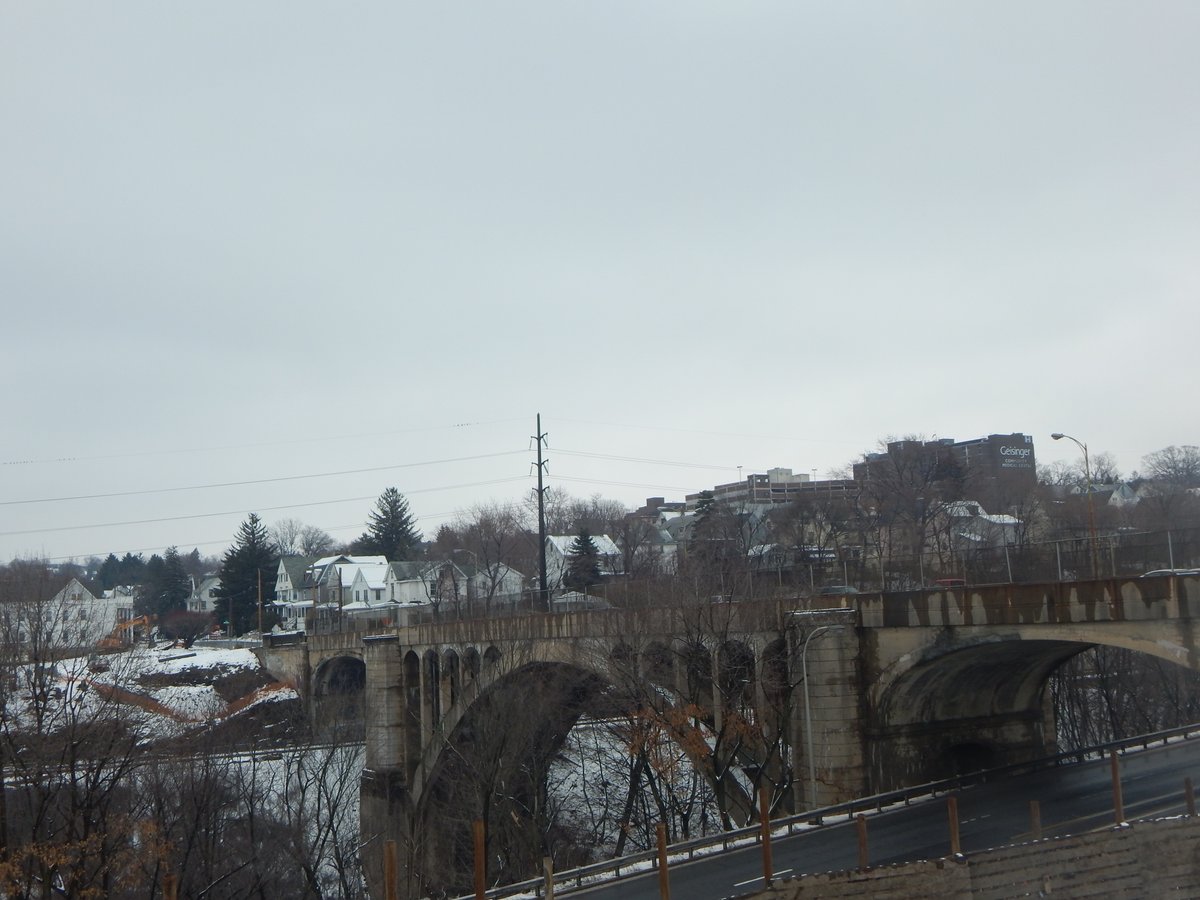
Nestled in the heart of Scranton, Pennsylvania, USA, the enchanting Harrison Avenue Bridge stands as a tribute to the architectural visionaries of yesteryears. Constructed between 1921 and 1922, this bridge is a beacon that continues to charm visitors even today, not just for its historical allure, but for its distinctive design, a testament to the power of architecture in fostering a sense of community. The bridge's design features three spans, an open-spandrel ribbed arch over Roaring Brook, with two closed-spandrel arches flanking it on either side.
The southwestern closed-spandrel arch expands over the former Lackawanna and Wyoming Valley Railroad, which was converted to highway use as the Central Scranton Expressway in 1964. The northeastern closed-spandrel arch extends over the former Delaware, Lackawanna, and Western Railroad, currently managed by Steamtown National Historic Site. The bridge's construction was mainly spearheaded by a determined community group called the South to East Scranton Bridge Association.
While the design was conceptualized by New York City-based consulting engineer Abraham Burton Cohen, the daily supervision of construction was entrusted to Scranton Department of Public Works chief engineer William A. Schunk and his assistant Charles F. Schroeder. The bridge earned a spot on the National Register of Historic Places in 1988. A new bridge was constructed in parallel alignment, starting in October 2014, and was completed in December 2017. The original bridge was demolished in June 2018.
Sources: Wikipedia, OpenStreetMap, Wikidata, Wikimedia Commons
Written by No other
Discuss this with the author and others
No comments yet. Be the first to start the conversation.