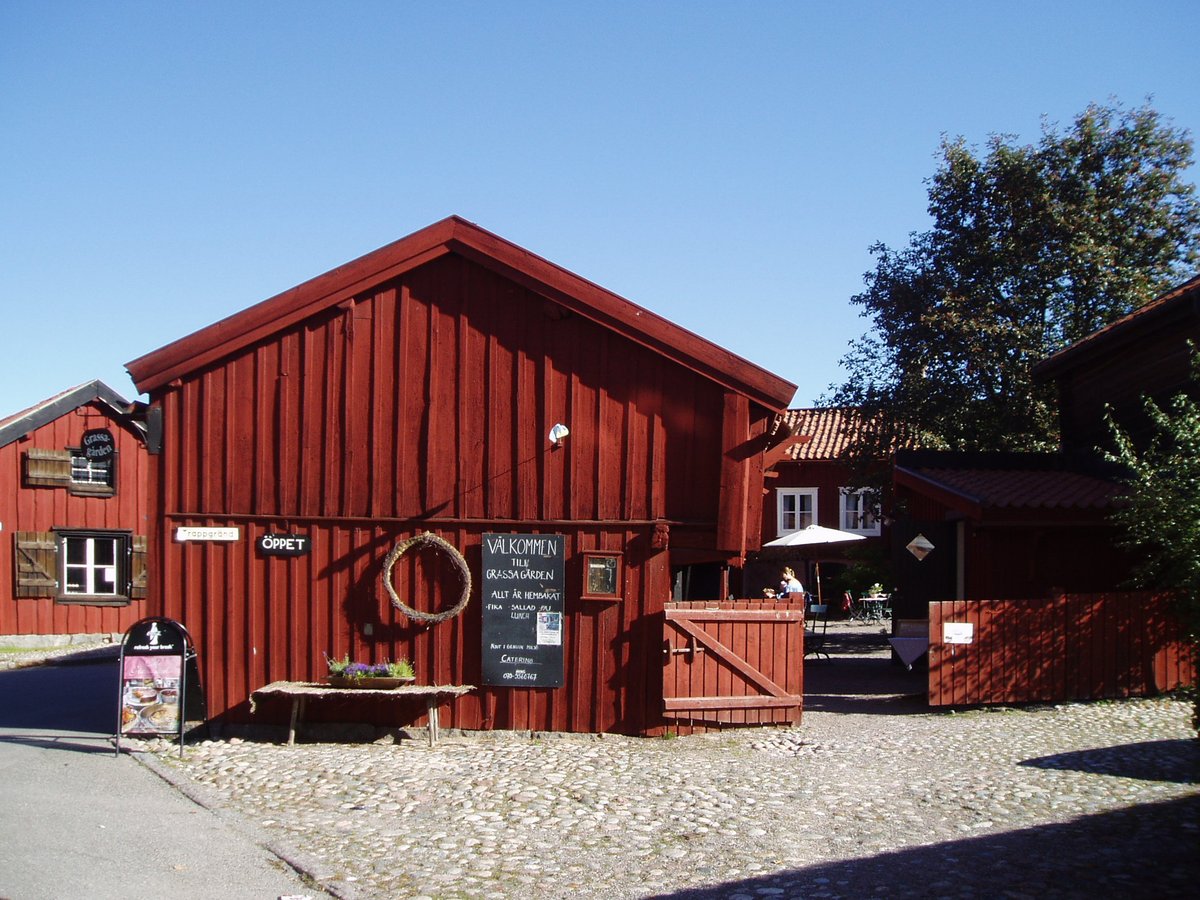

The name on the gate belongs to two people who arrived late in the story. Olof Christian and Wilhelmina Grass moved into the property on Kvarngatan in 1793 and opened a tavern there. By that point the northeast dwelling house had already been standing for around 180 years.
Grassagården is a borgargård — a burgher's farmstead, the working town property of a merchant or craftsman household in central Sweden, part home and part workplace. Thousands of these once filled Swedish towns. Very few survive, and fewer still survive where they were built. Grassagården is one of the small number that has never been moved, taken apart for an open-air museum, or reassembled somewhere more convenient. It sits on its original plot, close to the Strängnäs windmill.
The layout is the point. Four sides enclose an inner courtyard, and each side did a different job. To the north stand two dwelling houses built together into a single range. The east side holds a farm building with living rooms and a brewhouse. The west range is a carriage shed and outbuildings — the transport and storage end. The south side is a visthus, the pantry and provision store where food was kept.
All of it is timber-framed, mostly clad in locklistpanel — vertical boards with narrower battens covering the joins, the standard Swedish solution to keeping weather out of a log wall. Painted red, with pitched roofs of single-lap tile. That combination is so familiar in Sweden that it can be easy to miss how much of it here is genuinely old rather than a later imitation.
The building history runs in three distinct stages. The northeast dwelling house came first, probably in the early 1600s. Then, in the early 1700s, the rest of the yard went up — the ranges that turned a single house into an enclosed farmstead. The visthus was the last piece, built only after the Grass family arrived in 1793, along with an extension to the east farm building. So the pantry store, the one part of the yard people tend to assume is oldest, is actually the newest.
What the sources do not say is what the Grass tavern was like inside, or who drank there, or how long the couple ran it. The name stuck anyway. It has outlasted every other owner the property has had, which is a modest kind of immortality: two tavern-keepers whose surname is now the official name of a protected national monument.
Strängnäs municipality has owned the property since 1917. On 23 September 1983 the county administrative board of Södermanland declared it a byggnadsminne — a listed building monument, Sweden's strongest form of heritage protection for individual buildings. That designation is what keeps the panelling, the tile and the courtyard plan from being quietly modernised.
Today there is a café in the yard. In summer the courtyard is used for theatre and music events, which is a reasonable second career for a space originally designed so that carts, brewing, cooking and sleeping could all happen within a few metres of each other. The local heritage association, Strängnäs gille, runs guided tours of the buildings.
It is worth walking the full circuit of the four ranges rather than stopping at the café tables. From the courtyard you can read the whole sequence: the early-1600s corner, the early-1700s expansion that closed the square, and the post-1793 additions that the Grass family paid for. Three centuries of building decisions, all visible from one standing position, on ground that has never been disturbed.
The windmill next door makes the pairing obvious — grain, bread, beer, a tavern. Kvarngatan means Mill Street. The street name, the mill and the brewhouse in the east range all belong to the same small economy, and the layout of Grassagården is a diagram of how it worked.
Written by Nik Frost
Discuss this with the author and others
No comments yet. Be the first to start the conversation.