RV75+HPG, Hara Sghira Er Riadh, Tunisia

The Jewish community of Tunisia, and in particular the island of Djerba, has existed for more than 2,000 years. It is believed that Jews arrived in Tunisia along with the Phoenicians as early as the 10th century BCE, who founded the ancient colony of Carthage at the northernmost tip of Africa.
El Ghriba is an important feature of Jewish life on the island. According to legend, the construction of the synagogue dates back to the flight of the High Priests after the destruction of Solomon's Temple by the Babylonians under Nebuchadnezzar II in 586 BCE (or alternatively, to the destruction of the Second Temple in 70 CE). The High Priests took with them a door and a stone from the destroyed temple. Thus, the synagogue connects the Jewish diaspora with the "sole sanctuary of Judaism." Today, the local Jews are distinguished by their clothing, which includes a black band on their trousers symbolizing the destruction of the Temple.
Until the 1950s, Djerba was home to the largest Jewish community in Tunisia. Although Jews remain actively present on the island—the second largest active Jewish community in the Arab world—the community numbers fewer than 1,500 people. Of the more than 20 synagogues and yeshivas (Jewish educational schools) on the island, many are abandoned.
The ancient El Ghriba synagogue is located in the Jewish village of Hara Sghira (now known as Er-Riadh), a few kilometers southwest of Houmt El Souk, the main town of Djerba. The synagogue is the oldest in Tunisia and possibly in all of Africa. The Ghriba synagogue itself is no longer used by the Djerba Jewish community for weekly prayers. Besides being the center of Jewish life on the island, it is also a pilgrimage site. Despite extensive reconstruction in the 19th century CE, the buildings may have been originally constructed in the 6th century BCE: one of the legends associated with its founding claims that a stone or door from Solomon’s Temple or the Second Temple is embedded in the building.
The covered courtyard, formerly open, impresses visitors with its decoration of bright ceramic tiles. The tiles resemble kallalines, painted tile frescoes often depicting vases with flowering branches or images of mosques framed by intricate geometric patterns. These tiles were typically used to decorate elite Tunisian residences and mosque architecture in the 18th and 19th centuries. The Ghriba tiles correspond to the dominant color palette of Tunisian kallaline—green, yellow, and blue—and feature similar geometric patterns.
The main prayer hall is adorned with a series of blue columns supporting arches painted with alternating blue and white stripes, imitating ablaq stonework, the alternating light and dark stones commonly found in Islamic architecture.

At the center of the prayer hall stands a richly decorated carved wooden bema, or reader’s table, behind which the clergy read the Torah and recite the weekly liturgy.
Above the bema rises a tower (also known as a lantern) pierced with windows. The lanterns of Djerban synagogues typically have 12 windows, reminiscent of the 12 tribes of Israel. Like its architectural plan, the Ghriba lantern was also modified: its 12 windows were increased to 16, thus providing more light to the sanctuary. Positioned above the bema, the lantern floods the reader’s table—the central place of worship—with light. From the outside, the tall synagogue lanterns were immediately recognizable in the island’s landscape, standing out on the horizon and marking synagogues in the villages. However, due to successive modifications of the Ghriba synagogue and for security reasons, its lantern is no longer visible.
From the outside, the current synagogue is a modest building, while inside it is richly decorated. Unlike other synagogues in Djerba, El Ghriba consists of two covered halls. After several structural expansions, the first of the two halls was built on the roof of the former open courtyard to increase visitor capacity. At the entrance, two columns divide the space into three zones. This hall is connected to the main hall by three vaults. On this side are two columns supporting a high ceiling opening with numerous windows. Originally, the hall had twelve windows symbolizing the twelve tribes of Israel.
During later renovations, additional windows were added. The northern side was also altered. The teva (ark for storing the Torah) is located under a glass roof (in the western part of the prayer room). The third column on the east is missing. It was probably never built. Local tradition regards this as a reminder of the destruction of the Jerusalem Temple. Moreover, it is said that the building must remain unfinished because "nothing but the divine is perfect." Wooden benches for worshippers surround the teva. The interior walls are tiled with ceramic tiles featuring blue, white, and brown ornaments that were hand-painted.
The inner courtyard is surrounded by covered loggias on columns. Pilgrims can stay in adjacent buildings. The oldest of these were built at the end of the 19th century, and newer ones in the early 1950s.
The legend of Ghriba emphasizes the local character of the synagogue, drawing on similar stories found in local Muslim and Amazigh communities. According to one version of the legend, a lonely young woman named Ghriba ("lonely") arrived on the shores of Djerba and lived alone in a small hut. One day her hut burned down completely, but to the astonishment of the island’s inhabitants, her body remained untouched. The islanders buried her, hoping to be forgiven for not honoring her memory during her lifetime. After her burial, those who visited her grave reported miracles of healing. A shrine was built over her grave, which today is considered the grotto beneath the Torah ark in the Ghriba synagogue; a hollow under the sacred arch marks the place where her body is believed to have been found: it is known as the "girl’s cave."
On the island of Djerba, Ghriba is revered as a Jewish saint, or holy deceased. It is generally believed that the veneration of saints and their relics—holy bodies and objects that came into contact with holy bodies—is marginal or alien to Judaism. However, from ancient Judaism to the present day, Jewish communities have worshipped the graves of rabbis and martyrs, made annual pilgrimages to the graves of righteous Jews (tzaddikim), and also used and valued earth and other secondary relics or objects that had contact with burial sites. This is especially characteristic of North African Jews, who lived side by side with their Muslim neighbors and likely began to follow Muslim customs of saint veneration.
The synagogue is managed by an independent administrative committee established in the late 19th century when Djerba was under French protectorate. The administrative committee organizes the annual pilgrimage and distributes the pilgrimage income among the village elders.
The pilgrimage takes place every year on the 33rd day of the Omer count, between Passover and Shavuot. The pilgrimage to Ghriba’s grave is celebrated annually along with the death anniversaries of two famous rabbis—Shimon bar Yochai and Meir Baal Hanes—who lived in Palestine in the 2nd century CE and to whom miracles are attributed. Although they are not from Tunisia, their veneration among Tunisian Jews is so great that they are often regarded as local saints. Pilgrims from around the world, especially from Tunisia, Libya, France, and Israel, flock to the Ghriba synagogue. Many pilgrims stay in the oukala or caravanserai—a large open courtyard with rooms for travelers—opposite the synagogue.
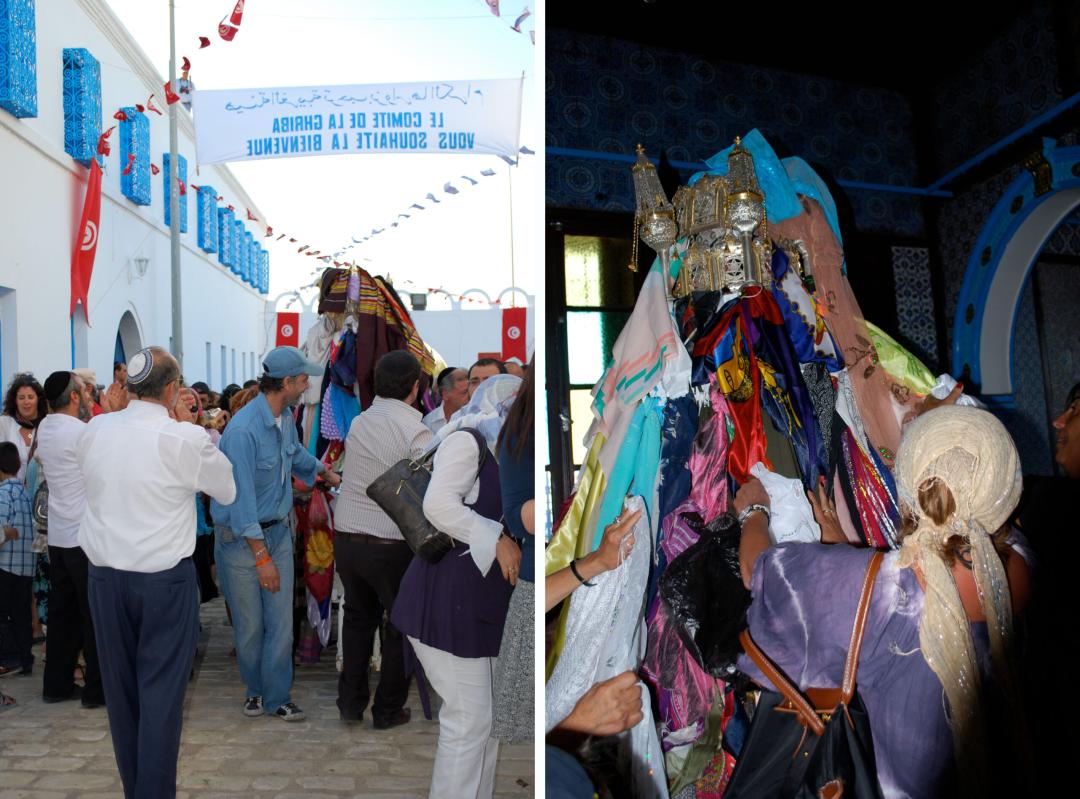
Left: Menara in procession near the Ghriba synagogue; right: women drape the menara with scarves (PilotGirl, CC BY-NC-SA 2.0)

A woman places eggs in the grotto of the Ghriba synagogue (photo: Manoel Penico)
The Menara, a large five-tiered hexagonal candelabrum, is decorated with symbols celebrating the Jewish history of Djerba, including the twelve tribes of Israel, famous Tunisian rabbis, and two mystical rabbis honored at the pilgrimage festival. The Menara is draped with silk scarves and carried through the streets between the Ghriba synagogue and other synagogues in nearby villages. The journey is meant to celebrate the mystical marriage of the Jewish community with God. The procession resembles a local Djerban wedding ritual, during which the bride is carried on a camel in a brightly decorated palanquin from her father’s house to the groom’s house. The word “menara” means “bride” in Arabic and “bride” in Hebrew, further emphasizing the parallels between the wedding ceremony and the annual procession.
Pilgrims to the Ghriba synagogue also visit the grotto beneath the Torah ark, where they light candles and place eggs inscribed with verses and wishes in Hebrew. According to local tradition, if a woman eats an egg, her wish for love and fertility will be fulfilled within a year. As in Muslim practice during ziyara (pilgrimage), Jews visiting Ghriba promise to return to visit the saint when their prayers are answered.
Numerous rituals of the annual pilgrimage strengthen their Jewish identity and also affirm their belonging to the wider Djerba community.
In 1985, during the celebration of Simchat Torah, a local police officer responsible for synagogue security opened fire on the crowd of celebrating Jews, killing three people, including one child, and injuring 15. This occurred after Operation Wooden Leg, when Israel struck the PLO headquarters in Tunisia. The local police officer, whose relative was killed during the operation, attacked the synagogue amid anti-Jewish sentiments that followed the operation. On April 11, 2002, a truck loaded with explosives detonated near the synagogue, killing 21 people, including 14 German tourists, five Tunisians, and two French citizens. Responsibility for the bombing was claimed by Al-Qaeda. It was established that the organizer of the bombing was Khalid Sheikh Mohammed, and it was financed by a Pakistani living in Spain.
On May 9, 2023, a shooting occurred near the synagogue, resulting in the deaths of two Jewish cousins, one French tourist and a Tunisian citizen living in Netivot, Israel, and two Tunisian security guards. Ten others were injured. The shooter, a naval base security guard, first shot his colleague and took his ammunition before heading to the synagogue. He was shot dead by security guards during the shootout.
History:
https://en.wikipedia.org/wiki/El_Ghriba_Synagogue
https://smarthistory.org/architecture-and-ritual-in-the-ghriba-synagogue-tunisia/

