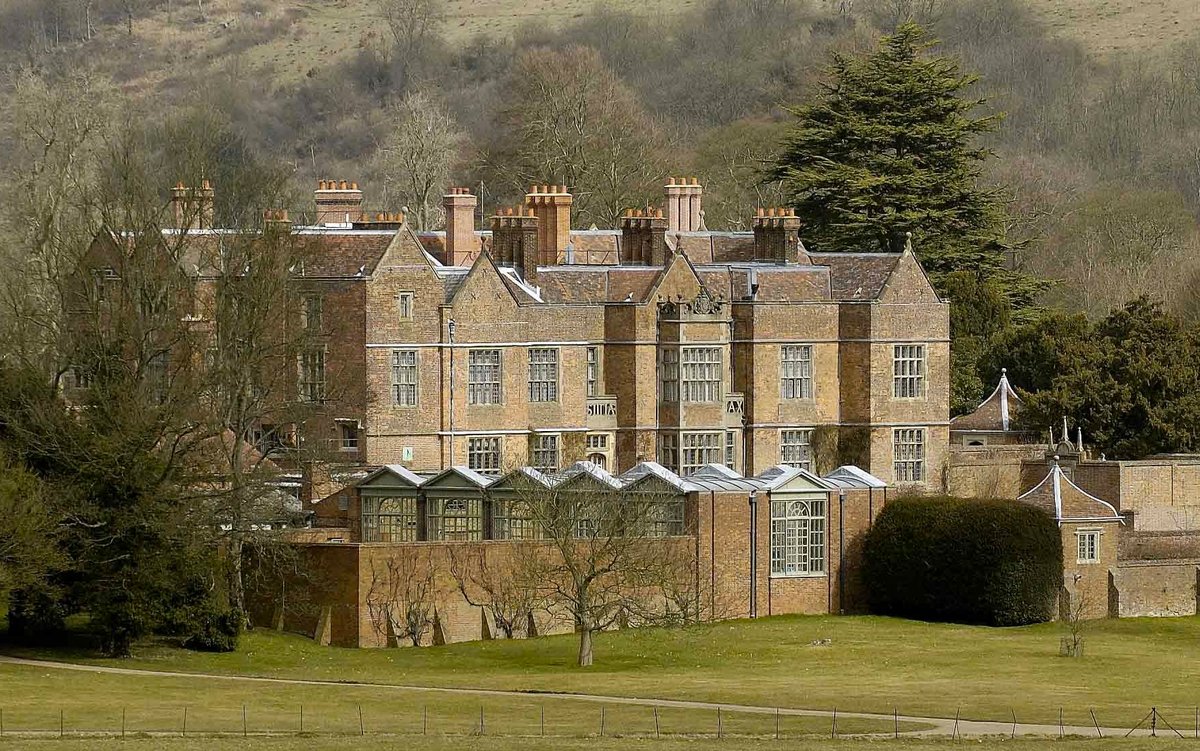
Chequers Court in Buckinghamshire, England, is more than just the country house of the prime minister. It started out as a royal residence for Lady Mary Grey, a great-granddaughter of King Henry VII, from 1565 to 1567. The house was built around 1565 by William Hawtrey, and bears his name in a reception room. Through the centuries, it passed through several families, including the Wooleys, the Crokes and the Thurbanes. In 1715, the owner of the house married John Russell, a grandson of Oliver Cromwell.
Chequers is known for its connection to the Cromwells, and still contains a large collection of Cromwell memorabilia. Henry Rhodes made alterations to the house in the Gothic style in the 19th century, ripping out the Tudor panelling and windows and installing battlements with pinnacles. Bertram Astley restored the house to its Elizabethan origins between 1892 and 1901, with the help of Reginald Blomfield and John Birch. Arthur Lee and his wife Ruth took the house on a long lease in 1909, immediately starting a restoration of the interior.
Chequers houses one of the largest collections of art and memorabilia pertaining to Oliver Cromwell in the country, as well as many other national antiques and books. The collection is not open to the public. Coombe Hill, which was part of the estate until the 1920s, was given to the National Trust. Today, the interiors and collection at Chequers largely reflect the work of Ruth and Arthur Lee, including a significant number of late 17th- and early 18th-century caned chairs.
A table at Chequers was made by George Bullock for Napoleon’s drawing room at Longwood House on Saint Helena. A large leather-bound trunk said to have belonged to James II while he was Lord High Admiral is also at Chequers.
Sources: Wikipedia, OpenStreetMap, Wikidata, Wikimedia Commons
Written by Nicolo Ciampini
Discuss this with the author and others
No comments yet. Be the first to start the conversation.