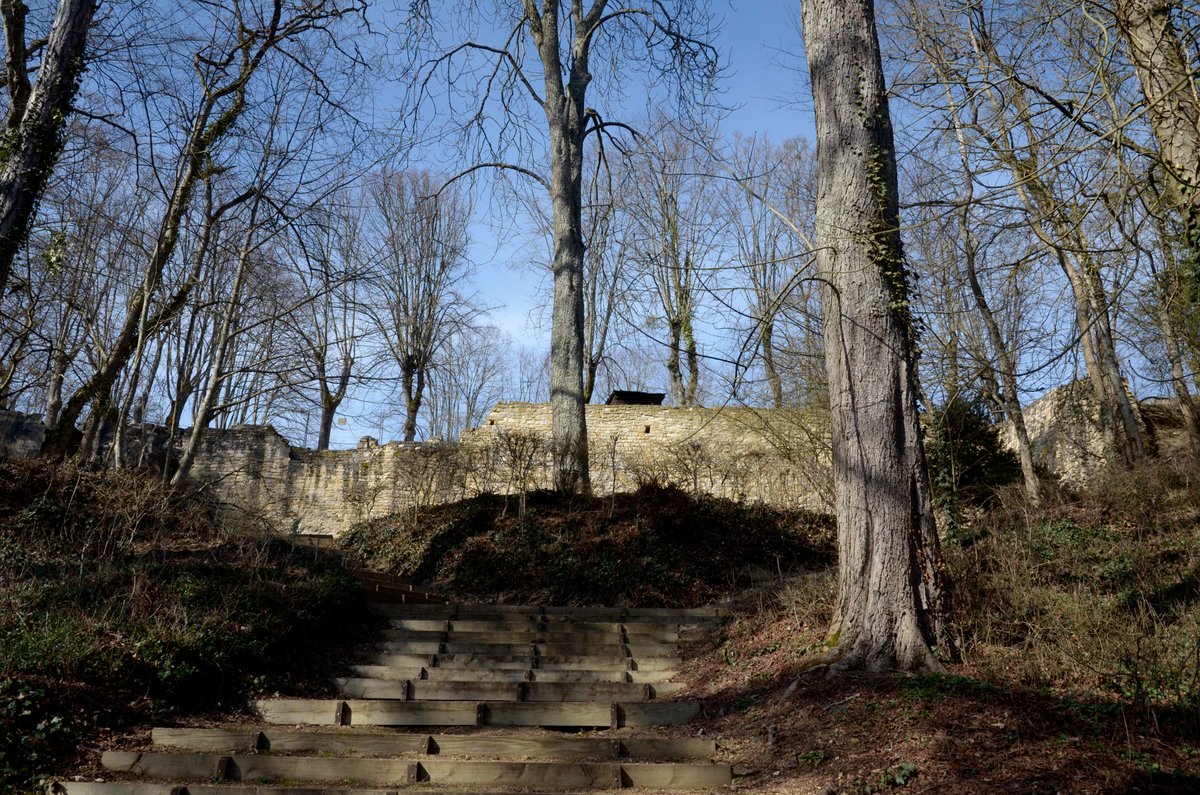

In 1652, Louis XIV ordered the immediate demolition of the Château de Montrond after it had been besieged for eleven months. Despite the order, a lack of gunpowder meant that only a few bastions were damaged. Twenty survivors surrendered with honour as the siege concluded.
The site has hosted a fortress since the end of the 9th century, with the first documentary evidence dating to 1225. After the English burned the previous site at Orval in the early 15th century, the seigneur of Orval and Saint-Amand moved to the better protected site of Montrond. Extensive construction followed, including a chapel for Isabeau de la Tour du Pin at the end of the 15th century.
The Duke of Sully took ownership of the dilapidated castle in 1606 and remodeled the residence, strengthened the fortifications, and created a garden. Between 1621 and 1652, the architect Jean Sarrazin completed fortifications for Henri II de Condé and his son Louis II le Grand Condé.
From 1736, the castle was progressively demolished and used as a quarry. In 1834, the site was transformed into a public garden. It is currently a monument historique and can be visited on the Allée du Prince de Condé in Saint-Amand-Montrond.
Sources: Wikipedia, OpenStreetMap, Wikidata, Wikimedia Commons





Written by Nicolo Ciampini
Discuss this with the author and others
No comments yet. Be the first to start the conversation.