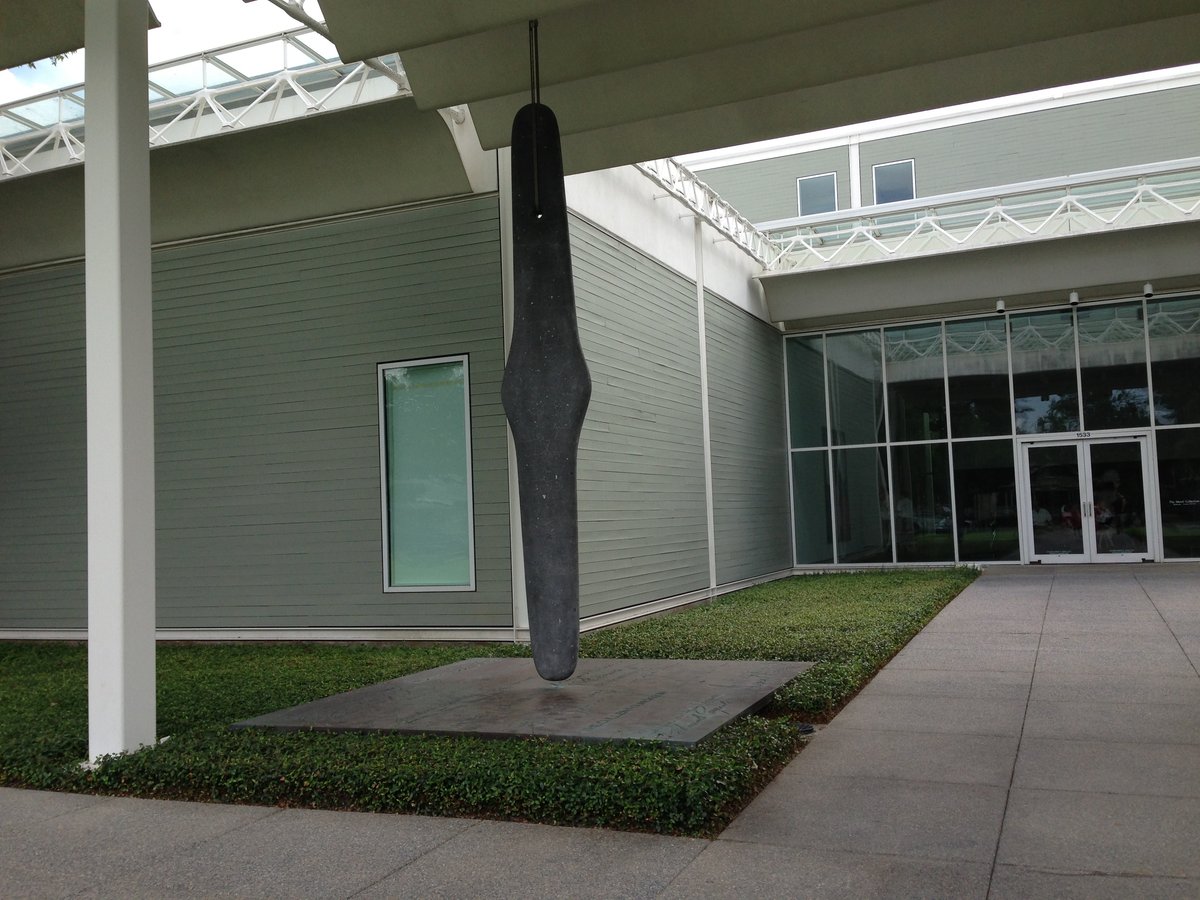
Concrete aggregate forms Charmstone. It hangs above a plaque at the Menil Collection entrance. A bulge in the middle creates a propeller shape.
Michael Heizer installed this in 1991. He wanted to mimic prehistoric tools. Early humans used these forms. Heizer stated that people wouldn’t look closely at these forms even if they walked by them every day, as they are probably indexed in their minds as obscure artifacts put away on a shelf.
Real charmstones uncovered in archeological digs in California and Southwestern United States are highly polished oblong stones, often with a hole drilled in one end. They may have been used as weights, or they may have been sacred objects used for religious or ceremonial purposes. Heizer's sculptures represent these forms in a new way.
Heizer's father was an archeologist who studied the Windmiller Culture. He created a typology for their charmstones, including Type B and C, which are very similar to the Charmstones his son created. This work mimics those specific shapes.
Sources: Wikipedia, OpenStreetMap, Wikidata, Wikimedia Commons




Written by Leroy
Discuss this with the author and others
No comments yet. Be the first to start the conversation.