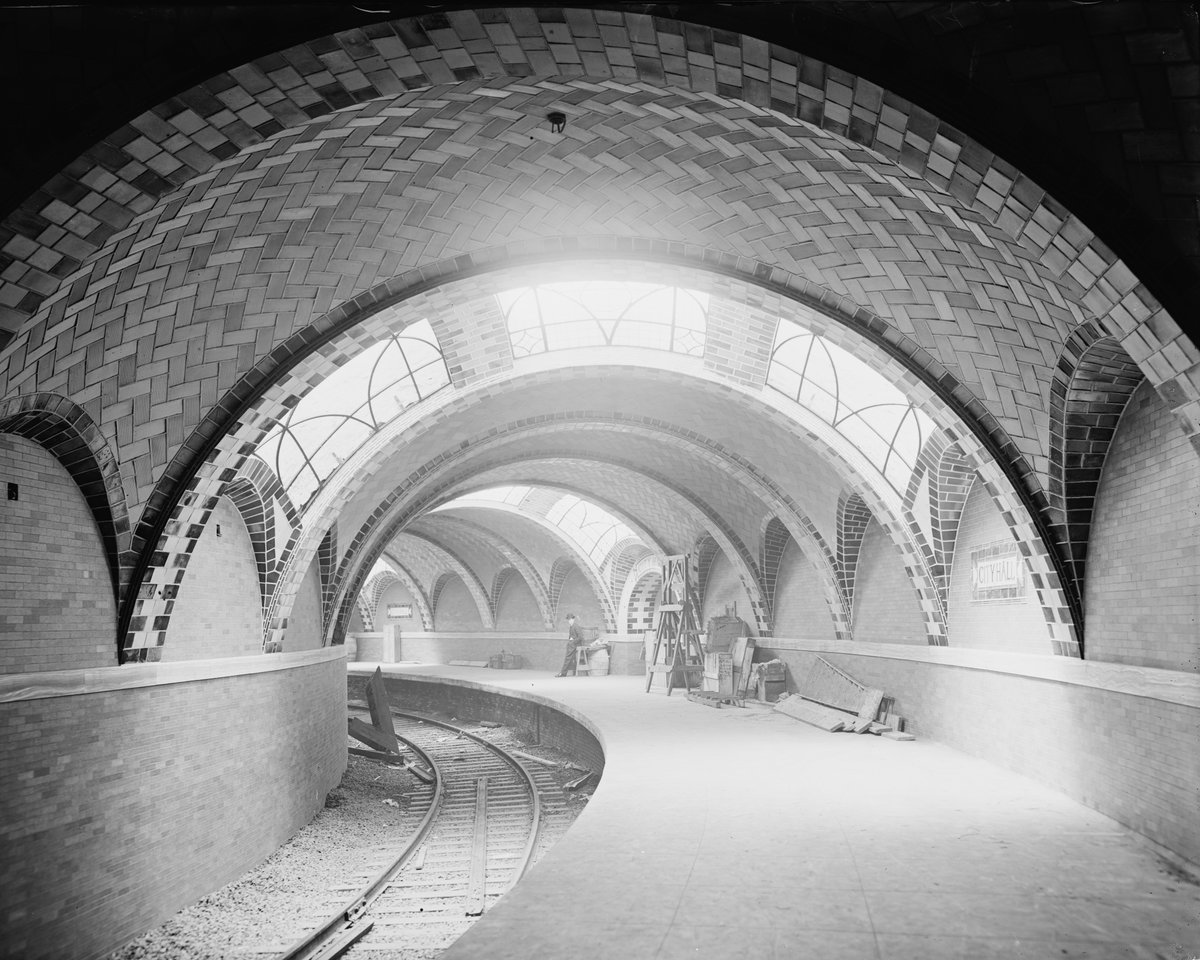

Deep beneath the streets of lower Manhattan lies the City Hall station, also known as City Hall Loop. A closed station on the IRT Lexington Avenue Line, it was built for the Interborough Rapid Transit Company (IRT) as the southern terminal of the city's first subway line. The station opened on October 27, 1904, as one of the original 28 stations of the New York City Subway. Its design is unique in the system for the usage of Romanesque Revival architecture, featuring Guastavino tile, skylights, colored glass tilework, and brass chandeliers.
The station was closed on December 31, 1945, because of its proximity to the Brooklyn Bridge station. Today, it is a New York City designated landmark and is listed on the National Register of Historic Places. While the platform has remained unused since its closure, except for occasional tours and events, its track continues to be used as a turning loop for the 6 and <6> trains. The tunnel passing through the station can still be seen from passing trains.
Construction began following a formal groundbreaking ceremony at City Hall on March 24, 1900. The portion of the loop in City Hall Park was excavated starting in April 1901, during which trees were removed using derricks. Sand from the 500-foot-long excavation was sold to builders who sought it for its good quality. Although work on the station was briefly placed on hold because concrete vaults were difficult to pour during winter, the station eventually opened to carry 27,000 passengers for free on its first day.
Sources: Wikipedia, OpenStreetMap, Wikidata, Wikimedia Commons


Written by Friendly Jane
Discuss this with the author and others
No comments yet. Be the first to start the conversation.