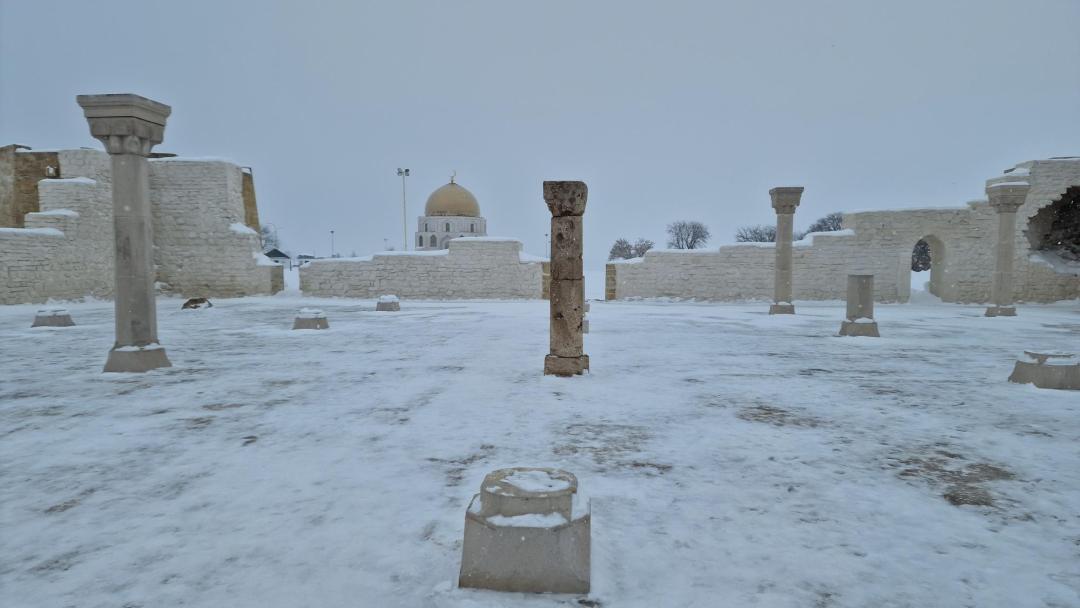
The Cathedral Mosque — the oldest building of Bolgar

X3P4+69 Bulgarians, Republic of Tatarstan, Russia

The Cathedral Mosque is the oldest building in Bolgar. The mosque in the city of Bolgar appeared during the time of Khan Batu. It began to be built shortly after the Mongol conquest and was completed by the 1260s. Over its existence, it was destroyed several times and reconstructed twice. In the 13th century, the mosque was the main religious structure of the Bolgar ulus of the Golden Horde.

The Cathedral Mosque is the oldest building in Bolgar. The mosque in the city of Bolgar appeared during the time of Khan Batu. Construction began shortly after the Mongol conquest and was completed by the 1260s. Over its existence, it was destroyed several times and reconstructed twice. In the 13th century, the mosque was the main religious structure of the Bolgar ulus of the Golden Horde. It was a large fortified building with a strong foundation and stone walls. The mosque amazed with the beauty of its decoration and was visible even from a great distance. However, it existed in this form for only 50 years before being almost completely destroyed. In the 14th century, it was restored, but the mosque then acquired defensive functions — the wooden flooring was replaced with stone, and polygonal fortress towers were added.

The purpose of this majestic structure was to symbolize the greatness of Islam and embody the power of the state. The mosque was meant to astonish visiting travelers so that they would spread its fame throughout the world.

The central streets of the city originated from the temple. This was convenient for residents who gathered here at prayer times. The mosque’s shape was a rectangle measuring 32 by 34 meters. Inside, there were 12 columns. The building’s walls were made of stone. The floor and ceiling were made of wood. Constructing this grand structure required 1,200 tons of marble.

In the 1960s, the mosque was restored: the walls were treated with special solutions, the towers were covered with artificial blocks, and the floor was reinforced with a special coating. To this day, only the foundation, walls, and towers remain, along with a restored part of the ruins.

Today, the mosque survives only in ruins: fragments of walls rise above the ground, and the interior space is divided into stone squares that served as the bases for columns inside the mosque hall. Only the foundation and some wall elements have survived to the present day. But even these impress with their scale. By the way, the architecture of the Cathedral Mosque can be appreciated at the Museum of Bolgar Civilization, where a model of the building is exhibited. It is located nearby. The mosque had an almost square shape and was supported by quadrangular pillars; the ceilings were wooden, and the main entrance was located near the minaret.


Follow us on social media

More stories from Bolgars: The Northern Mecca (In the Footsteps of the Golden Horde)

Black Chamber

X3J3+RJ Bulgars, Republic of Tatarstan, Russia

The Black Chamber is the best-preserved monument of Bulgar architecture. It is one of the most beautiful and mysterious structures of Bolgar, built in the 14th century from white limestone. The Black Chamber got its name either from the very status of the building, where "black" (secret or serious) matters were dealt with, or after the fire of 1361, when the building was completely burned down.

White Chamber

X3H2+WX Bulgars, Republic of Tatarstan, Russia

South of the Black Chamber lie the ruins of the 14th-century bathhouse – the White Chamber. The development of urban life demanded the construction of public facilities such as caravanserais and bathhouses. Bathhouses in the East, since ancient times, have been a subject of special attention as a means of achieving cleanliness and neatness, which as virtues were sanctified by customs and religion.

Red Chamber

Kamskaya St., 25, Bolgar, Republic of Tatarstan, Russia, 422840

The existence of public and private baths, as well as their engineering design, testifies to the advanced hygienic culture of the inhabitants of Bulgar. But, as already mentioned, baths were used not only for washing. They were a kind of social clubs – people relaxed, communicated, exchanged news, and played chess here.

The History of Bolgar (Bulgar) - the Ancient Capital of Volga Bulgaria and, Later, the Golden Horde

20 Kalinina St., Bolgar, Republic of Tatarstan, Russia, 422840

All known written sources about Bulgaria and the city of Bulgar were created outside its borders and do not contain a systematic account of its history. These are works by Arab and Persian authors, mentions by ancient Russian chroniclers, and Western European travelers. They mostly represent records of their impressions during brief visits to Bulgaria or relay second-hand information. The name "bulgar" is the Russian variant of the Tatar word "bolgar."

Small minaret

X3J6+F7 Bulgarians, Republic of Tatarstan, Russia

In the second half of the 14th century, residential quarters in the area of the Small Minaret and to the southeast of it disappeared. This may have been a consequence of the 1361 campaign of the Golden Horde Khan Bulak-Timur. Here, a noble cemetery emerged, from which several tombs and mounds concealing the ruins of stone buildings have been preserved. An excavation was laid on one of these mounds. It turned out to conceal the ruins of a small mausoleum, of which only the foundation and a pile of stones remained. The only burial was found to have been looted. According to legend, the cemetery near the Small Minaret is called the "Khan's Cemetery."

Gabdrakhman’s Well or Captain’s Well

X3QC+94 Privolzhsky, Republic of Tatarstan, Russia

Legends associate it with the history of the Volga Bulgars' adoption of Islam. The name of the well is linked to the name of one of the followers of the Prophet Muhammad.

Khan's Mausoleum

X3J6+J9 Bulgars, Republic of Tatarstan, Russia

To the north of the small minaret, on the territory of the former cemetery, the ruins of four 14th-century mausoleums have been preserved. The middle one is called the "Khan's Mausoleum."

Northern Mausoleum

X3P4+CF Bolgar, Republic of Tatarstan, Russia

Opposite the main entrance of the northern facade of the Assembly Mosque, in the 1330s, the Northern Mausoleum was constructed, known in literature as the "Monastic Cellar," since it was used by the monks of the Assumption Monastery for storing food.

Great Minaret

X3P4+67 Bulgars, Republic of Tatarstan, Russia

Attached to the northern wall of the Cathedral Mosque is a projection — the foundation of the Great Minaret, the image of which has been preserved in old drawings and blueprints. A valuable description of the monument was made by Pallas in 1769: “The most distinguished of these towers, or mizgir, is made of hewn stones and stands a little over 12 sazhen high. One ascends it by a steep staircase with 72 steps, each of which is one Paris foot in height. This staircase was repaired, and the tower was covered with a wooden roof.”

Eastern Mausoleum

X3P4+5M Bulgars, Republic of Tatarstan, Russia

To the east of the Cathedral Mosque is the Eastern Mausoleum. It is the burial place of the Bulgar nobility. The building stands on a cubic base, which transitions harmoniously through chamfers into an octagonal tier. The structure is crowned with a tented roof. The monument is almost 700 years old.

Khan's Palace (House with Towers or Batu's Palace)

X3P5+G2 Bolgar, Republic of Tatarstan, Russia

The Khan's Palace (also known as the House with Towers or Batu's Palace) was built from white limestone and later faced with brick. To this day, the building has survived in the form of ruins, fragments of what was once a majestic structure. For better preservation of the palace walls, a protective dome was constructed over them.

Memorial Sign "Acceptance of Islam"

67 Nazarovykh St., Bolgar, Republic of Tatarstan, Russia, 422840

The memorial sign is an octagonal building, the walls of which are decorated with ornamentation, and the dome is covered with gold leaf. In the main hall of the memorial sign is the largest printed Quran in the world — it is listed in the Guinness Book of Records. This impressive structure was built in 2012 in honor of Bulgaria's acceptance of the Islamic faith.

The complex of the former Assumption Monastery

X3P4+8J Bulgarians, Republic of Tatarstan, Russia

In the ancient city of Bolgar, the first thing you notice is the Christian church, standing intact and almost untouched among the Muslim ruins. The Assumption Church was built in 1732, the year the Nikolskaya Church was closed, as the central place of the Assumption Monastery.

Complex "White Mosque"

X386+FG Bolgar, Republic of Tatarstan, Russia

Tatarstan is famous for the White Mosque in the city of Bolgar, built in 2012. The "White Mosque" complex of the Academy consists of the mosque building itself, the mufti's residence, and a madrasa surrounding the prayer square. The collective image of the "White Mosque" complex is an example of the combination of the best works of world Islamic architecture. The walls are decorated with traditional decorative elements of Turkic and Arab cultures.