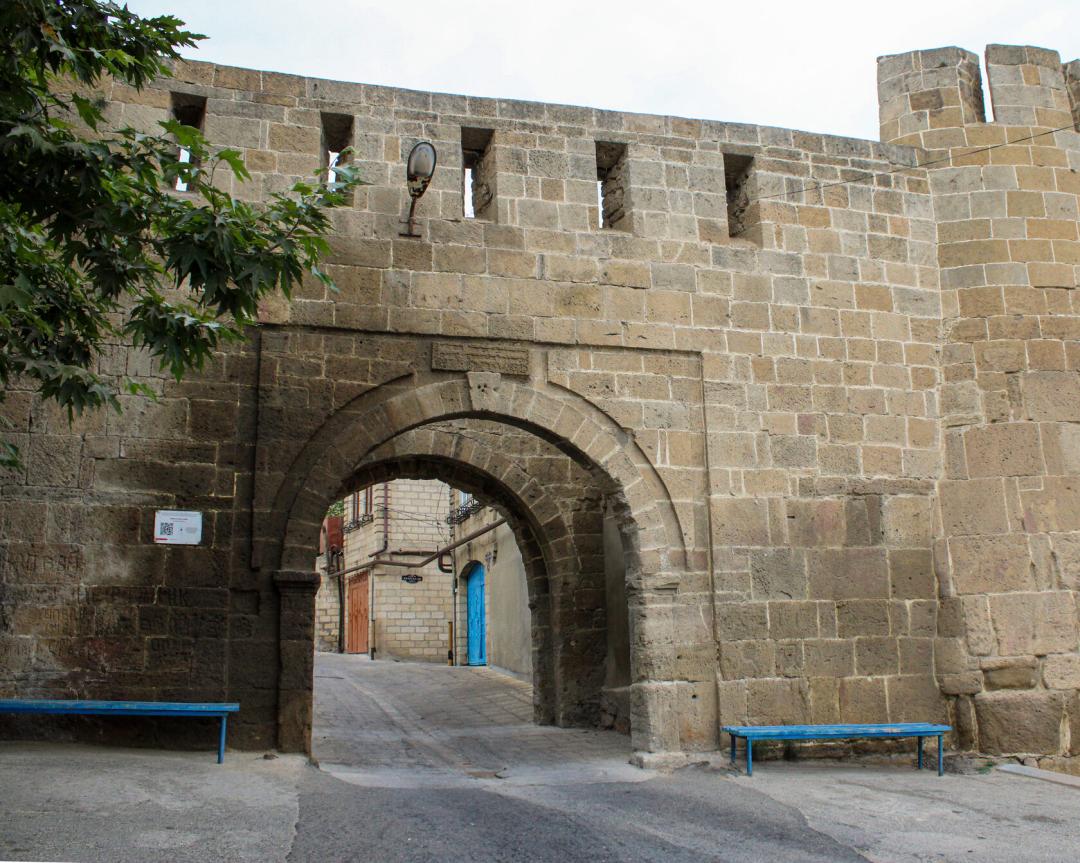
Bayat-Kapy — the second gate from the Naryn-Kala citadel on the southern wall of Derbent
Orta-Kapy Street, Derbent, Republic of Dagestan, Russia, 368600
Bayat-Kapy are the second gates from the Naryn-Kala citadel on the southern city wall. According to Arab authors of the 9th-10th centuries, the Kala-Kapy gates did not exist before, and the Bayat-Kapy gates were the first of the three gates on the southern wall from the Naryn-Kala citadel.
Bayat-Kapy — the second gate from the Naryn-Kala citadel on the southern city wall. According to Arab authors of the 9th-10th centuries, the Kala-Kapy gate did not exist before, and the Bayat-Kapy gate was the first of the three gates on the southern wall from the Naryn-Kala citadel. Therefore, these gates are considered to have been laid during the construction of the city wall itself or, at least, during major works carried out under the Arabs (8th–9th centuries). This was also indicated by an Arabic inscription above the arch of the gate on the outside: “These gates [were built or restored] in the one hundred fifty-third year of the Hijra” (the 153rd year of the Hijra corresponds to 770 or 771 AD). According to legend, the name of the gate is connected with the Turkic tribe Bayat, 500 families of which were resettled by the Persian Shah Ismail I (1501–1524) from Iran and settled in the area near these gates. According to another, less common version, the gates got their name from the Turkic word “bayah” (old, decrepit, stale), which quite corresponds to the inscription above the gates. Arab sources call them Bab al-Maktub (Gate of Letters, Postal Gate). On drawings from the early 18th century, the gates are depicted with two arched openings, inner and outer, between which a passage was arranged in the thickness of the fortress wall, covered by a pointed vault. In 1811, during repair and restoration works of the city fortifications carried out under the guidance of the Russian military engineer Karpov, the gates were completely rebuilt. The gate openings took the form of a semicircular arch, and the passage between them was covered with a wooden vault. Two semicircular guard towers were built on the sides of the gates. Above the old Arabic inscription over the gate opening, a new Russian inscription was carved: “Time destroyed me, and disobedience built me 1811.”
Source:
https://derbentmuseum.ru/monuments/vorota-bayat-kapy/
Follow us on social media