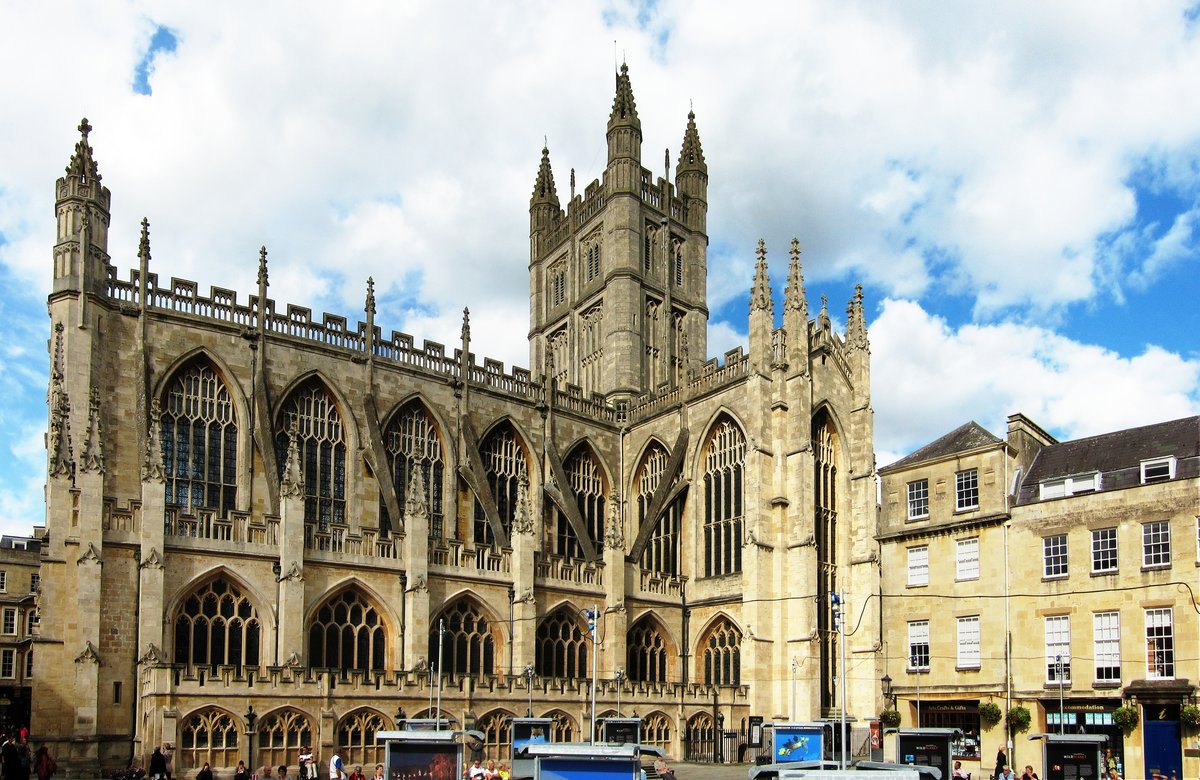

Sitting amidst the Church of England, the Abbey Church of Saint Peter and Saint Paul, commonly known as Bath Abbey, has a history that spans over a millennium. Founded in 675 by King Osric, who bestowed 100 hides of land to Abbess Berta for a religious house, it became a monastery under the patronage of the Bishop of Worcester. In 781, King Offa of Mercia successfully wrested that most famous monastery at Bath from the bishop and rebuilt the monastic church to a standard that King Eadwig described as being "marvellously built".
The 10th century witnessed the monastic reorganization prompted by the reforms of Oswald and Dunstan, with the monastic community at Bath aligning with the Rule of Saint Benedict. King Edgar advocated for this rule, which was adopted by the monks under Abbot Ælfheah (St. Alphege), who also repaired the church. The Benedictine community remained until the Dissolution of the Monasteries in 1539.
The west front of the abbey includes sculptures of angels climbing to heaven on two stone ladders, representing Jacob's Ladder. While some stories suggest these represent a dream had by King Oliver King, this interpretation first appeared in writings around 100 years after the event was supposed to have happened. Today, the building remains a Grade I listed structure noted for its fan vaulting and its distinct proportions within the Perpendicular Gothic style.
Sources: Wikipedia, OpenStreetMap, Wikidata, Wikimedia Commons
Written by Nicolo Ciampini
Discuss this with the author and others
No comments yet. Be the first to start the conversation.