52, Forbes St, Kala Ghoda, Fort, Mumbai, Maharashtra 400001, India

Before the arrival of Jews from the Middle East (Baghdadi) in India, the Jews living in Bombay (as Mumbai was then called) had already settled in Indian cities, peacefully coexisting with other Indian communities. Harry D. Wall, in an interview with the New York Times, said that among the Jews currently remaining in Mumbai, there is a group known as the Bene or Bene Israel Jews, who trace their lineage to the descendants of the seven tribes of Israel who, in the 2nd century BCE, were shipwrecked on the Indian Konkan coast while fleeing persecution in Galilee. They found life in India, among a cosmopolitan community of Hindus, Buddhists, Jains, and much later Muslims, to be a very warm environment, completely free of antisemitism.

However, the Jewish trading community that played a significant role in the commercial development of then-Bombay (now Mumbai) consisted of Jews from Iraq, Syria, and other Middle Eastern countries who immigrated at the end of the 18th century under threat of persecution. They found the environment favorable for continuing their trade and settled in the city, achieving prosperity in business ventures such as textile factories and international trade. In 1784, the British government took over the administration of the East India Company. Thanks to these changes in India, and particularly in Bombay, many business opportunities arose, prompting immigrants to establish enterprises. In 1790, one such business magnate was Shalom ben Ovadia Ha-Cohen, a Baghdadi Jew who migrated from Aleppo (Halab) in Syria to Bombay; he was followed by other Jewish businessmen from Baghdad, Basra, and Yemen.
Some Jews arrived from Bukhara, Persia, and after the Farhud pogrom in Iraq in 1941, even more immigrants moved to Bombay. They gathered in large numbers at the Knesset Eliyahoo synagogue during festivals, as well as on Rosh Hashanah and Yom Kippur. On many such occasions, due to the large gathering of devotees, overcrowded prayer services were held in the neighboring Kawasji Jehangir community hall.
In 1832, David Sassoon immigrated to Bombay and soon founded an extremely successful trading and manufacturing enterprise that provided him, his sons, and their descendants with opportunities for Jewish and civic leadership and philanthropy. He built the Magen David synagogue in Byculla, Mumbai in 1864, in addition to the old Magen Hasidim synagogue. His son, Albert Sassoon, transformed the weaving industry in Bombay.
A large and impressive synagogue, built in 1884, was constructed and donated to the Baghdadi Jewish community in Mumbai (then Bombay) by Jacob Elias Sassoon and his brothers in honor and memory of their father Eliyahu (Elias) David Sassoon, son of David Sassoon.
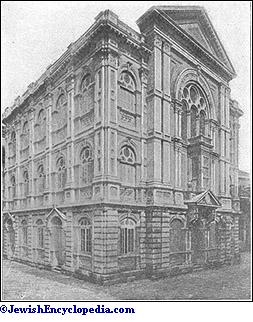
Kenesset Eliyahoo (Hebrew for "Assembly of Elijah") was designed by English architects David E. Gostling and James Morris, who lived in Mumbai in the second half of the nineteenth century and designed numerous important civic, religious, residential, and institutional buildings of the British colonial period. Over the past century, this area has been a key commercial business center, housing some of the city's most important civic and commercial structures. Previously, there stood a castle within a walled settlement called Fort George (named after King George III). The strategic fort settlement was periodically strengthened by the British, but in 1863 the fortifications were deemed unnecessary, as by then Bombay was protected from external aggression, and the Governor of Bombay, Sir Bartle Frere, ordered the walls to be dismantled. The free land inside the fort walls provided ample space for the construction needed for Bombay's growth in the latter half of the nineteenth century. On this open land, Jacob Sassoon acquired a building site from the Land Mortgage Bank of India and organized the design and construction of Kenesset Eliyahoo. Due to its location, it has always been called the Fort Synagogue.
The synagogue is located on V.B. Gandhi Street (formerly Forbes Street), a busy secondary street lined with mid-rise residential and commercial buildings. The exterior of Kenesset Eliyahoo is an example of English composite architecture. The building is mainly neoclassical in style but with elements of neo-Baroque — an aesthetic popular in the Edwardian period in Britain and elsewhere in British colonies. It features a prominently rusticated base with quoins, a middle section consisting of a group of stained glass windows and repeating window bays separated by pilasters, as well as a ceiling with a high pediment and balustrade. The exterior finish is not stone masonry but a less expensive (and therefore popular at the time) chunam (a smooth facing of polished lime slate and sand) over plain brick. For many years, the synagogue was painted in bright colors: a few years ago it was pale, and more recently bright blue with white inserts and highlights. This blue color is common to many synagogues and Jewish buildings worldwide, but it may have been chosen simply as a color preference of the managing committee.
Many details of the exterior of Kenesset Eliyahoo were precisely executed according to established stylistic traditions, including rounded arches with keystones, aligned niches, entrance pediments supported by brackets, as well as paneled pilasters and plinths. Other elements are more stylized, such as the detailing of the first-floor windows, the stepped structure of the rusticated base, and the remote location of the main entrance to the building. Similar to an urban palazzo in Europe, the first floor of Kenesset Eliyahoo houses secondary rooms such as offices, classrooms, event halls, a mikveh (ritual bath), and storage rooms, while the main room, in this case the sanctuary, is a double-height space located on the two upper levels.

Compared to the more stylistically pure exterior, the double-height interior is quite eclectic with neo-Gothic carving and pattern combined with stylized classical components, including rounded arches and slender iron columns. Above the hekhal (ark), set into the wall closest to Jerusalem according to synagogue convention and containing an unusually large storage space for Torah scrolls behind the doors, is the visual focus of the sanctuary: a large stained glass window (by John Hardman Trading Co., Ltd.), framed by a decorated frame topped with a panel bearing the Ten Commandments. An impressive crystal chandelier once hung above the centrally located tebah (bimah/raised platform with a Torah reading table), but at some point it was replaced by a smaller brass fixture. Other fixtures of the same design hang elsewhere. The sanctuary is equipped with turned wooden columns, decorative copper railings at the tebah with brass and glass dome lights projecting from the four corners, a teak reading table with intricate carving, a women's gallery around the perimeter, and polychrome encaustic Minton floor tiles from England, popular before this era. The space is filled with long freestanding teak benches with plush cushions and matching chairs. The building’s architecture is Western in style and corresponds to the mindset and tastes of the Sassoons and much of the Baghdadi Jewish community, who considered themselves loyal subjects of the British Crown in India.
A few minutes’ walk from this majestic synagogue are key Mumbai landmarks, confirming its important place in the city. Nearby are the Chhatrapati Shivaji Maharaj Vastu Sangrahalaya (formerly known as the Prince of Wales Museum), the Flora Fountain, Jehangir Art Gallery, the Gateway of India, Mumbai Town Hall, the Old Mint, Customs House, and the Taj Mahal Hotel. Alongside these sites, Kenesset Eliyahoo is marked on the city map provided by the Indian Tourism Department.
Once, this synagogue had hundreds of congregants and was a lively center of religious and civic life for Mumbai’s Baghdadi Jews (along with the Magen David synagogue in the Byculla area). Today it has a very small community but remains open and viable. Regular prayers and holiday services are held here, conducted by cantors appointed by the community. Tourists and other visitors are welcomed, and the synagogue is more than ever an integral part of Mumbai’s Jewish identity and a testament to the city’s traditions of diversity and tolerance.
In honor of important anniversaries, Kenesset Eliyahoo has hosted celebratory events over the years attended by its members, the wider Mumbai community, Indian political leaders, and dignitaries. To mark the synagogue’s centenary, the Indian Department of Posts and Telegraphs issued a commemorative stamp dedicated to this momentous occasion.
The first terrorist attack on Jews in Mumbai occurred on November 26, 2008. Rabbi Gavriel Holtzberg, who had conducted the preceding Sabbath service and religious talks at Knesset Eliyahoo, was killed along with his wife and several others at the Nariman House, the Chabad community center. This sowed fear among members of the Jewish community living in Mumbai and also strengthened the bond between the city’s Baghdadi Jews and the Bene Israel Jews.
Sources:
https://www.indianjews.org/en/research/jewish-sites-in-india/59-keneseth-eliyahoo-synagogue
https://en.wikipedia.org/wiki/Knesset_Eliyahoo

