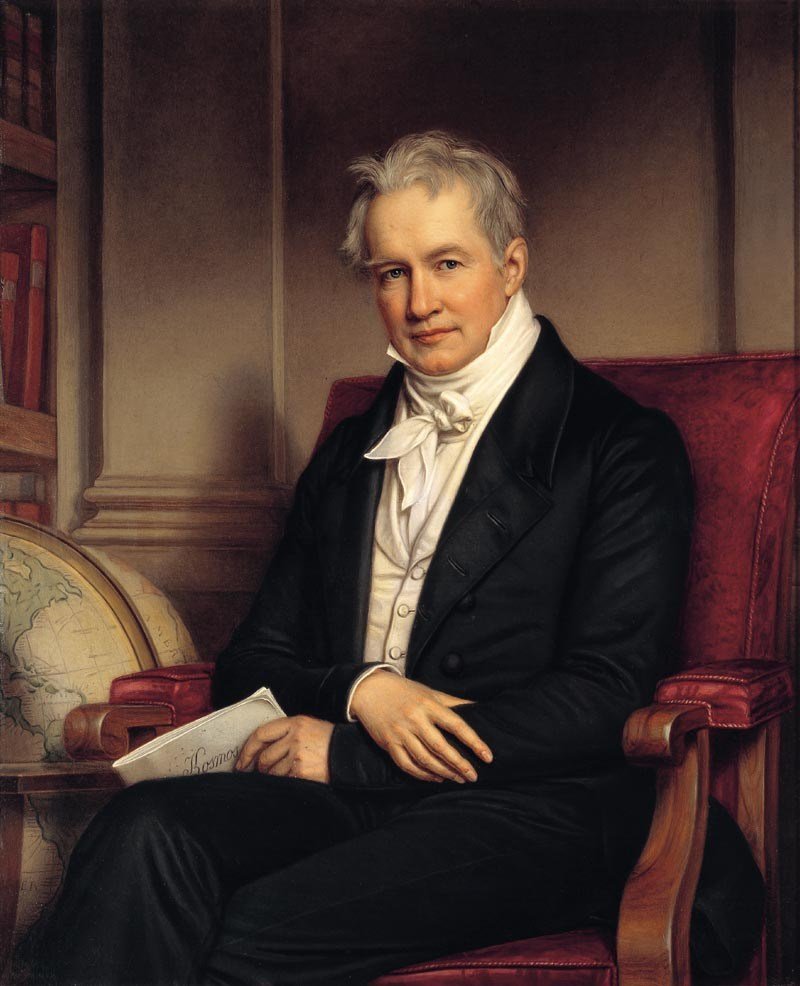

Raised by a mother with high academic ambitions in Berlin, Alexander von Humboldt was tutored by Enlightenment thinkers including Kantian physician Marcus Herz and botanist Carl Ludwig Willdenow. Due to a youthful penchant for collecting and labeling plants, shells, and insects, he received the playful title of "the little apothecary". Though marked for a political career, he studied finance for six months in 1787 at the University of Frankfurt (Oder) before matriculating at the University of Göttingen in 1789.
At Göttingen, Humboldt met Georg Forster, a naturalist who had traveled with Captain James Cook. In the fall of 1789, Humboldt traveled to the Rhine with a Dutch medical student, where his scientific excursion resulted in his 1790 treatise, Mineralogische Beobachtungen über einige Basalte am Rhein. The following year, he embarked on his first sea voyage to England, the Netherlands, and France with Forster. In England, he met Sir Joseph Banks, who showed him a huge herbarium of specimens from the South Sea tropics.
Between 1799 and 1804, Humboldt traveled extensively in the Americas, exploring and describing them for the first time from a non-Spanish European scientific point of view. Along with French explorer Aimé Bonpland, he traversed thousands of miles through some of the most difficult and little-known places on Earth. This included identifying the source of the Orinoco River and, in 1802, climbing the highest mountain in Ecuador to a height of 19,286 feet, a world record altitude for a Westerner at the time.
Humboldt resurrected the use of the word cosmos from the ancient Greek and assigned it to his multivolume treatise, Kosmos. In this work, he sought to unify diverse branches of scientific knowledge and culture, promoting a holistic perception of the universe as one interacting entity. This approach introduced concepts of ecology leading to ideas of environmentalism. In 1800, and again in 1831, he described the local impacts of development causing human-induced climate change based on observations from his travels.
Humboldt is seen as "the father of ecology" and "the father of environmentalism". His quantitative work on botanical geography laid the foundation for the field of biogeography, and his advocacy of long-term systematic geophysical measurement pioneered modern geomagnetic and meteorological monitoring.
Sources: Wikipedia, OpenStreetMap, Wikidata, Wikimedia Commons





Written by Mutabor
Discuss this with the author and others
No comments yet. Be the first to start the conversation.