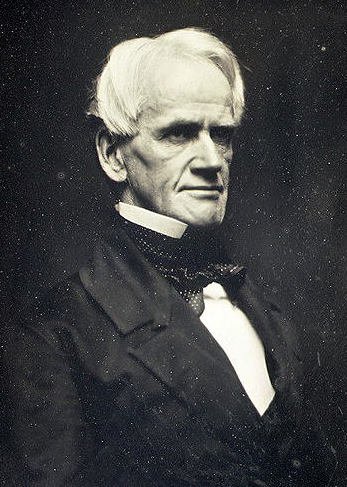
Horace Mann (1796–1859) was an American educational reformer and Whig politician known as the Father of American Education. He argued that universal public education was the best way to provide quality education for all of America's children.
Born in Franklin, Massachusetts, Mann experienced a variety of educational opportunities, from vocational training on the family farm to religious education. From age ten to twenty, he had no more than six weeks of schooling each year, but he made use of the Franklin Public Library, the first public library in America. He graduated as valedictorian from Brown University in 1819.
After serving in the Massachusetts legislature, Mann was appointed Secretary of the Massachusetts Board of Education in 1837. He withdrew from all other professional and political engagements to focus on his work. He traveled to every school in the state to examine the grounds and inaugurated a system of normal schools to train professional teachers.
To justify new taxes for public schools, Mann told businessmen that a more educated workforce would create a richer and more profitable economy. He also advocated for the disuse of corporal punishment in school discipline. His work led to most northern states adopting versions of the public school system he established in Massachusetts.
Today, a stone obelisk stands as a memorial to Horace Mann. He remains a major figure in the history of the Common School Movement, credited alongside Henry Barnard and Catharine Beecher for his advocacy of public education.
Sources: Wikipedia, OpenStreetMap, Wikidata, Wikimedia Commons



Written by No Other
Discuss this with the author and others
No comments yet. Be the first to start the conversation.