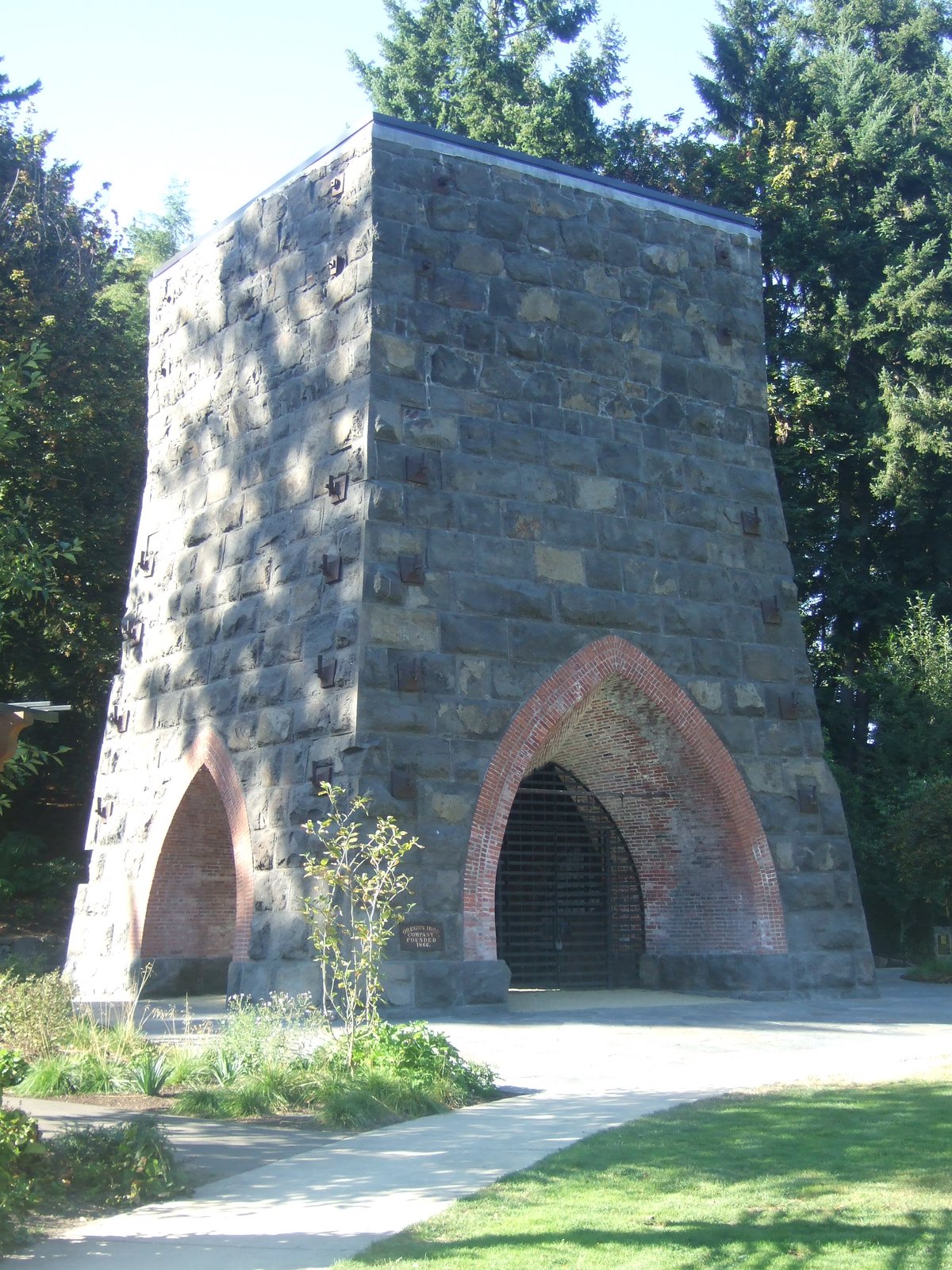
At the heart of Lake Oswego, nestled within George Rogers Park, stands the Oregon Iron Company Furnace - the only structure that remains of the original iron company. Before 1862, the majority of Oregon's iron came from the East Coast of the United States. Due to the long and difficult journey, these imported iron products were sold for up to ten times what they originally cost. Aaron K. Olds, a blacksmith who worked with the first iron on Lake Superior, created the first iron from Oswego ore in 1862 in his iron forge.
Olds had started the forge with the intention to smelt the iron ore, but the ore proved refractory and he was unable to smelt it down. However, Olds and his business partner H.S. Jacobs eventually turned a significant profit from creating horseshoe nails and miner's picks that were displayed in Jacobs' wagon shop window on Portland's Front Street. With Olds' profits, a group of investors from Portland saw the economic opportunity in forming an iron company based in Oregon. The project was, in part, spearheaded by Olds' competitor Henry D. Green, who had purchased the water rights to Sucker Creek and a few acres of land above Oswego Landing in 1862.
The Oregon Iron Company Furnace was built in 1866 under the supervision of George D. Wilbur. The furnace is 32 feet tall with gothic-style arches lining the walls, 34 feet square at the base, and 26 feet square at the roof. Wilbur modeled the stone furnaces after those of the Barnum Richardson Company in Lime Rock, Connecticut. Basalt from the north side of Lake Oswego was used in the stonework, while firebrick was imported from Great Britain for use in the shafts, chimneys, and heat exchangers. The cost of construction was $126,000.
By February 1865, twenty stockholders had invested a total of $500,000 in the company, with some investors hailing from New York and San Francisco. While water disputes and Eastern competitors suspended the company several times, operations finally shut down indefinitely in 1894. Today, the furnace remains a historic landmark that underwent a major renovation in 2010.
Sources: Wikipedia, OpenStreetMap, Wikidata, Wikimedia Commons
Written by No Other
Discuss this with the author and others
No comments yet. Be the first to start the conversation.