Colonial Cities of Mexico - Merida

For Browsing

The city was founded on January 6, 1542, on the ruins of the ancient Maya city of T'ho. The stones from the ruins served as building material for the Spanish colonizers led by Francisco de Montejo and León. The ruins reminded the colonizers of the preserved Roman fortresses in the Spanish city of Mérida, and the new settlement was named in its honor. Mérida became the very first city in Yucatán built by Spanish colonizers, and the other cities were established following its example. It is an old city with its own traditions, featuring the architecture of Spanish colonists and Europeans, with narrow streets and shady parks.

Cathedral of Mérida - Catedral de Mérida (Yucatán)

C. 58 508, Centro, 97000 Mérida, Yuc., Mexico

The construction of the main cathedral of Mérida was carried out by enslaved Maya Indians. They were forced to dismantle their own temples and then use the resulting stones to build a Christian church. According to Catholic priests, this was meant to symbolize the victory of Christianity over local beliefs. In total, the construction of the Cathedral of San Ildefonso lasted 37 years. The temple’s appearance resembles a well-fortified fortress. The Yucatán Cathedral is considered the first temple to appear in mainland America and is the oldest cathedral in Mexico. Chroniclers of that time describe the cathedral with admiration. Francisco de Cárdenas Valencia wrote in 1618 that “this is undoubtedly the most beautiful and finest temple built to date in the Indies.”

Arch of San Juan - Arco de San Juan

C. 64ᴬ 524, Centro, 97000 Mérida, Yuc., Mexico

The San Juan Arch is located on 69th Street in the center of Mérida, opposite the park and the San Juan church. Tourists passing under this arch have no idea that they are retracing the path of the Spanish conquerors of Yucatán. The San Juan Arch was recently renovated, so now it looks incredibly bright in the rays of the southern sun.

Paseo de Montejo - Paseo de Montejo

P.º de Montejo 452, Paseo Montejo Zone, Downtown, 97000 Downtown, Yuc., Mexico

Paseo de Montejo is named after the founder of the city of Mérida, Francisco de Montejo y León (El Mozo), the conqueror of Yucatán. It is an avenue that stretches from the Santa Ana district in the city center to the exit leading to the port of Progreso, Yucatán. The layout and design are inspired by the planning of French boulevards, mainly the Champs-Élysées in Paris. On both sides of the avenue stand beautiful palaces and mansions of the wealthy people of 19th-century Yucatán. Along the entire length of Paseo de Montejo, there are important monuments and structures symbolizing the city of Mérida and the state of Yucatán.

Monument to Gonzalo Guerrero – a Spaniard and a Maya, son and father of two peoples

C. 33 501, Gonzalo Guerrero, 97115 Mérida, Yuc., Mexico

In Mérida, on Paseo de Montejo, there is a monument to one of the most famous Spaniards to ever visit the New World. It is a monument to Gonzalo Guerrero, his wife Zazil Há, and their three children. There are no plaques with explanations on it, and few of those who pass by have even heard of the incredibly fascinating story behind the first Spaniard who truly fell in love with Yucatán and its people and became Maya.

Casa de Montejo - the oldest building in Merida
C. 63 506, Centro, 97000 Mérida, Yuc., Mexico

Francisco de Montejo the Younger "el Mozo" began the construction of the Casa de Montejo in 1542. The construction lasted seven years, and today it is the oldest surviving building in Mérida. It is a true colonial palace; on the facade, triumphant conquistadors with halberds stand on the heads of ordinary barbarians. Typical of colonial symbolism are sculptures where the defeated are much smaller than the victors; in various churches in the region, high priests are depicted towering over or standing before the small number of indigenous people.

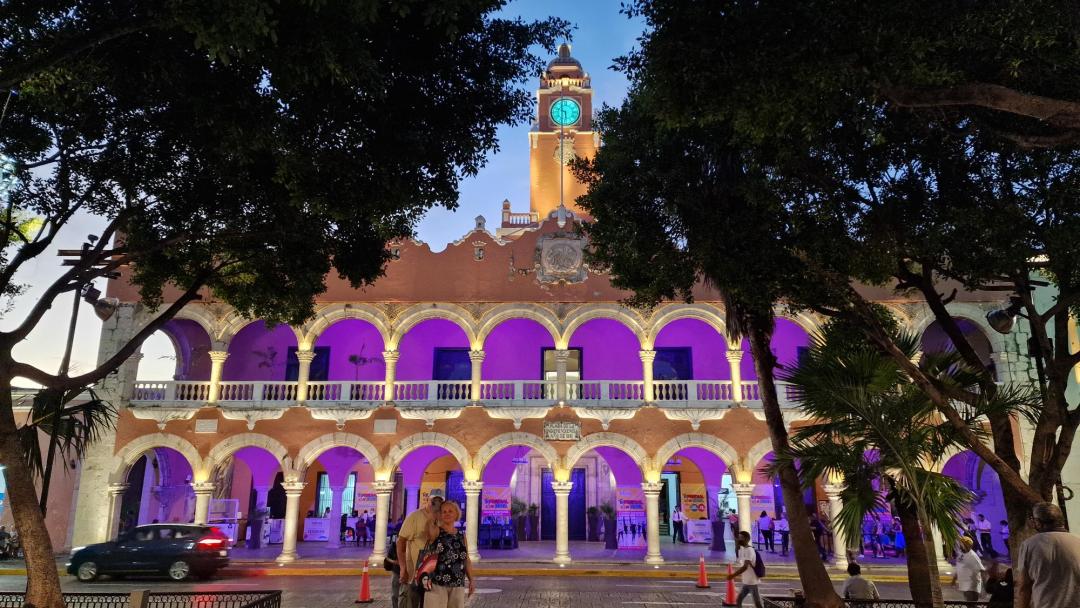
Municipal Palace - Palacio Municipal

C. 62 LB, Centro, 97000 Mérida, Yuc., Mexico

Opposite the Mérida Cathedral stood a one-story stone mansion of the Consistory, which included the municipal jail. The building was constructed in 1542 on the site of the pre-Hispanic mound "Shbakluum-Chan." In 1735, it was rebuilt as the Municipal Palace of Mérida. Over the centuries, it underwent several renovations, the most important of which took place in 1928, when its facade was reconstructed and a new clock tower was built.