
Petersburg: Neo-Gothic
För bläddring
Pointed arches, tall slender turrets, wrought iron spires, tall windows, stained glass – all of this is the mysterious and majestic Gothic style. In the mid-18th century, after a prolonged period dominated by Classicism, Europe suddenly made a sharp turn toward Romanticism. Gothic castles and cathedrals of the 12th-13th centuries abruptly became models to emulate in construction, although not long before they had been considered old-fashioned and tasteless. At the end of the 19th century, during the Art Nouveau era in Russia, pseudo-Gothic buildings experienced a revival. Architects and patrons of the Russian Empire noticed new trends, but the country had no native historical Gothic architecture. Therefore, Russian and foreign architects working in St. Petersburg began borrowing features of medieval European Gothic architecture. Initially, individual elements were used, and then entire majestic carved facades were created. It was during these years that the buildings of the famous architect Yuri Felten, a student of the great Rastrelli, appeared. He was able to combine Gothic features of European architecture with traditional Russian elements in construction. This is how Russian Gothic, or pseudo-Gothic, came into being.
 Jermaine
 Karta

Evangelical Women's Hospital

Chesme Palace

Lutheran Church of Saint Michael

Saltykova's Dacha
TD "Burda Moden, Akademika Krylova St., 4, Saint Petersburg, Russia, 197183
Petersburg: Neo-Gothic Jermaine 
Church of the Nativity of John the Baptist

Church of Peter and Paul in Pargolovo

Mesmakher's Dacha

Gothic Chapel in Peterhof - Church of Alexander Nevsky

New Peterhof Station Terminal
New Peterhof, Bratyev Gorkushenko St., 9, Saint Petersburg, Russia, 198510
Petersburg: Neo-Gothic Jermaine 
Gothic well in Alexandria Park

Gothic Palace Stables

Guardhouse (Gothic) with gates

Peterhof Post Office

Vsevolozhsky's Dacha

The building of the V.I. Truveller estate.

Farmer's Palace, Alexandria Park
Alexandria Park 19, Saint Petersburg, Petrodvorets, Saint Petersburg, Russia, 198510
Petersburg: Neo-Gothic Jermaine 
Arsenal
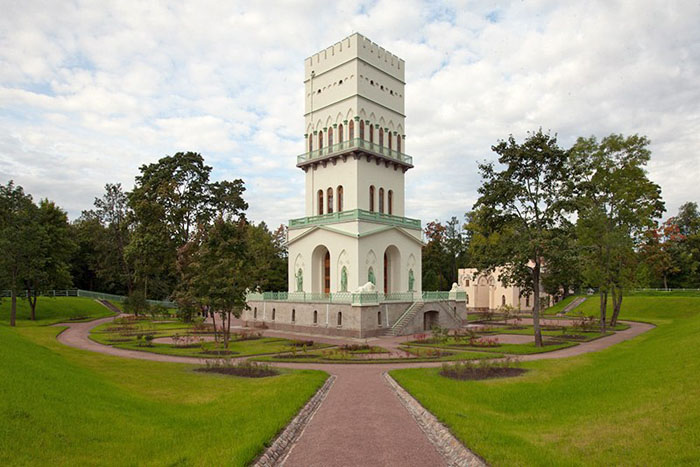
White tower and gate ruin

Tower Ruin Chapel

Gothic gates
Catherine Park / Ekaterininsky Park, Saint Petersburg, Russia, 196603
Petersburg: Neo-Gothic Jermaine 
Palace Power Station in Pushkin

Renella Pavilion (Tea House or Gothic Cottage)

P.K. Alexandrov's Dacha (Lviv Palace)

Cottage Palace

The Mansion of Countess Kleinmichel

German Reformed Church — Palace of Culture of Communications Workers
