8P7R+R9V, Changikhisarak, Tashkent Region, Uzbekistan
First, in 1940, a Physico-Technical Laboratory appeared in Tashkent, and just three years later, the Physico-Technical Institute was established, which was the first research institute of a physical profile in Central Asia. Later, several subdivisions were opened, including the Scientific Production Association (NPO) "Physics-Sun." Research was conducted here for the military-industrial complex and space projects, so it is understandable that it was classified.
Construction of the complex in Uzbekistan began in 1981. A number of factors influenced the choice of location. Firstly, Uzbekistan had the necessary scientific personnel — the Physico-Technical Institute in Tashkent, founded in 1943, was the first institute of physical profile in Central Asia. Its director, Academician Sadik Azimov, confident in the prospects of using renewable energy sources, became the initiator of building the solar furnace.
This amazing place is located 45 kilometers from Tashkent in the foothills of the Tien Shan mountains at an altitude of 1050 meters. The Sun Institute (as it is commonly called, officially the Physico-Technical Institute of NPO "Physics-Sun" of the Academy of Sciences of the Republic of Uzbekistan) is situated beyond Parkent in a settlement named Sun. In the Tien Shan foothills, nature created ideal conditions for the installation’s operation: 250–270 sunny days per year and a clean, rarefied atmosphere. The entire complex stands on a rocky foundation, meaning it is safe from earthquakes. Precise adjustment is necessary for the heliostats, so even minor underground tremors could affect the operation of the entire furnace.
There are only two such complexes in the world. Another one operates in Font-Romeu-Odeillo in the Eastern Pyrenees of France. It is the largest solar furnace in the world, opened in 1970. Its helioconcentrator, 54 meters in diameter, can generate about 1 megawatt of power. The Uzbek facility is comparable in power. What are they used for?
According to legend, Archimedes used a similar technology to set enemy ships on fire. During the Second Punic War, the Roman fleet attacked Syracuse, but the scientist was prepared and focused sunlight on wooden ships using several mirrors, setting them ablaze. Most likely, this is impossible in combat conditions, but the principle works.
The solar furnace consists of three main elements. The heliostat field — parabolic mirrors whose task is to catch sunlight and direct it to the concentrator. The concentrator focuses this energy into a small point. And the furnace itself, where the main action happens: substances placed inside are heated to 3,500–4,000 degrees Celsius. Thanks to such temperatures, it is possible to obtain unique materials without impurities.
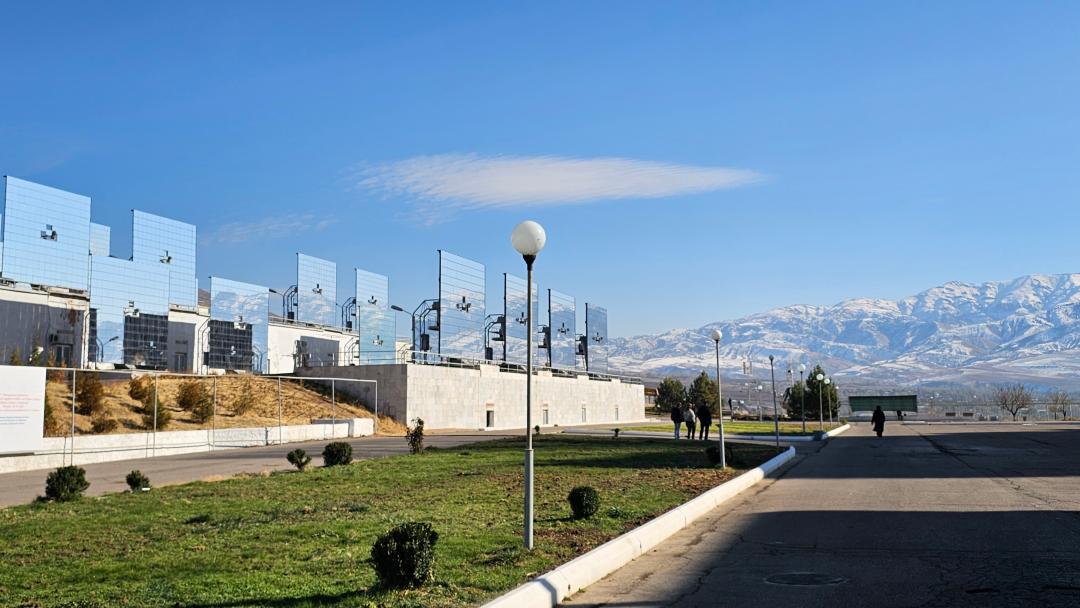
On the hillside, mirrors are arranged in rows in a checkerboard pattern (there are 62 in total), which rotate following the sun and direct its rays to a giant concentrator (a large curved mirror measuring 54 meters by 47 meters). The heliostat field consists of 62 installations covering an area of more than 3,000 square meters. The heliostats are installed on a gentle slope in a checkerboard pattern to avoid shading each other. Each heliostat, measuring 7.5 by 6.5 meters, consists of 195 facets — flat reflective elements. The heliostats automatically rotate to provide the necessary reflection to create the required temperature in the furnace. For this, a sensor is installed in front of each one, which adjusts the device’s position depending on the sun’s location.
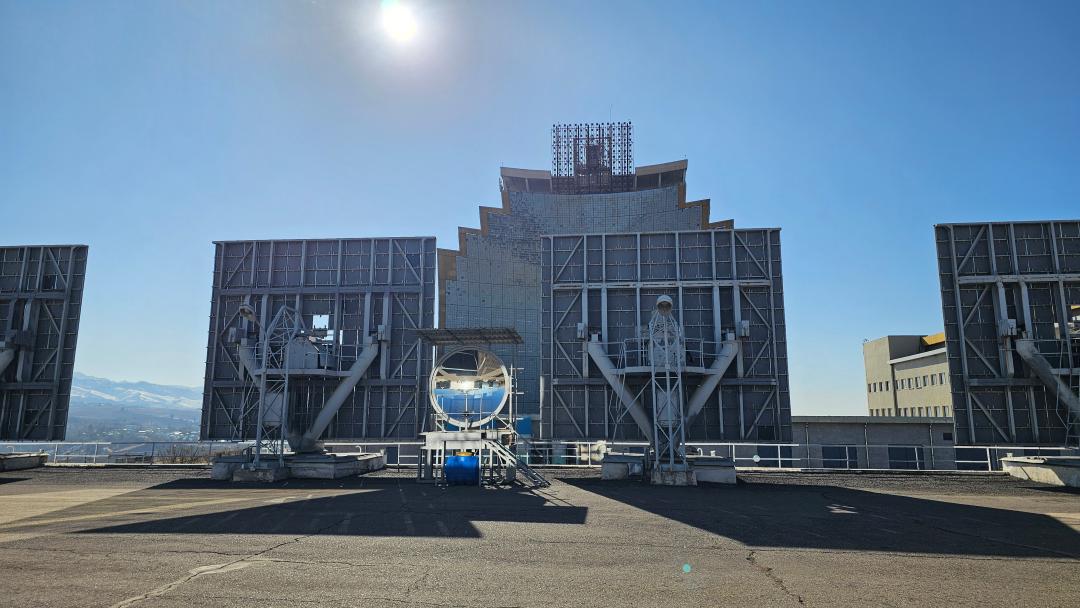
The most outstanding part of the complex — the helioconcentrator — consists of 10,700 mirrors, organized in blocks of 50 mirrors each. Yes, sometimes they need to be replaced and cleaned. Fortunately, the weather conditions are almost ideal, so they are hardly threatened. But if necessary, ladders and lifts are used, and the entire process takes several days. The back side of the concentrator is covered with sun protection panels — these are needed so that the metal structures do not overheat and deform.
At the very top of the concentrator are sight marks for aligning (bringing into working position) the heliostats.
At the height of the sixth floor inside the concentrator is the pyrometric laboratory, from which the furnace operation is controlled. To get there, the complex has a freight-passenger elevator. However, during our visit, it was not working, so we had to climb the stairs.

The reflected light is focused on a 40-centimeter diameter hole in the technological tower, which stands 18 meters from the concentrator — this is its focal length. To cool the tower during furnace operation, water constantly circulates through it. The temperature inside the furnace can reach 3,000 degrees Celsius. Mainly, scientific research is conducted there, such as the effect of high temperatures on various materials. Besides the ability to obtain impurity-free materials, the furnace can simulate various conditions. This means the installation is suitable for testing new materials under space or other planetary conditions. Here, fireproof ceramics that withstand very high temperatures are created — for example, used for high-voltage line insulators and spacecraft cladding. Thanks to unique technology, it is lightweight and strong. Currently, the Institute of Materials Science is researching the production of fullerenes, carbon nanotubes, and hydrogen production technologies for clean energy in the furnace.
Based on several laboratories of the Physico-Technical Institute, the Institute of Materials Science was established in 1993, which specifically develops and tests new materials under unique conditions.
Construction of the complex was completed in 1987, but shortly thereafter, party officials harshly criticized both the project idea and the resources spent on it. Academician Azimov died of a heart rupture right during the devastating party report.
Almost immediately after the complex’s completion, the Soviet Union ceased to exist. In independent Uzbekistan, the heliocomplex was not only preserved but also successfully operated. Naturally, this was partly due to the unique installation allowing orders from organizations worldwide, thus earning money for its existence.
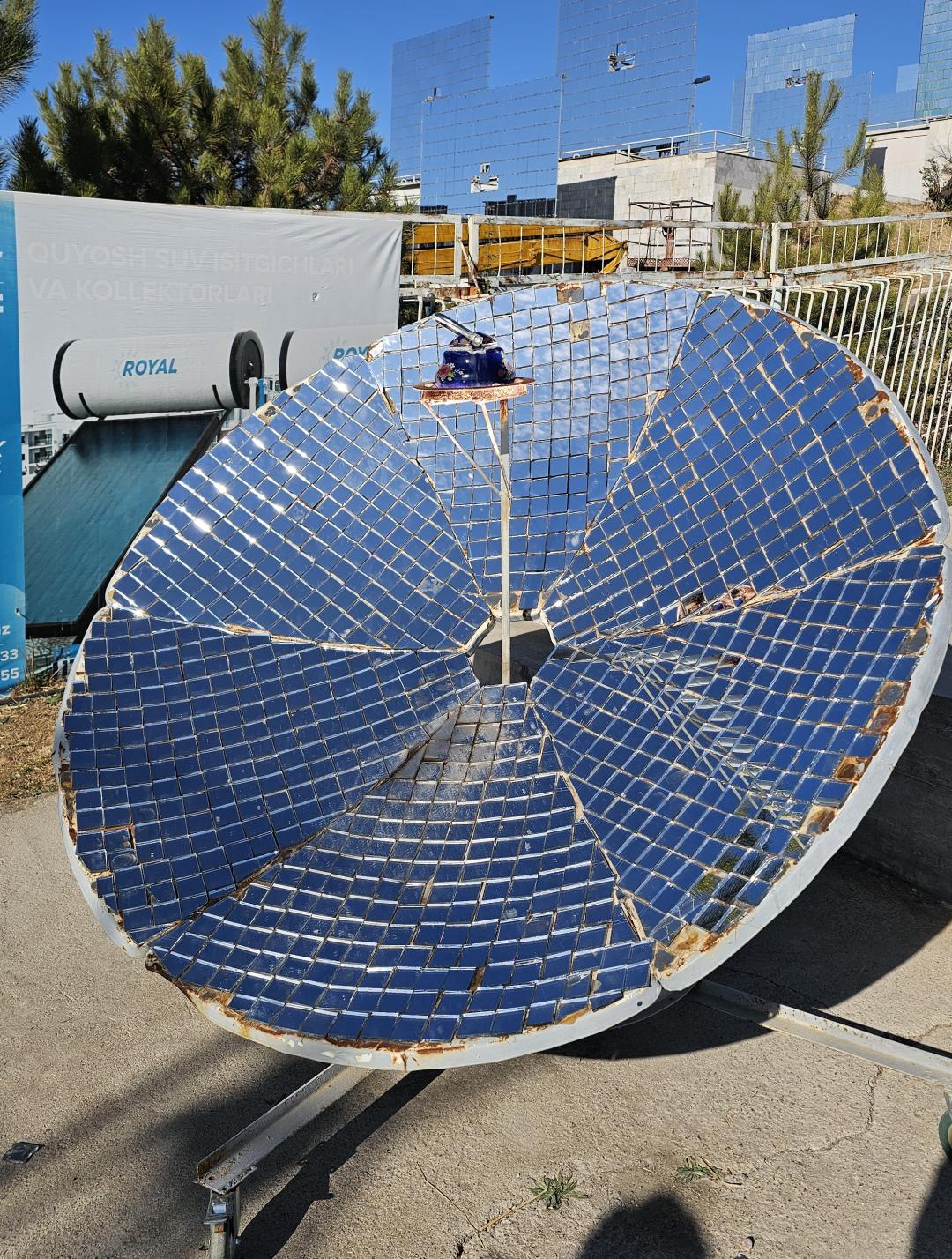
On the territory, they not only tell about science but also demonstrate how the concentrator works. You can boil a kettle by focusing the sun’s energy and even ignite a stick using Archimedes’ method. The kettle boils in a couple of minutes, and the stick starts smoking almost instantly. After this, the legend about the ships no longer seems so incredible.
Even without considering its scientific significance, the complex is a huge achievement of human engineering in every sense.
Sources:
https://dzen.ru/a/ZUocRlmlc2ikJ9vE

