Broken symbol of independence

Parkovaya St., 19, Vyborg, Leningrad Region, Russia, 188811

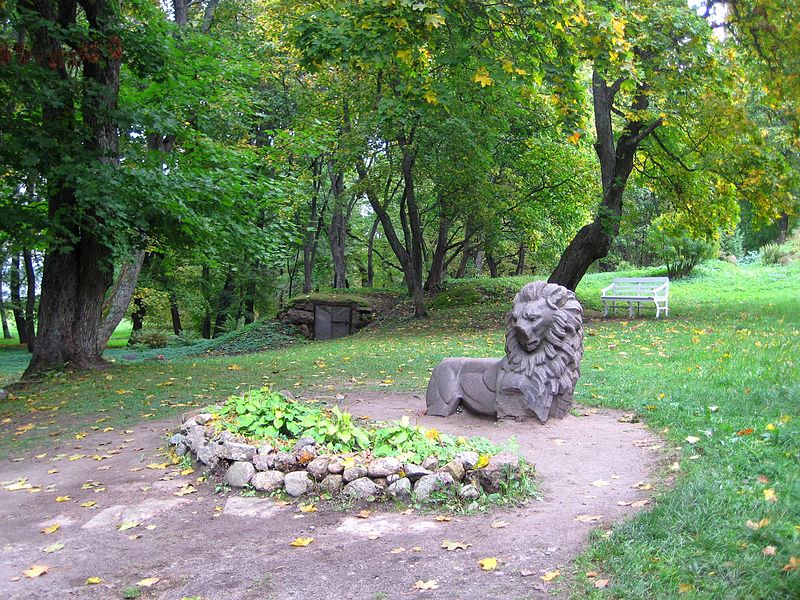
A rare Finnish tourist visiting Monrepo understands that the granite lion on the lawn in front of the museum-reserve administration is the very same one that once proudly gazed over the city from the top of Terva-niemi hill.

In the Monrepo estate, which has become a museum-reserve, the Vyborg symbol of Finnish independence found refuge — a granite lion created by sculptor Gunnar Finne. Few Finns, among the generations who honor their history, do not know that a Monument of Independence was erected in Vyborg, the design competition for which was held in 1924 among sculptors from all over the country. But few Finnish tourists visiting Monrepo realize that the granite lion on the lawn in front of the museum-reserve’s administration building is the very same one that proudly overlooked the city from the top of Tervaniemi Hill, or Petrovskaya Hill (the old name of Smolyanoy Cape). It is hard to believe, but this is the granite monument of Finnish independence.

A bit of history: in 1910, on the summit of Petrovskaya Hill, a monument to Peter the Great was erected in honor of the 200th anniversary of the city’s capture by Russian troops. This happened at a time when relations between the Russian Empire and its autonomous Grand Duchy of Finland were no longer amicable. After Lenin signed the Decree on Finnish Independence and the failed Finnish revolution, the suppression of which took place amid hostility also toward everything Russian, the monument to Peter I, which reminded of Russia’s greatness, was toppled on July 21, 1918. The idea to place a monument on the rock summit, on the site of the demolished statue of the Russian emperor, was proposed by Vyborg native Major General Teslev, who also donated money for the creation of the sculpture (about one hundred thousand Finnish marks). From 1927 to 1940, the lion stood on the high pedestal of the Peter monument in Petrovsky Park in Vyborg, holding the coat of arms of Vyborg Province in its right paw. In 1940, Soviet troops restored the monument to Peter I to its historic place, and the Finnish lion was thrown off the cliff. Upon falling, the granite sculpture cracked, and the lion lost its paws. However, in 1941, the fragments of the sculpture were reinstalled in the park by Finnish soldiers, who again toppled the monument to Peter I after capturing Vyborg during World War II. Later, the returning Russians once again threw the granite crippled lion down and, to be sure, buried it in Monrepo Park, where it was found in 1989 by museum staff and carefully installed by them among the grass and flowers. It still stands there to this day, quite familiar and homely to the local inhabitants, a descendant of that ancient sword-bearing lion that recently adorned yellow pennies and stamps.

Sources:

https://ru.wikipedia.org/wiki/Monument_of_Independence_(Vyborg)

http://vvyborg.ru/skulptura-lev-v-parke-monrepo

Follow us on social media

More stories from Vyborg: Monrepo Landscape Park

Väinämöinen in Monrepo

Unnamed Road, Leningrad Region, Russia, 188811

The granite gorge with the sculpture of Väinämöinen, the main hero of the Karelian-Finnish epic "Kalevala," serves as a natural extension of the park's most "stone" section.

The Main Gate of Monrepo

Parkovaya St., 19, Vyborg, Leningrad Region, Russia, 188811

Решение построить новые ворота усадьбы в неоготическом стиле было принято владельцем имения, Павлом Николаем.

Source Narcissus

Unnamed Road, Leningrad Region, Russia, 188811

“The conductor told us that the spring water is famous for its healing power, taste, and freshness. Indeed, I have never drunk water like that in my life.”

A column erected in honor of Emperors Paul I and Alexander I (The Column of the Two Emperors)

PPMM+GJ Vyborg, Leningrad Oblast, Russia

…A short dedicatory inscription, Which you can read on the base of a column Made of Finnish marble. It states: “Caesar has granted us peace.”

Obelisk of the Broglie Brothers

Unnamed Road, Leningrad Region, Russia, 188811

The Island of the Dead and Ludwigsburg

Unnamed Road, Leningrad Region, Russia, 188811

In the northern part of the Monrepo estate, on a small island that is a granite rock called Ludwigstein, there is a complex of structures and monuments, including the snow-white Ludwigsburg Chapel, the family necropolis of the Nicolai family, the Medusa Grotto, gates, a pier, and several granite staircases leading up to the rock.

Monrepo Landscape Park

Ural Street, 72, Vyborg, Leningrad Region, Russia, 188811

A picturesque landscape park is located on Tverdysh Island on the shore of the Protective Bay of Vyborg Bay.

Witch's Cave in Monrepo

PPPC+GC Vyborg, Leningrad Region, Russia

In the northwest of the park, there is a small through grotto. Many legends and rumors exist about unexplained phenomena and instant healings occurring in this little cave. It is called the Witch's Cave, the Hermit's Cave, or the Cave of Wish Fulfillment. Such a mini-journey helps women to relieve nervousness, while for men it adds courage and strengthens the spirit. If you decide to visit Monrepo, know that visiting this unique place has a very beneficial effect on your mental and physical well-being.

Temple of Neptune

Unnamed Road, Leningrad Region, Russia, 188811

In the poem "The Monrepo Estate in Finland" (1804), Ludwig Nicolai mentions an "open temple" being built in the Greek style, next to which stand two old fir trees.

Chinese umbrella

Parkovaya St., 19, Vyborg, Leningrad Region, Russia, 188811

Not far from the gate, right by the fence, stands a huge boulder. On it was one of the park's "surprises" – the "Chinese Umbrella."