Kiryanovo Estate ("Dashkova's Dacha," "Horseshoe")

pr. Stachek, 3 92, Saint Petersburg, Russia, 198096

Kiryanovo ("Dashkova's Dacha," "Horseshoe") is a country house in the Palladian style, built in 1783–1784 for Princess Vorontsova-Dashkova according to a design by Giacomo Quarenghi at the 4th verst of the Peterhof road.

Kiryánovo (“Dashkova’s Dacha,” “Horseshoe”) is a country house in the Palladian style, built in 1783–1784 for Princess Vorontsova-Dashkova according to a design by Giacomo Quarenghi, located at the 4th verst of the Peterhof road.

The first mistress of the estate was the famous Princess Ekaterina Romanovna Dashkova, née Vorontsova. A friend and ally of Empress Catherine II, participant in the 1762 palace coup, director of the St. Petersburg Academy of Sciences, memoirist, and one of the most prominent figures of the Russian Enlightenment.

The estate’s original name was “Kir and Ioannovo.” It was named after the holy unmercenaries Cyrus and John, on whose feast day, June 28, 1762, Empress Catherine II ascended the throne. Dashkova deliberately chose this name because the purchase of the land and construction of the dacha coincided with the preparation of the conspiracy to remove Emperor Peter III from power.
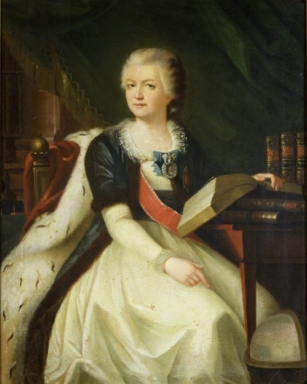

Dashkova herself recounted this in her “Notes.” Initially, the estate was wooden, rectangular in plan, with the main house in the center and four wings at the corners. Upon returning to Russia after a long trip abroad in 1782, Dashkova decided to build a new stone house. Despite her closeness to the Empress, the princess was financially constrained and could not afford to buy a mansion in the city. The decision to rebuild was also prompted by the fact that the estate suffered severe damage during the 1777 flood.


According to the “Notes,” construction lasted throughout 1783–1784. “I even worked alongside the masons who laid the walls,” the princess writes. Officially, the estate’s design is attributed to architect G. Quarenghi, although in her memoirs Dashkova omits his involvement, naming herself as the sole author. The building’s exterior is characteristic of Russian classicism of the 1780s–1790s and corresponds to the Palladian style trends. The central building is a structure with smooth walls, rectangular windows, and a portico of four Ionic columns decorating the main staircase. The main house is connected to two-story wooden wings by a semicircular covered gallery, an arc that formally enclosed the rear but in fact faced the road—the ceremonial courtyard. This contradiction arose because, by Peter I’s decree, dachas along the Peterhof road were to be built with their facades facing the sea.

The building’s plan is semicircular, which explains its informal name “Horseshoe.” There is a popular legend that during one of the Empress’s country trips, a horse pulling the carriage lost a horseshoe at the future site of the dacha. At that moment, Catherine II conceived the idea to build a country mansion for her friend and companion in the shape of a horseshoe—a symbol of happiness. Around the dacha, a large English landscape park was laid out, stretching to the seashore. A clearing was cut through it toward the Gulf of Finland, and the territory was intersected by winding canals forming islands. A description of the park by Georgi from 1794 is known: “Noble stone buildings form an open courtyard with the wings, extending to the main road and planted with various trees along it. Next to the buildings is a fruitful garden with greenhouses. Behind the buildings is a mixed forest with a noble meadow near a stream and notable canals, also surrounding a small island with a bathhouse. Straight and winding paths lead through the forest to the sea gulf, where stone houses stand, and between both is the main entrance.”

Judging by the plans, engravings, and Georgi’s description, the estate differed from similar nearby aristocratic dachas by the austerity of its overall layout: a minimum of wings, service buildings, and pavilions, and the garden was deliberately created as a place for walks in solitude or in the company of close friends.


However, Dashkova was able to enjoy the idyllic lifestyle in the estate she built and arranged for only a short time. The princess’s financial situation remained constrained, and soon she was forced to rent out the dacha. For example, in the early 1790s, the dacha was rented by the family of Prince Shakhovsky.

Falling into disgrace, Ekaterina Romanovna Dashkova spent the last years of her life away from St. Petersburg and Kiryánovo. She settled in her husband’s estate—the village of Troitskoye in Kaluga province. On January 4 (16), 1810, she died in Moscow. Kiryánovo was inherited by her cousin’s nephew Ivan Illarionovich Vorontsov-Dashkov.

The estate’s subsequent fate was full of unexpected twists. As early as 1805, the “Great Britain” tavern operated on the estate grounds. Owners and tenants changed frequently: besides the Shakhovskys, the Katenins, Khvostovs, and others lived here. At literary evenings held within the estate walls, Krylov read his fables.

There are various legends associated with “Kiryánovo.” Pylyayev, in his book “Forgotten Past of the St. Petersburg Surroundings,” mentions the tragic death of 23-year-old Princess Shakhovskaya and a treasure of family diamonds allegedly buried by Count Zavadovsky. There is also a comical story in the style of a Gogol tale about how Senator Naryshkin and Princess Dashkova quarreled over two pigs that wandered into the estate.

In 1838, Vorontsov-Dashkov sold “Kiryánovo” to the Yakimov merchants, who in the same year built a silk factory there. By 1865, besides the stone and two wooden merchant houses, the former estate grounds already housed two factories producing silk and woolen goods. In 1847, Yakimov sold the seaside part of the dacha to Starikova, which effectively led to the garden’s division. The park was finally destroyed in the 1870s during the construction of the Putilov railway. Soil was taken from its territory to build the embankment; thus, a huge quarry pond was formed, partially existing to this day.

At the end of the 19th century, the estate housed greenhouses of the well-known philanthropist and merchant Ushakov. At that time, revolutionary-minded workers began gathering in the abandoned corners of the park. At one such meeting, Kalinin spoke. In the early 20th century, Ushakov organized a family club for workers of the Putilov factory in the estate, and the estate building was altered: wooden superstructures appeared on the wings and outbuildings, distorting its appearance.

In 1934, a railway overpass for the Putilov railway branch was built near the estate according to a project. After the October Revolution, the estate building housed various institutions at different times: a pioneer camp of the “Red Putilovets” factory, a residential building, an adult school, and after the war—a kindergarten. In 1970–1975, the estate building was taken under state protection and adapted as the wedding palace of the Kirov district. In the 1970s, an attempt was made to partially restore the estate park, but it was interrupted when, in the mid-1980s, construction of a new workshop for the Kirov factory began. Now the ugly skeleton of this unfinished construction looms behind the estate. Since 2007, the right wing of the estate houses a branch of the “Narvskaya Zastava” museum and a memorial room dedicated to Princess Ekaterina Romanovna Dashkova.

Sources:

https://ru.wikipedia.org/wiki/Kiryánovo_(estate)

https://www.citywalls.ru/house5193.html


Follow us on social media

More stories from Great Architects: Giacomo Quarenghi

English Palace - The Executed Masterpiece of Quarenghi

VVJJ+7P Petrodvortsovy District, Saint Petersburg, Russia

The English Palace was located in the center of the English Park, on the northern shore of the English Pond. The monumental three-story building with an eight-column portico was built in 1796 based on a design by Giacomo Quarenghi. This was Quarenghi's first project in Russia. The palace's patron, Catherine II, planned to rest here away from the courtly bustle.

Narva Triumphal Gates

Stachek Square, 1, Saint Petersburg, Russia, 190020

A 19th-century architectural monument built in the Empire style based on the design by architect Vasily Petrovich Stasov. The gates were erected between 1827 and 1834 in memory of the Patriotic War of 1812 and the foreign campaigns of the Russian army in 1813–1814. The compositional center of Stachek Square (formerly Narvskaya Square) was constructed to replace the old wooden gates designed by Giacomo Quarenghi, which stood on the border of Saint Petersburg near the city’s Narva outpost closer to the Obvodny Canal.

Italian Architects in Saint Petersburg - Busts of Four Italian Architects

Manezhnaya Square, 4, Saint Petersburg, Russia, 191023

The busts of four Italian architects—Antonio Rinaldi, Carlo Rossi, Giacomo Quarenghi, and Bartolomeo Rastrelli—appeared on Manezhnaya Square in Saint Petersburg in 2003 thanks to sculptors V.E. Gorevoy and architect V.V. Popov. This was a gift from the government of the Italian Republic and the municipality of the city of Milan for the 300th anniversary of Saint Petersburg.

Konstantinovsky Palace in Pavlovsk Park

MFQC+H9 Pushkinsky District, Saint Petersburg, Russia

The time of the creation of the Konstantin Palace dates back to the late 18th century. The construction of the palace began in the Catherine Park of Tsarskoye Selo in November 1792. The palace was built from November 1792 to June 1793 according to the design of architect Giacomo Quarenghi. It is known that it was a rectangular two-story building, 58 meters long and 23 meters wide. The central part of the main facade, with three Venetian (triple) windows, was crowned with a pediment. Ten Ionic half-columns were installed between the windows. The exterior of the palace was clad with boards, the walls were painted yellow, and the roof was green. The years of the Konstantin Palace's existence in Tsarskoye Selo represent only the first stage of its history. On August 19, 1797, when Paul I ascended the throne, a decree was issued to move the Konstantin Palace with its kitchen to Pavlovsk. The relocation began in February 1798 and lasted more than five months. The construction of the palace was carried out under the supervision of architect Brenna.

The Church of Saint Mary Magdalene - the first stone building in Pavlovsk

Sadovaya St., 17, Saint Petersburg, Russia, 196620

The Church of Saint Mary Magdalene is an Orthodox temple in Pavlovsk, the first stone building in the city. The church was founded in May 1781 in the presence of Grand Duke Pavel Petrovich and his family. The construction of the church was funded by Empress Maria Feodorovna. The project was designed by Giacomo Quarenghi. All the stonework on the church was completed on September 12 (23), 1781, but the consecration of the church by Metropolitan Gavriil (Petrov) in the name of Saint Mary Magdalene took place only on September 6 (17), 1784.

The Grand Palace in Pavlovsk

Sadovaya St., 20, Saint Petersburg, Russia, 196621

Pavlovsk Palace is a uniquely beautiful structure that once served as the residence of Emperor Paul I. The majestic palace is located near Tsarskoye Selo, on a small elevation, making it clearly visible from any point in the city. Many talented architects contributed to the creation of this architectural gem of world significance, including Charles Cameron, Vincenzo Brenna, Andrey Voronikhin, Giacomo Quarenghi, and Carlo Rossi.

Kitchen-ruin

Catherine Park / Catherine Park, Saint Petersburg, Russia, 196603

Located next to the Concert Hall, the Kitchen Ruin, built by Quarenghi in the 1780s, is among the architect's finest works. The entrance to the pavilion—a circular in plan structure complicated by two rectangular projections—is designed as a niche, with a door set deep inside. The curved parts of the facade between the projections are decorated with columns.

Concert hall in Catherine Park

Catherine Park / Ekaterininsky Park, Saint Petersburg, Russia, 196603

In the 1780s, architect Quarenghi built a Concert Hall in Catherine Park, which he described as "a music hall with two cabinets and an open temple dedicated to the goddess Ceres." Confirmation that the pavilion was conceived as a temple to Ceres was provided by the panel "Sacrifice to Ceres" in its large hall, depicting a statue of the goddess in the temple portico, in front of which an altar is placed. Initially, the pavilion was called the "Temple of Friendship," but from 1788, at the request of Catherine II, it became known as the "Music" or "Concert" Hall.

Turkish bath

Parkovaya St., 40, Saint Petersburg, Russia, 196603

In memory of the signing of the Treaty of Jassy in 1791, Empress Catherine II commissioned architect Giacomo Quarenghi to design a pavilion called the Turkish Bath. This project was never realized. Nicholas I decided to fulfill his grandmother the Empress's intention by decorating the park with a pavilion dedicated to the victories of the Russian army over the Turks, but during another victorious war for Russia against Turkey in 1828–1829 and the subsequent Treaty of Adrianople concluded as a result.

Alexandrovsky Palace - The Palace of Catherine II's Beloved Grandson

Alexandrovsky Park, Dvortsovaya St., 2, Saint Petersburg, Russia, 196601

The history of the creation of the palace here, surrounded by an oasis of man-made nature, is connected with the names of two august figures – Empress Catherine II and her grandson, the future Emperor Alexander I, as well as the architect Giacomo Quarenghi. In the northern part of the picturesque Alexander Park, a magnificent building was erected — the New Tsarskoye Selo (later Alexander) Palace. It was founded in 1792 by order of Catherine II and was built for the wedding of her beloved grandson, Grand Duke Alexander Pavlovich (the future Emperor Alexander I), to Grand Duchess Elizabeth Alexeievna.

City Duma building with a tower

Nevsky Ave., 33, Saint Petersburg, Russia, 191186

The City Duma Building with the Tower is a complex of buildings located at the corner of Dumskaya Street and Nevsky Prospect in Saint Petersburg, a federally significant architectural monument. It consists of the City Duma building, with its facade facing Dumskaya Street, and the City Duma tower, situated at the corner. The entire complex is often referred to as the City Duma building. The tower, which is part of the complex, is one of the dominant features of Nevsky Prospect and is sometimes considered separately from the City Duma building. Occasionally, the Duma building and the tower are viewed as an ensemble together with the adjacent Silver Rows building, which has its facade facing Nevsky Prospect. The height of the tower is approximately 47.5 meters.

Alexandrino Estate or Chernyshev’s Dacha

Stachek Ave, 226, Saint Petersburg, Russia, 198262

Alexandrino is one of the old estates that has been preserved. It is an ancient Palladian estate of the Chernyshev counts located in the Peterhof Road area, now within the city limits of Saint Petersburg. Surrounding the monument is Alexandrino Park, named after the last pre-revolutionary owner — A. D. Sheremetev. It preserves traces of former grandeur, remembers its time as a communal apartment, and the period when these walls were damaged by German shells.

English Park — the first landscape park in Peterhof

VVMH+5V Petrodvortsovy District, Saint Petersburg, Russia

The English Park is the first landscape park in Peterhof. The park covers an area of 173.4 hectares (the largest park in Peterhof). It was designed for Catherine II by the English garden master James Meaders. Currently, it is in a semi-neglected state and is used as a place for "picnics."

The Church of the Icon of the Mother of God "The Sign" - the first stone building of Tsarskoye Selo

Dvortsovaya St., 1, Saint Petersburg, Russia, 196601

The Church of the Icon of the Mother of God "The Sign" is an Orthodox church in the city of Pushkin (Saint Petersburg), located on Dvortsovaya Street, in the city center, near the Catherine Palace. The church is the oldest structure of the Tsarskoye Selo palace and park ensemble, the first stone building in Tsarskoye Selo. The Znamenskaya Church is affiliated with the Catherine Cathedral of the Saint Petersburg Diocese of the Russian Orthodox Church.

Church of the Smolensk Icon of the Mother of God in Pulkovo

Peterburgskoye Highway, 68, Saint Petersburg, Russia, 196140

The Church of the Smolensk Icon of the Mother of God in Pulkovo is a parish Orthodox church in the settlement of Shushary in Saint Petersburg. The church was built in the village of Pulkovo between 1783 and 1785 based on a design by Giacomo Quarenghi, destroyed during the battles for the Pulkovo Heights in 1943, and reconstructed from 2011 to 2016 about 50 meters higher up the slope. The modern building is located on the territory of the Expoforum Congress and Exhibition Complex.

School of the Order of St. Catherine (Catherine Institute) - Russian National Library

Fontanka River Embankment, 36, Saint Petersburg, Russia, 191025

The Institute for Noble Maidens, opened in Saint Petersburg on the initiative of Empress Maria Feodorovna in 1798. It occupied a building constructed for its accommodation based on a design by J. Quarenghi.

Horse Guards Manege - Central Exhibition Hall

Isaakievskaya Square, 1, Saint Petersburg, Russia, 190000

A monumental building in the neoclassical style, constructed in Saint Petersburg between 1804 and 1807 based on a design by Giacomo Quarenghi for winter and summer training, as well as ceremonial horse rides of the Life Guards Horse Regiment. It occupies part of the Konnogvardeysky Boulevard, with its facade facing Isaakievskaya Square. During the Soviet era, it was converted into an NKVD garage, and since 1977 it has been used as an exhibition hall.

Building of the Petersburg Academy of Sciences (Imperial Saint Petersburg Academy of Sciences)

Universitetskaya Embankment, 5, Saint Petersburg, Russia, 199034

At first, the St. Petersburg Academy of Sciences was located in the Shafirov House on City Island, as well as in neighboring buildings: the former house of Count Zotov, which housed the academic office, and the house of Prince Gagarin. Since 1728, it was situated on Vasilievsky Island, in the Kunstkamera building and the nearby palace of Tsarina Praskovya Fyodorovna. From the beginning of the 18th century, the Kunstkamera building became a symbol of the Russian Academy of Sciences. Between 1783 and 1789, architect G. Quarenghi built a new building for the Academy at 5 University Embankment. Today, this building is a monument of strict classicism architecture, part of the ensemble of the Strelka of Vasilievsky Island and the University Embankment. It housed academic warehouses (stores), a bookshop, and apartments for employees.

Hermitage Theatre

Palace Embankment, 34, Saint Petersburg, Russia, 190000

The Hermitage Theatre is a theatrical building in Saint Petersburg, constructed between 1783 and 1789 based on a design by the Italian architect Giacomo Quarenghi. The building is located on the site of Peter I's former Winter Palace, at the corner of Palace Embankment and Winter Canal. It completes the complex of buildings stretching along the Neva River and connected by arches and passages into a single entity with the Winter Palace.

Assignation Bank Building (Saint Petersburg) - Financial and Economic Institute

Griboedov Canal Embankment, 30, Saint Petersburg, Russia, 191186

The building of the State Assignation Bank is a monument of strict classicism architecture, constructed between 1783 and 1790 by architect Quarenghi, whose bust is installed in front of the bank's facade. The horseshoe-shaped building of the Assignation Bank consists of a central three-story block with a massive six-column Corinthian portico on a rusticated arcade and storage rooms connected to it by open gallery colonnades. The ceremonial courtyard is separated from Sadovaya Street by an iron fence with pavilion-propylaea and granite pillars, and from the Griboedov Canal, the building is enclosed by an iron fence from 1817, created by architect Ruska.

Saltykov House (Groten House) - University of Culture and Arts

Millionnaya St., 3, Saint Petersburg, Russia, 191186

The Saltykov House (Groten House) is a spacious mansion in Saint Petersburg, located at the intersection of Palace Embankment and Millionnaya Street. After its completion in 1788, it was gifted by Catherine II to the courtier Nikolai Ivanovich Saltykov. Subsequently, it underwent multiple renovations, with architects Quarenghi, Carlo Rossi, Harald Bosse, and K. I. Lorentzen all contributing to the building's current appearance.

Yusupov Palace - Institute of Railway Engineers Corps - Petersburg State Transport University

Moskovsky Ave., 9b, Saint Petersburg, Russia, 190068

The estate of Prince Yusupov on the Fontanka River in the mid-18th century was one of the wealthiest in the city. On the plot stood a luxurious Baroque palace, whose layout resembled a widely spread letter H. The building, raised on high cellars, combined a central two-story volume with one-story transverse wings, connected by one-story sections. A trellis fence separated the estate from the river.

The estate of Count P.V. Zavadovsky, Church of Saint Catherine

2G7R+V8 Lyalichi, Bryansk Oblast, Russia

Not far from Novozybkov, in the village of Lyalichi in the Surazh district, lie the majestic ruins of the Ekaterinodar estate, built in the 18th century by Count Pyotr Vasilyevich Zavadovsky. This architectural monument, alas, shared the fate of many similar structures — the estate of Catherine II’s favorite passed from hand to hand, slowly falling into ruin, and was already a pitiful sight by the early 20th century. But it is encouraging that the estate is gradually being restored, and the Church of St. Catherine located right there has almost been fully renovated.

The Bezzarov Dacha or Zhernovka

Irinovsky Ave., 9, Saint Petersburg, Russia, 195279

Former noble estate. Throughout its history, it has changed owners and names multiple times. The estate was built at the end of the 18th century, presumably by architect Giacomo Quarenghi, and was reconstructed in the 1880s. After the revolution, it fell into decline.

Round market - cloudberries for Pushkin

Moika River Embankment, 3, Saint Petersburg, Russia, 191186

The Round Market is an architectural structure from the 18th century. It was built according to the design of Giacomo Quarenghi in 1790. The structure is considered one of the oldest in Saint Petersburg. Its urban and architectural value is directly related to the development of the embankment and canal in St. Petersburg. The building has a triangular shape with rounded ends, which gives it its name. The building is located between Krugovoy Avenue, Aptekarsky Lane, and the Moika River.

Anglican Church of Jesus Christ (on English Embankment)

English Embankment, 56, Saint Petersburg, Russia, 190121

The building was constructed in the 1730s of the 18th century. The Anglican Church of Jesus Christ was established in 1723 by members of the English community in a house rented for this purpose from the Sheremetevs. In 1753, the building was acquired by the British consul. In 1814-1815, the building was rebuilt according to the design of architect J. Quarenghi in the neoclassical style.

Kamenny Island Palace

Embankment of the Malaya Nevka River, 1, Saint Petersburg, Russia, 197045

The Kamenny Island Palace, built for Paul I, never became his home. His son Alexander I, on the contrary, made it his main residence, where he subsequently made a number of the most momentous decisions for the country. It is also here, according to legend, that the emperor dreamed of Peter I in the form of the "Bronze Horseman."

Maltese Chapel

26 Sadovaya St., bldg. A, Saint Petersburg, Russia, 191023

The Catholic Church of the Order of the Knights of Malta, built by Giacomo Quarenghi at the end of the 18th century. The chapel is part of the architectural complex of the Vorontsov Palace in Saint Petersburg (attached to the main building of the palace on the garden side).

Vorontsov Palace

26 Sadovaya St., Building A, Saint Petersburg, Russia, 191023

A palace in the central part of Saint Petersburg, located on Sadovaya Street opposite Gostiny Dvor. It was built according to the project of architect Francesco Rastrelli between 1749 and 1758 for Chancellor Mikhail Vorontsov. The palace was distinguished by its rich, elegant facade decoration and lavish interior finishes, featuring more than 50 ceremonial halls and rooms. Due to the colossal expenses on construction, just a few years after completion, Vorontsov was forced to sell the palace to the treasury for 217,000 rubles. Under Paul I, the palace was given to the Maltese Order, during which the Maltese Chapel was built based on a design by Giacomo Quarenghi. In 1810, Emperor Alexander I placed the Page Corps in the palace, and the building belonged to it until the revolution. In the 20th century, the palace complex was occupied by various military schools. In 2019, the building was taken over by the Third Cassation Court of General Jurisdiction. In 2021, under the guise of major repairs, the institution initiated a tender for the demolition of three pre-revolutionary wings on the palace grounds.