The Dacha of Architect Voronikhin

Kamennoostrovsky Ave, 62, Saint Petersburg, Russia, 197022

At one time, there really was a wooden summer house (home) of the architect Andrey Nikolaevich Voronikhin here — the author of the designs for the Mining Institute building and the Kazan Cathedral.

Once upon a time, there really was a wooden summer house (home) of the architect Andrey Nikolaevich Voronikhin — the author of the designs for the Mining Institute building and the Kazan Cathedral. Andrey Nikiforovich Voronikhin was born on October 17, 1759, in the Urals. His parents were serfs of Count Stroganov.

Voronikhin received his initial education in the Urals at the Stroganov icon-painting workshop, where he ended up at the age of six or seven. His talents did not go unnoticed. Stroganov gave him an excellent education; he studied history, mathematics, and natural sciences alongside Stroganov’s son. Andrey Voronikhin studied extensively in Moscow and abroad but always returned to St. Petersburg to live in the Stroganov Palace, where he resided permanently. It was in the Stroganov Palace that he met the English governess Mary Lond, who became his wife. After their wedding, the young couple moved from the Stroganov Palace to one of the houses near the under-construction Kazan Cathedral. In early October 1804, the City Construction Committee granted the architect permission to build his own summer house on Kamennoostrovsky Prospect (plot of house No. 62).

At first, it was a one-story building housing only a spacious living room and several living rooms. There is a legend that the architect built the summer house from wooden scaffolding left over from the construction of the Kazan Cathedral.

Over time, Voronikhin himself reconstructed the building, adding a six-column portico and a terrace. The architect and his family periodically lived in this house until his death in 1814.


In the 1890s, a second floor was added to the building, and a stone staircase was attached. Until 1917, the house housed City Infirmary No. 29 of the commercial partnership. In the 1930s, the portico of the former summer house was dismantled, resulting in something very strange and unsightly.
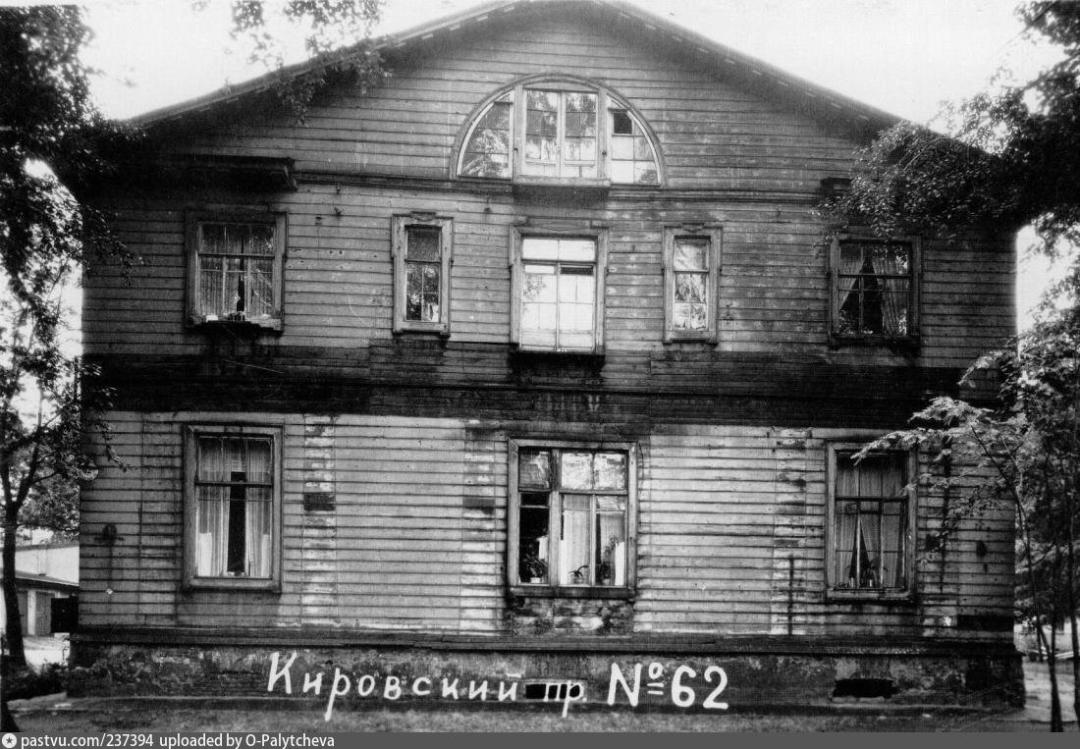

In the 1940s, the wooden building was converted into apartments, and it remained in this form until the spring of 1980, when it was dismantled and transported to the Alexander-Svirsky Monastery. The press reported that the summer house was sent for restoration, and after restoration and wood reinforcement, it would be reassembled in its original place. In reality, the city simply got rid of the wooden “ugly duckling” so as not to spoil the ceremonial appearance of the northern capital during the 1980 Olympics, considering that the old wooden building spoiled the view of the government route. The press reported that the summer house was sent for restoration, and after restoration and wood reinforcement, it would be reassembled in its original place.

Almost 30 years passed since the start of the “restoration” until in 2009, an almost exact replica of the wooden summer house appeared in its original place.

The fact is that the new three-story, 600-square-meter building is made of brick and reinforced concrete and does not replicate the interiors of Voronikhin’s summer house at all (although this is not surprising). The facade is decorated to look like wood using plaster.

Sources:

https://dzen.ru/media/id/5dea29d4c7e50c00b8dbd208/dacha-voronihina-na-kamennoostrovskom-prospekte-pamiatnik-arhitektury-ili-kommercheskii-novodel-5f74d65a28bb441afd14ed50

https://www.citywalls.ru/house6119.html

Follow us on social media

More stories from Great Architects: Andrey Nikiforovich Voronikhin

Voronikhin Colonnades of Peterhof

Razvodnaya St., 2, Saint Petersburg, Russia, 198510

How bright, how emerald-dark In the shade of its dense gardens, And how sparkling, and how transparent Is the water-dripping Peterhof.” P.A. Vyazemsky

The Grand Palace in Pavlovsk

Sadovaya St., 20, Saint Petersburg, Russia, 196621

Pavlovsk Palace is a uniquely beautiful structure that once served as the residence of Emperor Paul I. The majestic palace is located near Tsarskoye Selo, on a small elevation, making it clearly visible from any point in the city. Many talented architects contributed to the creation of this architectural gem of world significance, including Charles Cameron, Vincenzo Brenna, Andrey Voronikhin, Giacomo Quarenghi, and Carlo Rossi.

The House of Countess A.G. Laval

English Embankment, 4, Saint Petersburg, Russia, 190000

On the English Embankment, there are many magnificent mansions, but one of the most remarkable is the former mansion of Countess A. G. Laval. "Wealth, splendor! A tall house on the Neva's shore, a staircase carpeted, lions at the entrance…" — this is how the poet Nikolai Alekseevich Nekrasov described this house in his poem *Russian Women*.

Novo-Mikhailovsky Palace

Palace Embankment, 18, Saint Petersburg, Russia, 191186

A federal architectural monument, the Grand Duke’s Palace, located in the center of Saint Petersburg at 18 Palace Embankment and 19 Millionnaya Street (Stallmeister Corps). The architect was Andrey Ivanovich Stakenschneider. The palace is considered the third major grand ducal residence built according to the architect’s design. It was constructed between 1857 and 1862 specifically for Grand Duke Mikhail Nikolaevich, son of Emperor Nicholas I. The palace’s construction is linked to the prince’s marriage to Princess Cecilie Auguste of Baden. Since there was already one Mikhailovsky Palace in the city, the residence for Mikhail was decided to be named Novo-Mikhailovsky. Currently, the palace houses several institutions of the Russian Academy of Sciences. The palace is designed in a style defined as early eclecticism, expressed through numerous stylistic references to different eras. Although the palace does not hold active urban planning significance, being just one building among a series of Petersburg palaces and mansions, it stands out noticeably in the cityscape of the area due to its lavish, ornate facade decoration and large scale.

Stroganov Palace

Nevsky Ave., 5m, Saint Petersburg, Russia, 191186

Built according to the project of architect Bartolomeo Francesco Rastrelli in 1753–1754 and rebuilt by Andrey Nikiforovich Voronikhin, it is one of the examples of the unique Rastrelli "Baroque-Rocaille style." Currently, it is a branch of the State Russian Museum, to which the building has belonged since 1988.

Sheremetev Palace (Fountain House) - Museum of Music

Fontanka River Embankment, 34, Saint Petersburg, Russia, 191014

One of the palaces of the Sheremetev counts in St. Petersburg, named after the Fontanka River on whose bank it stands. Until 1917, the Sheremetev Palace and estate belonged to five generations of the senior (count) branch of the Sheremetev family. Currently, the main building of the palace houses the Museum of Music, which includes a restored enfilade of the ceremonial halls on the second floor. In one of the wings is the Anna Akhmatova Museum in the Fountain House.

Marble Palace - Konstantinovsky Palace

Millionnaya St., 5/1, Saint Petersburg, Russia, 191186

It is called the Marble Palace because its decor features thirty-two types of marble from quarries in Karelia, Italy, the Urals, and Altai. The palace was a gift from Catherine II to her favorite, Grigory Orlov. He did not remain in debt and gave her a Persian diamond, the value of which was equal to that of the gifted palace. The diamond was named "Orlov" and was set into the imperial scepter. Since the late 20th century, the palace has housed the Russian Museum.

Maryino Estate - the ancestral estate of the Stroganov-Golitsyn family

72, Andrianovo, Leningrad Region, Russia, 187031

The ancestral estate of the Stroganov-Golitsyn family — the Maryino estate is located in the Tosno district of the Leningrad region, near the village of Andrianovo, 60 kilometers from Saint Petersburg. This famous 19th-century Russian estate ensemble still amazes the imagination with its magnificence today.

Lion Cascade (Hermitage)

VWQ3+23 Petrodvortsovy District, Saint Petersburg, Russia

The idea behind the design of the Lower Park was based on the principle: each palace should correspond to a cascade of fountains. In 1721, the construction of the "Hermitage" pavilion began, and an alley leading to it was laid out. The cascade project, referred to as the "Moses Cascade" in Peter's sketches, was prepared by the architect Nicolo Michetti, but the original plan was not realized. Initially, statues of Hercules and Flora were used as sculptural decoration, but a year later they were replaced by bronze figures of lions, made based on Prokofiev's models. The cascade, named the Hermitage Cascade by its location, received its second, more famous name "Lion's" – after its decoration.

Kazan Cathedral - import substitution

Kazan Square, 2, Saint Petersburg, Russia, 191186

This marks the beginning of the golden period of Russian architecture, and Petersburg finally takes on the appearance of the capital of a great empire. Nevsky Prospect becomes not just a "perspective." One of the largest cathedrals in Saint Petersburg. Built on Nevsky Prospect between 1801 and 1811 by architect Andrey Voronikhin in the style of Russian classicism to house the revered copy of the miraculous icon of the Kazan Mother of God. After the Patriotic War of 1812, it gained significance as a monument to Russian military glory. In 1813, the commander Mikhail Illarionovich Kutuzov was buried here, and the keys to captured cities and other military trophies were placed inside. The cathedral gave its name to Kazanskaya Square, Kazanskaya Street, Kazansky Island in the Neva delta, and the Kazansky Bridge at the intersection of Nevsky Prospect and the Griboedov Canal.

Andrey Nikiforovich Voronikhin - The Story of an Architect

Andrey Nikiforovich Voronikhin (October 17 [28], 1759, born in the village of Novoye Usolye, Kazan Governorate — died February 21 [March 5], 1814, in Saint Petersburg) was a Russian architect and decorative-applied arts artist of the Alexandrian Classicism period of the early 19th century. Many outstanding buildings in Saint Petersburg and Pavlovsk are associated with his name.

Stroganov Dacha (Stroganov's Dacha, Stroganov Garden, Stroganov Park)

Stroganovsky Park, Ushakovskaya Embankment, 15 building 2, Saint Petersburg, Russia, 197342

The area on the Vyborg side of Saint Petersburg, near the place where the Chyornaya River flows into the Bolshaya Nevka, belonged to the baron-counts Stroganov from the mid-18th century to the early 20th century. It is bordered to the south by the Bolshaya Nevka, to the east and north by the Chyornaya River, and to the west by the park of the Saltykova dacha. The owners themselves called this area the "Mandurova estate." In a narrower sense, the Stroganov dacha also referred to the main building of this estate.