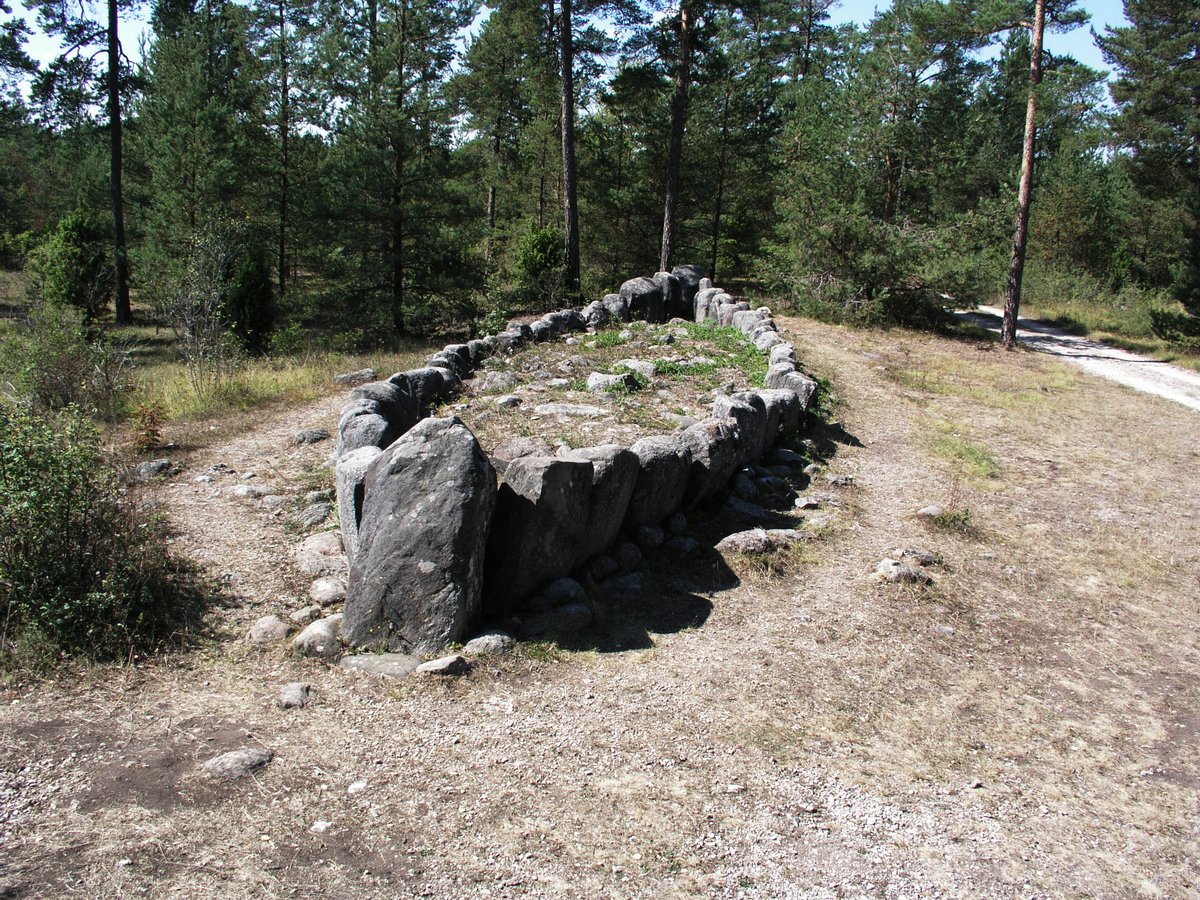

Tjelvar's Grave, a Bronze Age stone ship-setting on Gotland, is situated near the eastern coast of Gotland, located almost directly east of Visby, Sweden. This burial site is about 18 meters in length and 5 meters in width, and is unique in constructing a ship-shaped grave with arranged stones during the Late Bronze Age, spanning from 1100 to 500 BC. The burial site is 18 meters long and 5 meters wide, with gunwale stones that subside towards the boat's center.
Inside, the ship is filled with stone like a built-up boat deck. It is believed that the grave dates back to the Late Bronze Age (1100–500 BC). At the time, graves were built in the form of ships with rows of erected stones. When Tjelvar’s grave was restored in 1938, a small box of stone slabs was found in the east containing burned bones and some pottery shards.
According to sagas, Tjelvar is buried here. According to Gutasaga, Tjelvar was the first to land on Gotland. He forged a fire and brought it to the island, ending the phenomenon of the sea sinking on the island on a later time. Legend says that after this, the island never sank again. Two fornborgs in the vicinity are probably from the Iron Age. Bronze Age Röset Majsterrojr is located a little south of Tjelvar’s grave.
Sources: Wikipedia, OpenStreetMap, Wikidata, Wikimedia Commons
Written by Nik Frost
Discuss this with the author and others
No comments yet. Be the first to start the conversation.