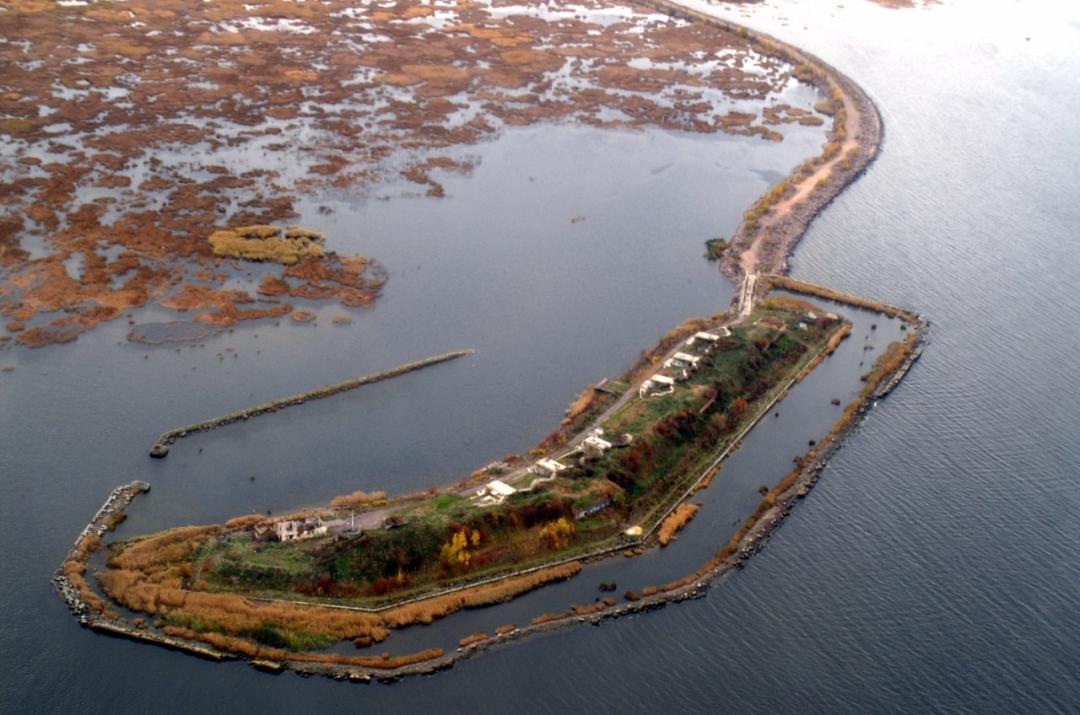
For the first time, naval fortifications north of Kotlin Island appeared in 1801: these were two pile-supported sea batteries No. 1 and No. 2, built about 1 kilometer from the shore, north of the city. By the end of the Russo-Swedish War of 1808-1809, a line of four double (i.e., two-tiered) batteries on crib foundations had been constructed (one of them—the double northern battery No. 4—was located on the site of the modern Northern Battery No. 1). These batteries were wooden-earth constructions and therefore suffered greatly from floods and ice drifts. After the flood of 1824 (the most destructive in the entire history of Saint Petersburg), the crib-based fortifications were severely damaged, and the pile-supported batteries were destroyed.
The beginning of the Crimean War of 1853-1856 marked a new stage in the development of the Kronstadt fortress as a whole, as well as improvements in the defense methods of the Northern fairway. The appearance of maneuverable screw-driven ships and gunboats with shallow drafts made it possible to break through to the empire’s capital via the weakly fortified Northern fairway. Creating a reliable defense system north of Kotlin Island was a crucial task, solved in three ways. First, a system of minefields was developed and implemented for the Southern, and later the Northern, fairways. For the first time in world practice, a mine-artillery position was created. Second, crib and pile barriers were built from the Oranienbaum to the Finnish shores of the gulf. Third, new temporary sea artillery batteries were established, which later became permanent.
On August 31, 1855, Emperor Alexander II gave his highest approval to the projects of four temporary sea batteries on the surviving crib foundations of the double northern batteries. Shortly thereafter, this plan changed: the total number of sea batteries was increased to nine (four on the Southern fairway and five on the Northern), so that the line of sea batteries would cover the entire Gulf of Finland from shore to shore. Initially, the batteries had continuous numbering, but later the forts and batteries of the Southern fairway received their own numbers, and the Northern Batteries theirs.
The perimeter of each battery consisted of closed lines of cribs; within the space enclosed by these lines, a log deck was laid on a pile foundation above the ordinary water level, over which earthen parapets and ramparts were piled. By early spring 1856, the batteries were armed with guns. However, due to the signing of the Paris Peace Treaty in 1856 and the end of the war, the temporary batteries were soon disarmed.
Due to the widespread adoption of rifled artillery, which significantly surpassed the old smoothbore guns in accuracy and range, as well as the worsening international situation in the 1860s, the issue of creating permanent fortifications to protect the Northern fairway and rebuilding the fortress as a whole became urgent again. The task was to bring the Kronstadt fortress into a "strong defensive state." In the first half of the 1860s, in addition to the five existing batteries on the Northern fairway, it was decided to build two more batteries and convert the others into permanent ones. An outstanding role in creating the temporary batteries and their subsequent reconstruction into permanent ones was played by Totleben. Under his leadership, the modern Northern Battery (fort) No. 1 was built in 1855–1856 and then rebuilt in 1861–1869 (engineer Zverev). At that time, the island on which the fort was located was connected to Kotlin Island by a dam, making it accessible even today.
According to the battery reconstruction projects, their previous area was significantly increased. Along the perimeter of the island, enclosing structures were created. From the front and flanks, their base was still a line of cribs. On the inner side of the island, a sheet pile wall was built tightly against them. Directly above the cribs, a low escarp wall up to 4 feet above the ordinary water level was erected, faced with granite. At the rear of the battery, the island’s enclosure structure was significantly simplified: here, no crib wall was built, only a sheet pile wall was erected, which was reinforced with stone on the outside up to the top. Thus, a continuous closed sheet pile wall was created around the entire perimeter of the island. Soil was piled inside the enclosed space, forming the island’s body. The battery courtyard rose 8.5 feet above the ordinary water level. Above this mark, the battery’s ramparts were piled, and brick casemated buildings were constructed.
To protect the island from the destructive effects of waves and ice drifts, a stone breakwater was built on a crib foundation around the entire perimeter of the battery. At the rear of the battery, this breakwater extended somewhat farther from the island, forming a harbor for supplying the garrison. A total of seven casemated buildings were constructed on the battery: four so-called casemated traverses and three barracks. Each casemated traverse contained two gun casemates. The guns were placed inside enclosed casemates. These traverses were among the first built in the fortress, already in 1864, indicating the great importance of sea battery No. 5 (the current Northern No. 1) in the overall defense system of Kronstadt at that time. In general, the battery was completed with construction in 1865, while the construction and reconstruction of other batteries continued for several more years. On June 13, 1868, by order of Alexander II, the sea batteries were renumbered, with each fairway’s batteries receiving their own numbering. Thus, sea battery No. 5 was renamed sea northern battery No. 1. Since then, it has not changed its official name, although in Soviet times all Kronstadt sea batteries, including Northern No. 1, began to be called forts, which contradicts the special fortification terminology, according to which a fort is a closed permanent fortification.
In the early 1870s, it was decided to abandon placing guns in casemates. Such placement significantly limited the firing sector, and the old casemates could not accommodate the emerging modern guns. The new artillery systems were too bulky, so they began to be placed openly in gun courtyards, providing the maximum firing sector. The built casemated traverses were repurposed as powder magazines; embrasures in the floor walls were sealed, and the walls themselves were covered with soil from the front (on the fort’s right flank, the old casemates remain, not rebuilt during further reconstruction).
The battery’s armament was quite diverse and changed over time. By 1894, the main armament of the sea northern battery No. 1 consisted of:
12 – 9-inch guns model 1867 on Semyonov carriages (4 of which were without carriages)
4 – 6-inch guns model 1877 weighing 190 poods on Durlacher carriages
2 – 9-inch mortars
2 – 6-inch mortars
However, by the end of the 19th century, all these guns no longer met modern requirements. The batteries and forts of Kronstadt required reconstruction and rearmament. According to the plan adopted in 1896, developed by a commission chaired by General-Adjutant Obruchev, the Sea Northern Battery No. 1 was to be reconstructed and rearmed with twelve 9-inch guns on Durlacher carriages and connected by a dam to Kotlin Island. The dam construction was postponed to the second phase, but the battery’s reconstruction in concrete began in 1898. The reconstruction was overseen by military engineer Captain Nikolai Vasilyevich Baranov from the Kronstadt fortifications construction management.
In 1899, without waiting for the completion of the works, the battery began to be armed with the assigned 9-inch guns starting from the left flank. The new gun positions were fully completed only in 1901, when they were armed with all the assigned guns. Six two-story casemated traverses were built from concrete at the positions. The guns were placed in gun courtyards protected from the front by concrete parapet walls. The full reconstruction of the battery was completed only by late 1903. By that time, three rangefinder pavilions, a concealed searchlight tower on the right flank, and several other works adapting the preserved brick buildings had been introduced. The concealed searchlight installation was placed in the right-flank traverse, and above the old covering, a pavilion for the Prishchepenko vertical-base rangefinder was built. The old left-flank traverse was also reconstructed and housed a kitchen, food storage, and icehouse. To the left of this building, two pavilions for Petrushevsky horizontal-base rangefinder instruments were erected. The Sea Northern Battery No. 1 became the only one of the seven northern sea batteries to be extensively reconstructed in concrete.
The issue of building a dam to Northern Battery No. 1 was raised year after year, but a dam specifically for the battery was never built. In 1909, the 9-inch guns stationed here were recognized as obsolete even in combination with Durlacher carriages, but it was decided to keep them in service. That same year, it was decided to use sea battery No. 1 to connect all the fortifications of the Northern fairway and Fort "Ino," whose construction began in October. For this purpose, in 1910, the dam that still exists today was built. A railway was laid along the dam. Interestingly, the dam reached only to the breakwater surrounding the battery island, and beyond that, a bridge was thrown over the moat (visible in the aerial photograph).

The railway ended at the breakwater, where a platform was arranged (later, in Soviet times, when the battery was used as a warehouse, the dam was extended directly to the island by filling in the moat section). A pier was arranged in the battery’s harbor, and the approaches to the harbor were deepened.
With the adoption of the new development plan for the Kronstadt fortress in 1909, the combat value of Sea Northern Battery No. 1, which remained in the rear of two new powerful forts ("Totleben" and "Obruchev") and was armed with obsolete artillery systems, significantly decreased. Moreover, the 9-inch guns were completely unsuitable for fighting modern warships, and in 1916 all 12 guns of Northern Battery No. 1 were transferred to field artillery, where they could still be used against land targets.
However, the history of the battery’s development did not end there. After its disarmament, an anti-aircraft battery of 76-mm Lender guns model 1915 was installed here. During the Kronstadt uprising of 1921, the fort’s garrison took an active part in the events. In the pre-war years, permanent firing points (DOTs) for anti-landing and ice defense were built on the fort, which have survived to this day. The DOTs were armed with Maxim machine guns.
Since 1935, Fort 1st Northern was part of Kronstadt’s air defense and was rearmed with four 34-K anti-aircraft guns. Two courtyards of 9-inch guns were converted to 76-mm anti-aircraft guns.
A railway led to the fort along the dam. Initially, the dam reached the breakwater and was extended during Soviet times when the fort was used as a warehouse. There was a moat at this location. On the left flank is a three-embrasure machine gun DOT No. 11, built in 1935 and intended for the fort’s anti-landing defense.
During the Great Patriotic War, the fort fired on enemy aircraft, and after the war, it was finally disarmed and used until 2002 as a warehouse for military property of the Leningrad Naval Base. Since 2002, the battery was abandoned by the military and looted; all metal parts (doors, railings, etc.) were torn out and sold for scrap metal. Unfortunately, graffiti has appeared on the fort, disfiguring its historic appearance, and the territory is littered with garbage.
Sources:
https://visit-saint-petersburg.ru/1stfort/