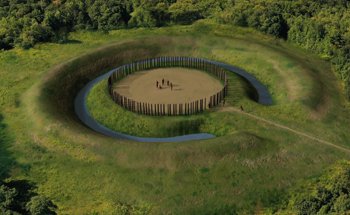

Situated in Lexington, Kentucky, the Mount Horeb Earthworks Complex is an Adena culture group of earthworks. The site consists of two major components, the Mount Horeb Site 1 and the Peter Village enclosure, along with smaller features including the Grimes Village site, Tarleton Mound, and Fisher Mound. The Peter Village and Grimes Village enclosures were mapped by Rafinesque and were featured in the 1848 publication Ancient Monuments of the Mississippi Valley.
The Peter Village enclosure has an earliest occupation dating from 300 to 200 BCE and is considered a pre-Adena site for harvesting and processing galena. This site was described as a twenty-sided icosogonal polygon 3,767 feet long with a 15 feet wide, 4 to 8 feet deep ditch surrounding it. An entryway to the enclosure was located to the south.
The University of Kentucky currently owns and operates Mount Horeb Site 1 as part of the Campus Recreation Department. Located on a bank 75 feet above Elkhorn Creek, the site features a causewayed ring ditch with a 105-foot diameter platform. In 1939, the site was excavated by William S. Webb and the Works Projects Administration, who discovered the postholes of a circular wooden structure on the platform. This timber circle was made up of 132 posts, including 62 paired posts and 8 single posts.
Sources: Wikipedia, OpenStreetMap, Wikidata, Wikimedia Commons




Written by Friendly Jane
Discuss this with the author and others
No comments yet. Be the first to start the conversation.