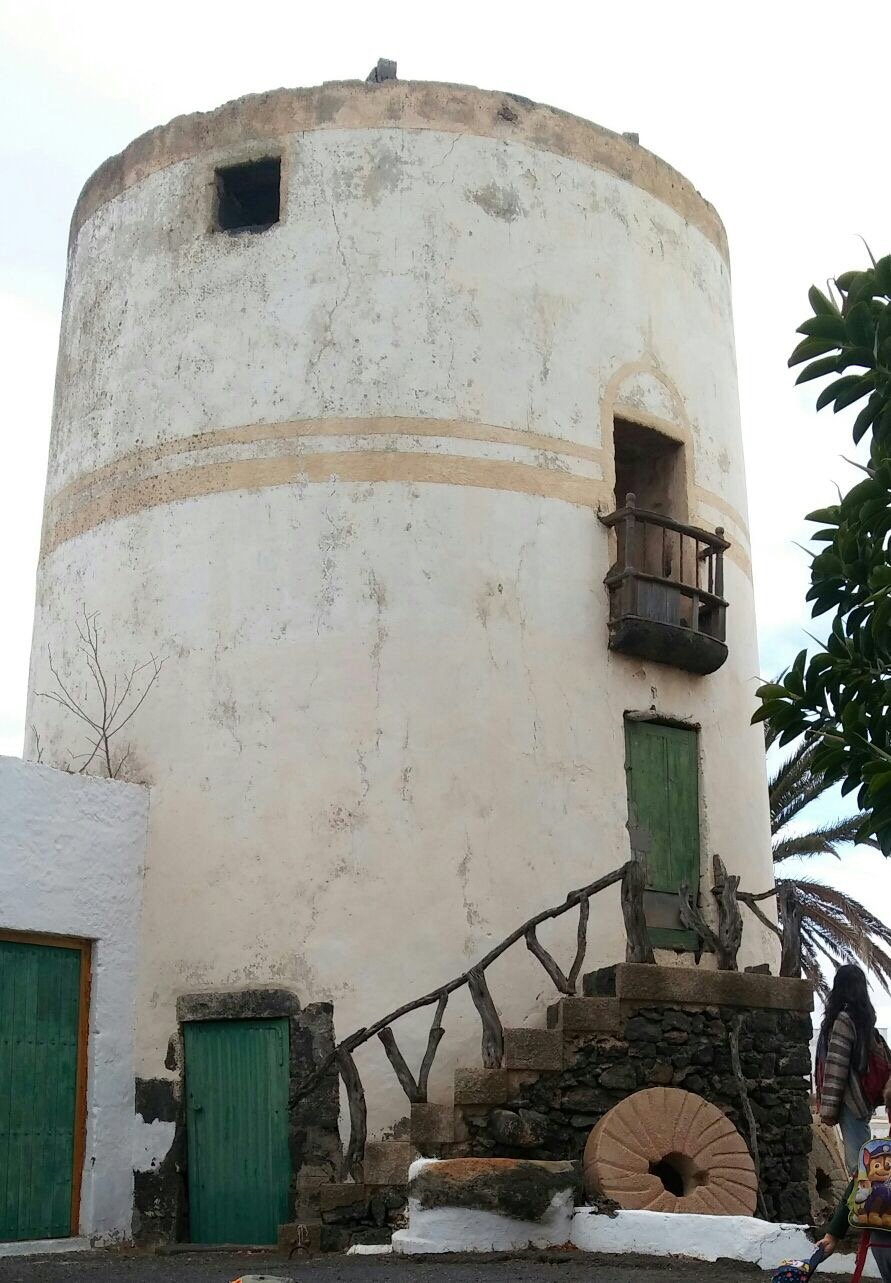

In the village of San Bartolomé, on the island of Lanzarote, stands the Molino de José María Gil. For many years, it served as the industrial center for the production of gofio, a staple food of the local diet made by roasting and grinding cereals and legumes. The building was constructed in 1870 by Baltasar Martín Rodríguez and is now a declared site of cultural interest.
José María Gil Santana acquired the mill in the early 20th century and put a diesel engine into operation, moving away from the wind-driven mill. The structure features a truncated conic tower base made of stone, mud, and lime with three internal floors. The ground floor served as a warehouse, the second floor was where the gofio or flour emerged, and the upper floor was where the grain was poured. The top part is made of rotating wood to move the blades in the dominant wind, though it is currently without blades and in a state of abandonment.
José María Gil Santana was originally from Gáldar in Gran Canaria but established himself in San Bartolomé, where he lived an active social, cultural, and professional life. He was a miller and a watchmaker, the first president of the Sociedad "El Porvenir" in 1930, and served as mayor during the period of the Spanish Civil War from 1936 to 1939. He was also a member of Falange, a founder of the Agrupación Folclórica Ajei, and an organizer of various cultural and theatrical activities.
In 1919, the diesel engine continued to provide the energy needed to move the grinding stones. José María Gil passed the business to his son Esteban Gil, who maintained it until his old age. After that, the mill was handed to a niece who eventually underwent a major renovation. It reopened as La Molina de José María Gil, updated with an electric motor. It remains the only gofio mill on the island of Lanzarote.
Sources: Wikipedia, OpenStreetMap, Wikidata, Wikimedia Commons
Written by Mutabor
Discuss this with the author and others
No comments yet. Be the first to start the conversation.