Malaya Konyushennaya St., 5, Saint Petersburg, Russia, 191186
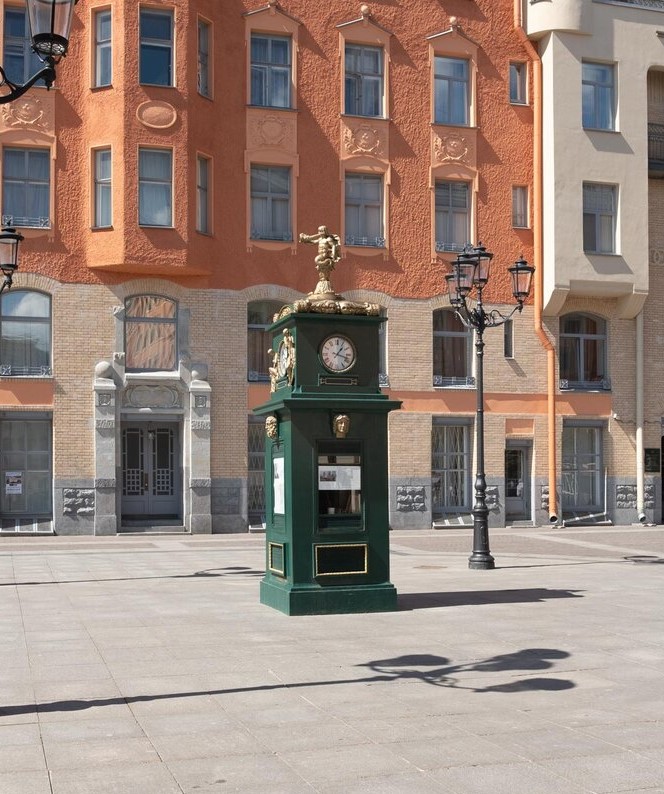

In the second half of the 19th century, meteorological pavilions began to be installed on the streets of Saint Petersburg, allowing city residents to stay informed about the weather forecast. One of the most famous and beautiful pavilions was the outdoor weather station on Malaya Konyushennaya Street, installed in 1914.
The outdoor stations were quite accurate; besides temperature, which was displayed on the thermograph, one could learn atmospheric pressure and the date using a barograph. The time was shown by clocks made by the Ericsson company, and the pressure was measured by the barograph—a self-recording barometer. Air temperature was measured using thermographs that continuously recorded readings. The sensitive element of the thermograph was a bimetallic strip, although a liquid thermometer or resistance thermometer could also be used. Hygrometers were used to determine humidity. The instruments’ data were recorded on special strips with ink, and by analyzing the measurement curves, one could assess how the weather changed throughout the day.
This was a significant innovative development for its time, allowing people to plan their activities and be prepared for changing weather conditions.

The weather station on Malaya Konyushennaya Street was not only functional but also a true work of art. It was designed in 1913 by the Russian architect Nikolay Yevgenyevich Lanceray and adorned with sculptures in the antique style, based on sketches by Vasily Kuznetsov. It incorporated clocks and a calendar designed by Lanceray in 1913, which displayed the hour, day, month, and year.
The operation of the thermograph required constant monitoring and care due to the periodic need to wind the clock mechanism, replace the chart paper, and refill special ink. However, over time, winding the mechanism, changing the paper, and adding ink to the pen ceased. This explains why almost all the windows are now covered with cloths, and the meteorological pavilion is inactive.

The monument is decorated with gilded sculptures by Kuznetsov; on all four sides of the pavilion are clock faces, and the gilded figures in the antique style framing the pavilion’s clocks symbolize Time. The pavilion is crowned with a figure of Triton blowing a conch shell. Below the cornice under the clocks are keystones with masks.
The idea to move it to the city center and restore the monument was proposed by Lanceray—the son of the creator of the old weather station. Even though the pavilion no longer works, it remains a monument to Saint Petersburg’s weather and attracts locals and tourists with its dignified appearance.
The weather station was made by order of the Saint Petersburg City Administration.
A photograph of the thermograph with a bimetallic strip, made at the beginning of the 20th century, is displayed on the pavilion’s stand.
Currently, the thermograph is part of the instruments found at a classic meteorological station.
In the showcase, you can see a thermograph made in 1971 by the Safonovo factory “Hydrometpribor.”
On all four sides of the pavilion are clock faces, and the gilded figures in the antique style framing the pavilion’s clocks symbolize Time. The pavilion is crowned with a figure of Triton blowing a conch shell. Below the cornice under the clocks are keystones with masks.
In the mid-1930s, the pavilion was dismantled from Malaya Konyushennaya Street and moved to Yelagin Island, where it stood abandoned for about 70 years. Over time, the thermograph and barometer with recorders disappeared from the pavilion, and the clock mechanisms broke down. However, in 1997, it was returned to Malaya Konyushennaya to preserve the historical significance of this object.
Originally, in 1914, it stood closer to Nevsky Prospect, but now it is located deeper within Malaya Konyushennaya Street. At the beginning of 2018, the district administration decided to restore this city symbol.
The restoration included replacing the old clock mechanism with a new Swiss-made one synchronized with precise time via GPS satellites, as well as manufacturing glass from tempered anti-vandal glass. The work was completed in November 2018, and the clocks began showing time again.
The pavilion, a symbol of a bygone era, has come back to life; it reminds us of the past era and that we build our future based on what came before.
Sources:
https://www.ptmap.ru/monuments/2208

