Troitsky Bridge, Troitsky Bridge, Saint Petersburg, Russia, 191186

Trinity Bridge (from 1918 to 1934 — Equality Bridge, from 1934 to 1991 — Kirov Bridge) is a metal drawbridge over the Neva River in Saint Petersburg. It connects the Petrogradsky and 1st Admiralteysky islands. It is the third permanent bridge over the Neva (after the Annunciation and Liteyny bridges), one of the most beautiful bridges in Saint Petersburg, and one of the symbols of the "Scarlet Sails" graduation celebration.
The bridge connects Suvorov Square in front of Mars Field and Trinity Square (Petrograd side). Kamenny Island Avenue begins just beyond the bridge. The northern part of the bridge is crossed by the Pulkovo Meridian. Upstream is the Liteyny Bridge, downstream are the Palace Bridge (across the Bolshaya Neva) and the Exchange Bridge (across the Malaya Neva).
The pontoon bridge existing since 1803 was named Petersburg Bridge in 1804. It was located upstream, connecting Kronverksky Avenue, which led to the Neva, and the Summer Garden. It was formed by relocating the Resurrection pontoon bridge. On the Petrograd side, an earthen dam was built, possibly to shorten the bridge. The bridge was in use for twenty years before becoming unusable. Moreover, its replacement was necessary for architectural reasons: it clashed with the surrounding ensembles along the Neva banks. In 1818, according to architect Rossi's project, Suvorov Square was formed, becoming the architectural foundation for the start of the bridge.
Reconstruction of the bridge began in 1824. The rebuilt bridge from 1824–1827 was intended to be named Suvorov Bridge after the adjacent Suvorov Square with the Suvorov monument. Granite blocks, previously removed from the canals surrounding the Mikhailovsky Castle, were used for the stone abutments of the new bridge. The abutment designs were created by engineer-major Lebedev. The left-bank abutment was completed by November 19, 1824, and construction of the right-bank abutment, designed as a dam deeply extending into the Neva, began in January the following year. The opening of the longest pontoon bridge in Saint Petersburg (over 500 meters) took place in 1827. However, in 1827 the bridge was named Trinity Bridge after the nearby Trinity Square and Trinity Cathedral (demolished in 1932). In 1891, the Duma proposed naming the permanent bridge under construction the Alexander-Marie Bridge to commemorate the 25th wedding anniversary of Alexander III and Maria Feodorovna, but the emperor ordered the bridge to retain the name Trinity Bridge. In October 1918, the bridge was renamed Equality Bridge. After Kirov's death, by decree of the USSR Central Executive Committee on December 15, 1934, the bridge was renamed Kirov Bridge. This name lasted until October 4, 1991, after which, by decision of the Presidium of the Saint Petersburg Council of People's Deputies No. 314 dated 04.10.1991 "On the restoration of historical names of city objects," the bridge was again named Trinity Bridge.

Compared to other pontoon bridges on the Neva, the Trinity pontoon bridge was richly decorated. The portals, railing fences, and lamp posts were made of artistic cast iron, produced at the Berd factory. The lamp posts were designed as bundles of spears, the central ones crowned with figures of double-headed eagles with wreaths. The obelisks were pyramidal, decorated with applied details — oval shields against crossed swords. Some decorative cast iron and copper elements were gilded with gold leaf. The black lacquer coating of metal items and gilding of cast iron and copper elements were done by masters Wolf and Yan.
In 1876, the bridge was reinforced to lay a horse-railway line. In 1886, the superstructure was replaced, and two navigable spans were widened and raised to allow barges to pass. The bridge was in use for 70 years until the construction of the permanent bridge began. When reconstruction time came, the granite-clad abutments were dismantled, and the cast iron lamp posts and railings, as elements of high artistic casting, were installed on the newly built embankment opposite the Peter and Paul Fortress. Some of these elements also decorate the Ioannovsky Bridge over the Kronverksky Strait.
At the end of the 19th century, there was a need to replace the pontoon bridge with a permanent one. This was intended not only to simplify operation but also to raise the status of the Petersburg (Petrograd) side, which remained a distant city outskirts. One of the decisive arguments for a permanent bridge was that the cost of land plots on the Petrograd side would significantly increase with the establishment of a permanent and more convenient connection across the Neva to the city center.
In 1879, engineer A. E. Struve approached the city Duma with a proposal to build a permanent bridge using machines and materials left after the completion of the Liteyny Bridge. The issue was considered by a special commission of the Duma, but due to lack of funds in the city budget, no decision was made.
The city Duma decided to build the third permanent bridge over the Neva on October 9, 1891. In April 1892, the Duma announced an international competition for the design of the Trinity Bridge. Within six months, 16 projects were submitted. Five were from Russian engineers, six from France, two from the Netherlands, and one each from Bulgaria, Hungary, and Spain.
The first prize — 6,000 rubles — went to Eiffel's firm for an arch system bridge project under the motto "Minor"; the second — 3,000 rubles — to Russian engineers Lembke and Knorre for an arch system bridge named "Kremlin"; the third — 1,500 rubles — to Bulgarian engineer Momchilov for a beam system bridge project under the motto "Acier" ("Steel"). Besides the winning projects, the city administration purchased documentation for two other options: one bridge — a truss in the form of a suspension system by Eiffel under the motto "Major"; the other — an arch system with a lower deck and an unusual draw span scheme — developed by the French company "Cail." According to the competition conditions, the Duma could use any of these five projects: after paying the monetary awards, they became its property. However, the choice of the final project and the start of construction were delayed because, outside the competition, a project by the French firm "Batignolles," excluded for formal reasons, was presented. The competition commission noted it as "very successful" because "due to the special design of three-hinged arches with cantilevers," it allowed a significant reduction in metal consumption. The question of which project to choose and with whom to sign the construction contract was long discussed in the Duma. Opinions were expressed that the commission "should develop an independent project by Russian forces and erect it under the supervision of Russian engineers, Russian workers, and from Russian materials."
Since the firm "Batignolles" had a good reputation for building beautiful and economical bridges and also held exclusive rights to use the "three-hinged arch with cantilever" design, several years later, in 1896, the Duma announced a second competition. Besides "Batignolles," two other authors, including one French firm, submitted bridge projects. At the City Duma meeting on February 5–7, 1897, it was decided to entrust "Batignolles" with the construction of the bridge according to its project for the sum of 5 million 200 thousand rubles. A special contract clause stipulated that the bridge had to be built from Russian materials and by Russian workers. The project was approved by Nicholas II on June 5, 1897. Many Petersburg engineers and architects actively participated in the development of the final project and the construction of the bridge.
The bridge was laid on August 12, 1897; the solemn ceremony was attended by Emperor Nicholas II and the President of the French Republic Félix Faure. The French president's visit was reciprocal: in October 1896, Nicholas II attended the laying of the Alexander III Bridge in Paris. The laying ceremony took place at Suvorov Square. Four meters from the embankment edge, a large granite monolith was placed — the first foundation stone of the future bridge. Nearby, a royal tent was erected in Russian style by architect Benois. The emperor, members of the royal family, and the French president placed gold coins in the bridge's foundation. After that, the president and then the emperor laid embedded plates in the foundation.
To free space for the permanent bridge construction, the pontoon bridge was moved downstream and placed opposite Marble Lane. The opposite end of the bridge reached Hare Island. The moat between the eastern bastions of the Peter and Paul Fortress and the Ioannovsky ravelin was filled in; the low walls (palisades) connecting them were temporarily dismantled and replaced by a passage leading to the temporary wooden bridge over the Kronverksky Strait built at the same time.
Initially, it was planned simply to move the Petersburg (Trinity) bridge downstream, but when it turned out that it required repairs, only the old pontoons were reused; all other parts of the old bridge were replaced with new ones. For the relocation and major repairs, the city Duma allocated 140 thousand rubles, and the work was carried out by the Horse-Railway Society. The temporary crossing was opened for traffic on January 21, 1893, and lasted almost 10 years until the metal Trinity Bridge was completed. On May 26, 1898, after a solemn prayer service, the first caisson was lowered under intermediate pier No. 4.

In 1899, two years after construction began, the question arose about replacing the long earthen dam on the right bank with a structure of a different type. By spring 1900, engineer Krivoshein developed four options for the overpass: two in the form of stone arches and two as lattice metal trusses. After lengthy discussions, the granite overpass project approved by the Academy of Arts was chosen.
At the Academy of Arts' suggestion, granite obelisks were installed before the bridge entrance. The city administration covered the cost of their construction (about 25 thousand rubles). Simultaneously with the bridge construction, granite embankments were built on the right bank of the Neva, connecting three bridges — Ioannovsky, Trinity, and Sampsonievsky — with a total length of about 1100 meters, including stairs, descents to the water, and piers for boats and vessels.
The bridge builders were engineers Floshe and Landau, Bonneve, De Longhi, Bernard, Smirnov, Volkov, and Herzenstein. The works on the dam, its exit, and Trinity Embankment were contracted to the engineer of communications Simonov, who completed only the foundations of the piers, abutments, and embankments.
The metal superstructure was manufactured at the Gut Bankov factory in Poland, the Riga steel casting plant, the Vigandt factory in Reval, and at the Petersburg Franco-Russian, Nail, Rolling, Belgian Bolt, Neva Shipbuilding and Mechanical factories. The Putilov, Bryansk, and Moscow factories were also involved (for the electric mechanisms of the drawbridge).
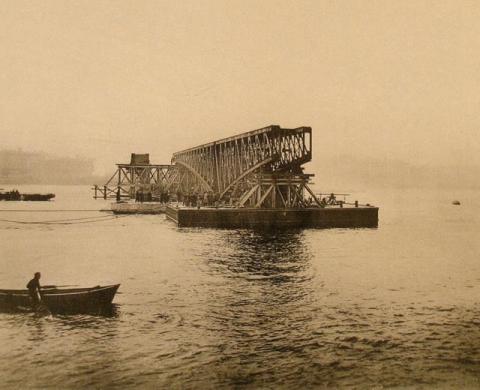
According to the contract terms, the bridge construction was to be completed in 1901. However, the firm did not meet the deadline and paid the city treasury a fine of 150 thousand rubles. The final cost of the bridge was 6.1 million rubles, including 5.2 million for the iron part of the bridge and 800 thousand for the stone dam. The cost of the exit and Trinity Embankment was 400 thousand, and the granite embankments of the Bolshaya Neva and Bolshaya Nevka up to the Sampsonievsky Bridge cost 1.5 million rubles.
At the end of March 1903, pedestrian traffic was opened on the bridge during the ice drift. From January to March 1903, static tests were conducted: rails were laid on the bridge, with 290 pieces evenly distributed across its width. Dynamic tests took place on April 22, 1903. For this, two fire brigades were simultaneously galloped twice across the bridge from Suvorov Square to Trinity Square. Each brigade occupied about 100 meters of the bridge length.
The solemn opening of the bridge was timed to coincide with the 200th anniversary of Saint Petersburg. On May 16, 1903, the bridge was opened in a solemn ceremony in the presence of Nicholas II and members of the imperial family. The program included a cannon salute and a religious procession. Additionally, the first ceremonial drawbridge opening took place: Nicholas II, pressing an electric button, activated the huge electric motors of the draw span. After that, the Dowager Empress Maria Feodorovna cut a ribbon of Russian national colors with silver scissors, then Empress Alexandra Feodorovna cut another ribbon, and the entrance to the bridge was opened. After this procedure, the royal couple, preceded by clergy with holy water, stepped onto the bridge. On that side, the procession was met by a decorated pavilion with a bust of Emperor Alexander III. Here, the city mayor presented the emperor and empress with gold jubilee medals commemorating the consecration of the Trinity Bridge and an album with photographic images of the construction works. The front side of the medal depicted profile images of Emperors Alexander III and Nicholas II, with Empress Maria Feodorovna between them. On the reverse side, in the center: Trinity Bridge and part of the embankment; above the inscription: "Trinity Bridge over the Neva River was built in memory of the 25th wedding anniversary of Emperor Alexander III and Empress Maria Feodorovna"; below: "laid in 1897, completed in 1903."
On May 17, 1903, city transport began operating on the bridge: carriages and horse-railway wagons. In December 1908, trams began running on the bridge (replacing horse-drawn trams).
The construction of the new bridge was not only an important engineering solution but also a serious step by Russia towards France. The interests of the firm were defended by the future French president Clemenceau. However, the deal was marred by financial difficulties. After completing the work, the builders demanded an additional amount beyond the estimate, claiming they incurred extra expenses due to the city's fault. "The representative of 'Batignolles' in Russia, Landau, was authorized to spend 5% of the money the firm demanded from the city on bribes — 35 thousand rubles. But a greedy city councilor named Romanov, using his influence in city government, did not wait for all the French money from the economical Landau. He obtained 700 thousand for 'Batignolles' for only 20 thousand for himself. And he got two years in prison for this," writes Lev Lurie.
The construction took six years, and the solemn opening ceremony was timed to the 200th anniversary of Saint Petersburg. Emperor Nicholas II arrived at the ceremony and pressed a symbolic electric button, activating the drawbridge mechanism (the button lay on a cushion and was not connected to anything — the bridge was raised synchronously with its pressing).
In 1936, by decree of the Leningrad City Executive Committee, bronze crowns were removed from the intermediate piers, and royal monograms were removed from the obelisks and candelabra pedestals. The double-headed eagles on the obelisk tops were replaced with five-pointed stars. In 1937, the roadway was widened at the expense of sidewalks, and the fixed spans' end pavement was replaced with asphalt concrete.
There is a legend that Valery Chkalov made his flight under the Trinity Bridge. There is no documentary evidence of this, although in an interview his wife gave many years later to the newspaper "Smena," she said such an event took place. The repetition of this flight was made in 1940 by pilot Yevgeny Borisenko for the film "Valery Chkalov." The flight was made twice — on October 22 and 24, as the first time the film was spoiled.
At the top of the bridge, there is a point indicating its midpoint. The point can be found on the railings — where the lattice patterns change slope. The axis of the Trinity Bridge in the northern part crosses the Pulkovo Meridian.
In 1942, a German aerial bomb hit the bridge span, and a German Messerschmitt crashed near the bridge.
Throughout its history, the bridge was reconstructed twice: in 1965–1967 (replacement of the draw span) and in 2001–2003 (repair of the metal structures of the superstructure).
Sources:
https://mostotrest-spb.ru/bridges/troiczkij
https://peterburg.center/maps/troickiy-most
https://spb.aif.ru/culture/event/vekovaya_pereprava_interesnye_fakty_iz_istorii_troickogo_mosta

