Krasnogo Molodtsa, Saint Petersburg, Russia, 196625

The Peel Tower is one of the poetic pavilions in the park, designed in a pastoral-romantic style. The pavilion was a tribute to the fashion of its time and served as a place for brief rest during a long walk through the park. The tall two-story pavilion of Pavlovsk Park was conceived as an original architectural work in the style of “romantic poverty.” At the turn of the 18th-19th centuries, when the tower was designed and built, it was fashionable to create modest exteriors with a pretension to poverty, while decorating the interiors in a royally luxurious manner. The exterior of the building is painted with patterns imitating brickwork at the bottom and wooden cladding at the top, and the roof is covered with ordinary straw. An additional external staircase leads to the second floor — the Romanovs preferred to enter the room through the balcony, bypassing the service areas. The pavilion’s plan was developed by Pietro Gonzago, and its realization was assisted by Vincenzo Brenna, architect Schreter, and stonemason Visconti.
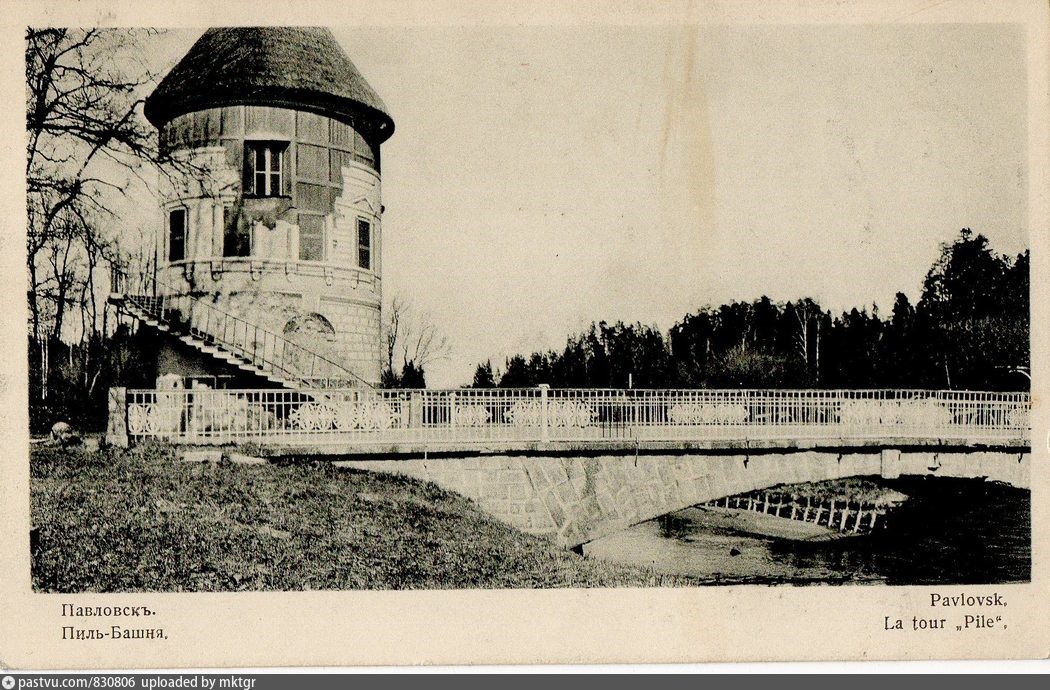
According to one version, the name of the tower comes from a sawmill that once stood on its site; according to another, it derives from the English “peel tower”: in Britain in the 15th century, watchtowers were called this.
The first floor, during the time of Paul I, served as quarters for servants, where, according to legend, misbehaving and negligent pages were confined. The Peel Tower is one of the most expressive buildings in Pavlovsk, resembling a miniature castle.
The second floor was used by the owners themselves: it was exquisitely and fabulously furnished, decorated with stucco and paintings by famous artists. Unfortunately, part of the decor was lost, but after restoration work, the interior of the late 18th–early 19th century was successfully imitated on the second floor. The room featured a fireplace, above which was a plaster relief and a large mirror; the floor was laid with expensive oak, and the walls were covered with Chinese fabrics. Currently, temporary exhibitions are held on the second floor, but only in the summer, as the pavilion is not heated.
Built on the bank of the Slavyanka River according to Brenna’s design in 1797, the pavilion impressively opens up from various scenic viewpoints. The Peel Tower is a round structure with a conical roof covered with straw. Its walls were painted by Gonzago, creating the illusion of a partially ruined building. On one side of the tower, a rickety staircase led to the second floor.
At the foot of the tower is a wooden bridge with a decorative watermill. The noise of the mill wheels and the splash of water complemented this rural idyll. Nearby was also a small summer bathing house. It is no coincidence that landscapes featuring the Peel Tower were favorite subjects of 18th-century artists.
In 1808, instead of the dismantled watermill, A.N. Voronikhin built a new Peel Tower Bridge with a beautiful gentle arch over the water and cast-iron railings. In the summer of 1808, Sukhanov’s team carried out “cutting of Chernitsky stone planks, laying them in place with lime mortar, fastening each piece with clamps, nails, and pouring lead over them.”
During the Great Patriotic War, the bridge was blown up, and the pavilion building was severely damaged. They were restored in the 1960s-70s.
Sources:
https://www.spb-guide.ru/page_20044.htm
http://www.pavlovskmuseum.ru/about/park/layout/39/1151/
https://tonkosti.ru/%D0%9F%D0%B8%D0%BB%D1%8C-%D0%B1%D0%B0%D1%88%D0%BD%D1%8F
https://www.votpusk.ru/country/dostoprim_info.asp?ID=10127


